Quick Links
Scouting & Observations
- Potato Leafhopper
- European Corn Borer
- Onion Thrips
- Continue to be on the lookout for Colorado potato beetles, cucumber beetles, flea beetles, cabbage root maggot, aphids, and mites
Upcoming Events & Opportunities
- Updated modules, open enrollment: Farm Risk Management Course
- 6/16 - Cover Crop Drone Seeding Workshop
- 6/24 - Solid Ground's Chicken Tractor Design Discussion
- 7/7 - Vegetable IPM Field Workshop
- 8/5 - Plant Science Day with CAES
Potato Leafhoppers
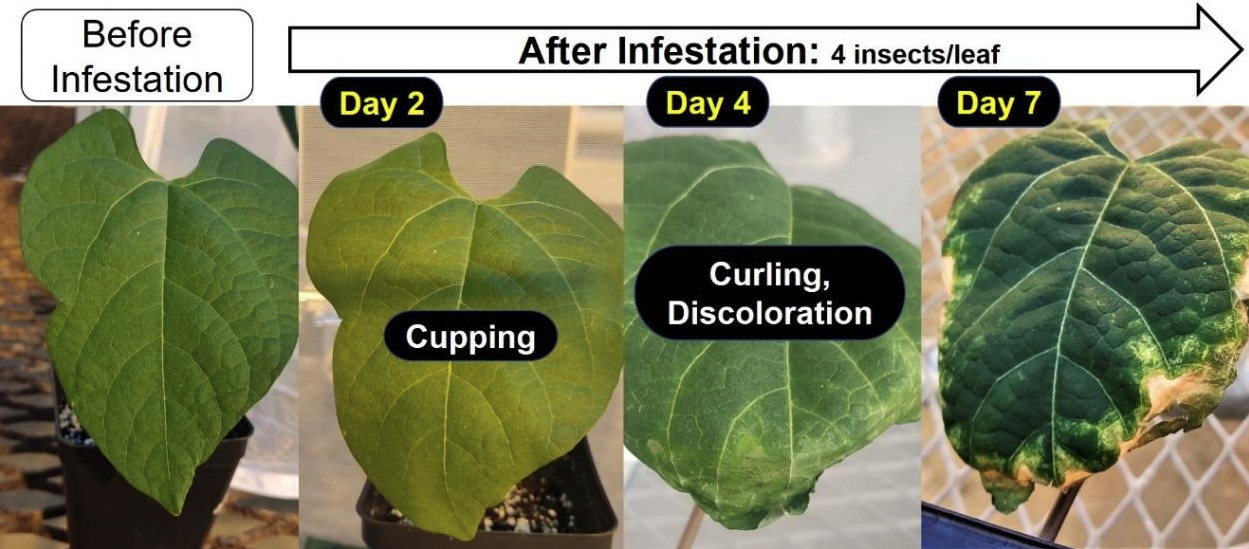
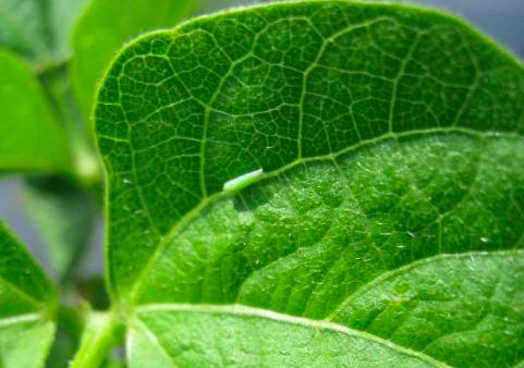
Potato leafhoppers (PLH) primarily impact potatoes, beans, and eggplant, but they are not picky eaters and have a wide host range, including other legumes (clover, soybean, alfalfa), solanaceous (tomato, pepper), and other vegetables (lettuce, celery). The presence of nymphs indicates an established population. Signs of injury begin with leaf veins turning pale, followed by the yellowing or browning of areas of the leaf or leaf tips which is known as "hopperburn". Leaves become brown, curl up, and die. Plants may be stunted and yields reduced or lost. PLH can also be a vector of many viruses.
Scout using sweep nets or by shaking plants to see if adults fly up when the plant is disturbed. Nymphs can be counted on the underside of leaves. Seedling beans should be treated if they have 2 adults per foot of row. From 3rd trifoliate leaf to bud stage, treat when PLH exceed 1 nymph per leaflet or 5 adults per foot of row. Repeat application in 7 to 10 days if necessary. In potatoes, treat if more than 1 adult per sweep is found, or more than 15 nymphs are found per 50 leaves. Be sure to treat lower leaf surfaces when spraying. In fields where systemic seed treatment was used, foliar treatment should not be needed before bloom.
See the New England Vegetable Management Guide for recommendations on insect control options for beans, potatoes, or eggplant. Additional information on management strategies can be found on the page for “Insects That Can Be Controlled By Row Covers”.
European Corn Borer (ECB)
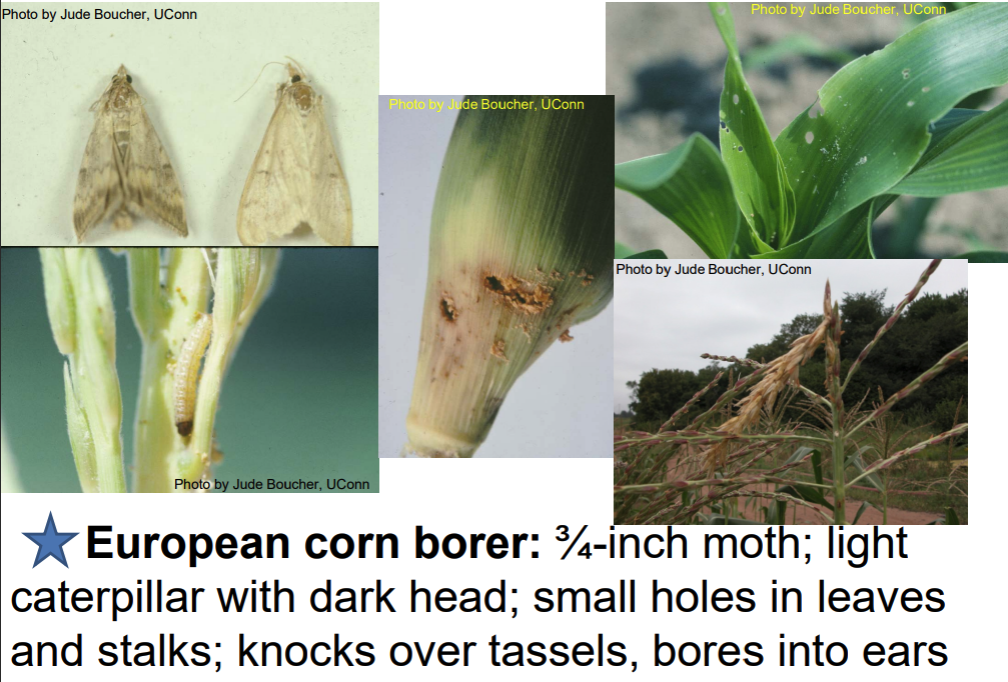
Corn with newly emerging tassels should be scouted weekly for the presence of European Corn Borer (ECB) larvae. Inspect the tassels of 50 to 100 plants, in groups of 5 to 20 plants, throughout the field. Treat if more than 15% of the plants have one or more larvae present. Use of selective products to control ECB will conserve natural enemies of aphids and ECB.
An important note about ECB is that it has more than 200 host plants, from common weeds to cash crops. In addition to impacting corn, ECB can also be a significant pest for pepper growers, for example. In southern New England, there are two generations each year. The first flight occurs in June, with larvae present between late June and early July, and the second flight typically spans mid- July to mid- August.
Pheromone traps and action thresholds are the best way to monitor ECB moth flights. If trapping, it is necessary to use two traps with one baited with the Iowa or Z lure and the other with the New York or E pheromone blend. They should be placed with the opening at plant height, in the weeds bordering corn or pepper fields. Plan to empty the traps and count the moths every three to four days during the height of the season.
Reference Documents:
Sweet Corn Pest ID & Trapping Factsheet
See the New England Vegetable Management Guide for more details on management strategies for sweet corn insect pests.
Onion Thrips
Onion thrips favor hot, dry weather. As temperatures rise, we expect their numbers to rise rapidly too.
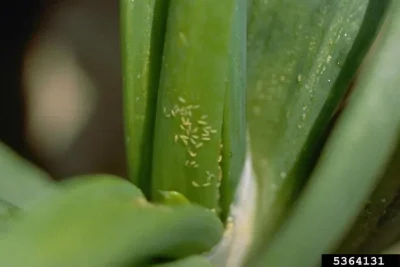
Adults overwinter in crop remnants, alfalfa, wheat, greenhouses, and weeds along the border of crop fields. They lay eggs one at a time in the plant epidermis, nymphs feed on leaves, and pupation occurs in the soil. Scout plants along field margins where infestations build early. Look closely between leaf blades to find the light-yellow nymphs or darker adults.
Damage may appear as silver lines, white patches, tip dieback, curling and twisting of leaves, slowed growth, reduced bulb size and yields, or if severe enough, can result in plant death. Begin applications when damage is first noticed or when there are 3 or more thrips per leaf.
The most effective material for organic growers is spinosad (e.g. Entrust) applied with insecticidal soap (e.g. M-Pede) to increase efficacy. Entrust can be used two times in a row before rotating to a different insecticide class. Neem oil (e.g. Trilogy) and azadirachtin (e.g. Azatin O) may be effective also if applied when poplations are still low. Pyrethrin (e.g. Pyganic) can provide knockdown control.
See the New England Vegetable Management Guide for more spray options.
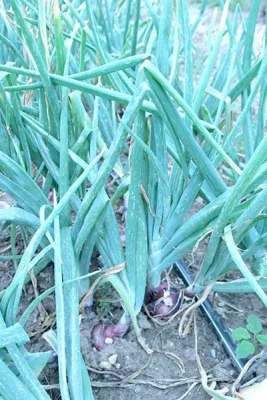
Continue to be on the lookout
The following pests that were covered in the previous pest alerts and are still relevant in current conditions:
- Flea Beetles
- Cabbage Root Maggots
- Thrips
- Mites
Upcoming Events & Opportunities
Cover Crop Drone Seeding Workshop
Tuesday, June 16th, 2026
10AM to 12PM
Valleyside Farms, 210 Child Hill Road, Woodstock, CT
This workshop is designed to demonstrate interseeding cover crop by drone into standing silage corn systems as an alternative to conventional post-harvest drill seeding. Topics to be discussed include cover crop planting date, seeding rate, planting strategy, species, and residue management. Refreshments will be provided.
Vegetable IPM Field Workshop
Tuesday, July 7th, 2026
3:30pm to 6:30pm
UConn Plant Science Research and Education Facility
This free workshop, led by UConn specialists, covers a range of agricultural topics and will include a cover crop and soil sampling demonstration, IPM monitoring using the NEWA system, update on squash variety trials and cucumber beetle management, hands-on white grub identification training, and report on sweet corn fertilizer trials. Pesticide recertification credits in PA and 1A categories are pending approval.
116th CAES Plant Science Day
Wednesday, August 5th, 2026
10AM to 4PM
Lockwood Farm, 890 Evergreen Ave, Hamden
The event will feature: Barn Displays, Field Plots and Exhibits, Technical Demonstrations, Plant Diagnosis and Plant Identification, Insect Identification, Questions Answered, Activities for Kids, Lockwood Farm Walking Tour, All About Apples Walking Tour, Connecticut Pesticide Credits Offered - All Categories and Private Applicator (PA) Categories: 3.75 Total Credit Hours.
Save These Dates!

2026 New England Vegetable & Fruit Conference
December 15, 16, 17, 2026
Manchester, New Hampshire

2027 UConn Extension Vegetable and Small Fruit Growers Conference
Tuesday, January 12th, 2027
UConn Student Union, Storrs, CT
Stay in touch with us
- Share what you see: We're here to assist with identification, management strategies, and guidance on best practices. Send us a photo/message via iMessage at 959-929-1031.
- Facebook Group: UConn Extension moderates a private Facebook group specifically for commercial vegetable producers. It is a space to share photos of insects and diseases you find in your fields, ask questions, share ideas, and stay engaged with growers across the state.
Join the "UConn Extension - Vegetable IPM" Facebook Group - Schedule a consultation: Would you benefit from meeting with an Extension Specialist at your farm to provide insight on pest or disease identification, management strategies, and more? If so, please contact our Vegetable Extension Specialist, Shuresh Ghimire, to setup a farm visit. Contact him at shuresh.ghimire@uconn.edu or 860-870-6933.
Contact Information
Shuresh Ghimire, Vegetable Extension Specialist: shuresh.ghimire@uconn.edu
Nicole Davidow, Vegetable Extension Outreach Assistant: nicole.davidow@uconn.edu
Vegetable IPM Office Phone Number:
860-870-6933
Vegetable IPM Cell Phone Number:
959-929-1031 (feel free to text/iMessage photos)
Any reference to commercial products, trade or brand names is for information only, and no endorsement or approval is intended. Always read the label before using any pesticide. The label is the legal document for product use. Disregard any information if it is in conflict with the label. UConn Extension does not guarantee or warrant the standard of any product referenced or imply approval of the product to the exclusion of others which also may be available. The University of Connecticut, UConn Extension, College of Agriculture, Health and Natural Resources is an equal opportunity program provider.