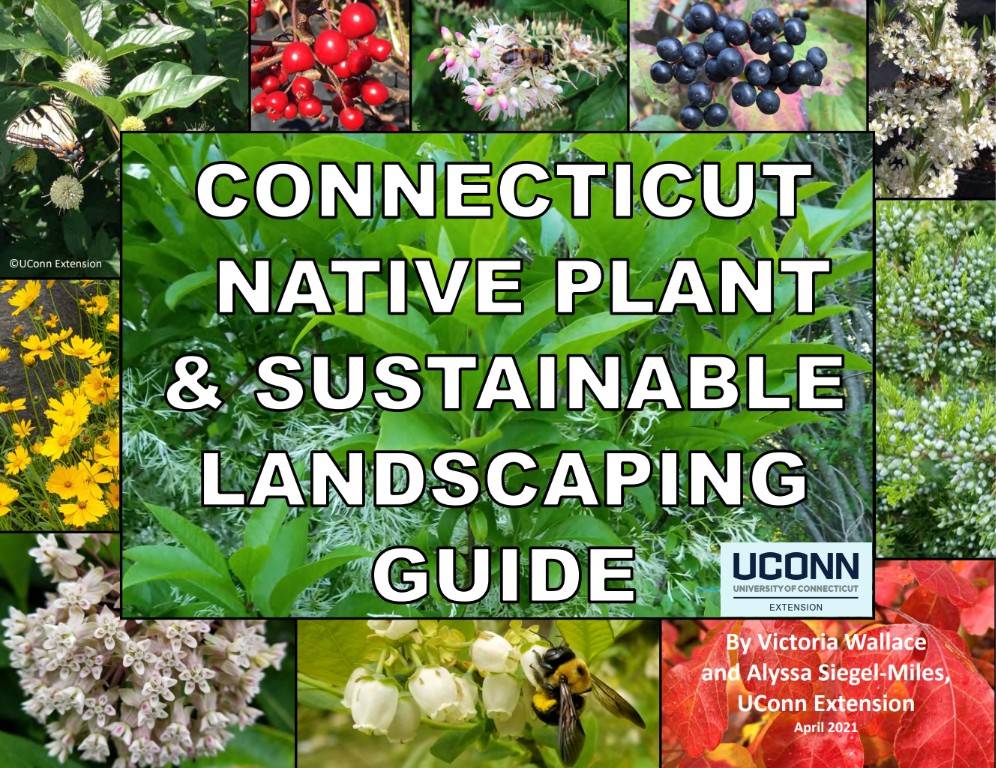
By Victoria Wallace and Alyssa Siegel-Miles
UConn Extension

Page 2. TABLE OF CONTENTS
SYMBOLS AND ABBREVIATIONS - PAGE 3
GLOSSARY - PAGE 3
SPECIES INDEX - PAGE 4-5
NATIVE FORBS THAT GROW EASILY FROM SEED - PAGE 6-7
NATIVE PERENNIALS FOR GARDEN BEDS - PAGE 8-9
LOW-GROWING GROUND COVERS - PAGE 10-13
LOW-MAINTENANCE & ALTERNATIVE LAWN OPTIONS - PAGE 14-15
AGGRESSIVE GROUND COVERS: SOLUTION PLANTS - PAGE 16-17
NATIVE FORBS FOR MEADOWS - PAGE 18-19
NATIVE PERENNIALS FOR RAIN GARDENS - PAGE 20-21
ANNUALS FOR BIOLOGICAL CONTROL GARDENS - PAGE 22-23
SALT TOLERANT & COASTAL-AREA PERENNIALS/GRASSES - PAGE 24-25
SALT TOLERANT AND COASTAL-AREA SHRUBS - PAGE 26-27
SALT TOLERANT AND COASTAL-AREA TREES - PAGE 28-29
TOUGH NATIVE TREES FOR CT LANDSCAPES - PAGE 30-33
TOUGH NATIVE SHRUBS FOR CT LANDSCAPES - PAGE 34-37
TOUGH NATIVE SHRUBS FOR CT LANDSCAPES - PAGE 35
PLANTS FOR RECLAMATION AREAS - PAGE 38
PASTURE CROPS - PAGE 39
COVER CROPS - PAGE 40-41
NATIVE PLANT NURSERIES AND VENDORS - PAGE 42
BIBLIOGRAPHY AND RESOURCES - PAGE 43
BOOKS AND ARTICLES

Funding for this program is supported by the Crop Protection and Pest Management Program [grant no. 2017-70006-27201/project accession no. 1013777] from the USDA National Institute of Food and Agriculture and by a grant from UConn Extension. It is a cooperative effort of UConn Extension and the Risk Management Agency/USDA. Any opinions, findings, conclusions, or recommendations expressed in this publication are those of the author(s) and do not necessarily reflect the view of the U.S. Department of Agriculture. These institutions are affirmative action/equal employment opportunity employers and program providers. ©UConn Extension. All rights reserved.
Authors:
Victoria Wallace
Senior Extension Educator, Sustainable Turf & Landscape
victoria.wallace@uconn.edu
Alyssa Siegel-Miles
Research Technician
alyssa.siegel-miles@uconn.edu
Special Thanks to:
Jessica Lubell-Brand, Ph.D.
Mary Concklin
Donna Ellis
Dustyn Nelson
Charlotte Pyle, Ph.D.
Mike Emmons
W. Michael Sullivan, Ph.D.
Jacob Ricker

Page 3. SYMBOLS AND ABBREVIATIONS
| MOISTURE/WATER NEEDS: | Dry = D | Medium = M | Wet = W |
| SUNLIGHT NEEDS: | Full sun | Part sun | Full shade |
| WILDLIFE/POLLINATORS ATTRACTED/SUPPORTED: |
birds = |
bees = |
Butterflies and moths (larval or adult stages) = |
| GRASSES AND COVER CROPS: |
Warm Season = WS | Cool Season = CS | Summer Annual = SA | Winter Annual = W |
DEER RESISTANT: *Note that no plant is deer-PROOF. Plants that are less palatable to deer and less likely to be eaten are labeled as deer resistant in this document. Plants with only moderate deer resistance are noted. In harsh winters or other times of scarcity, deer may eat any plant that is accessible to them.
GLOSSARY:
1. Allelopath: a plant that produces and releases chemicals that inhibit the germination or growth of nearby plants (or another organism)
2. Bunch-type grasses (also known as bunchgrasses): grow in clumps. Produce tillers from the crown of the plant, with minimal lateral spreading.
3. Catkin: cylindrical flower cluster/spike, with inconspicuous or no petals; plants with catkins are usually wind-pollinated
4. Cool Season Grasses: grasses that thrive in areas with cold winters and hot summers, including Northeast U.S., with optimum growth in the cool temperatures of spring (with fertilization) and fall. Cool season grasses start growth start growth in early spring when soil temperatures reach 40-45°F (4.5-7°C) and reach optimal growth at air temperatures between 60-75°F (15.5-24°C). Cool season grass species include Kentucky bluegrass, perennial ryegrass, fine fescue, tall fescue, and creeping bentgrass.
5. Dioecious: having separate male and female plants. Both male and female plants needed for fruit production. Seeds and fruit on female plants only.
6. Forbs: herbaceous flowering plants; other than grasses.
7. Monoecious: having both male and female organs in the same individual.
8. Nativar: a cultivar of a native plant.
9. Rhizomatous (sod-forming) grasses: produce either rhizomes (underground “stems”) or stolons, which extend laterally, enabling the grass to develop a firm sod. Rhizomatous grasses form a tight-knit and dense turf.
10. Rhizome: an underground, elongated stem (or shoot) that grows horizontally. Adventitious roots arise from the nodes.
11. Stolon: an elongated stem (or shoot) that grows along the surface of the ground, from which leaves and adventitious roots develop at the nodes, producing a dense stand of turf/plants.
| Latin Name | Common Name | Pages |
|---|---|---|
| Acer rubrum | red maple | 30, 31 |
| Acer saccharum | sugar maple | 30, 31 |
| Achillea millefolium | yarrow | 6, 7, 14, 15, 19, 25 |
| Actaea racemosa | black cohosh | 9 |
| Aesculus parviflora | bottlebrush buckeye | 34, 35 |
| Agastache foeniculum | anise hyssop | 8, 9, 19 |
| Ageratina altissima | white snakeroot | 7, 19, 20, 21 |
| Agrostis gigantea | red top | 38, 39 |
| Alnus incana ssp. rugosa | speckled alder | 35, 38 |
| Amelanchier arborea | downy serviceberry | 29 |
| Amelanchier canadensis | shadbury serviceberry | 28, 29 |
| Amelanchier laevis | Allegheny serviceberry | 29 |
| Amsonia hubrichtii | blue star | 7, 21 |
| Amsonia tabernaemontana | eastern blue star | 7, 20, 21 |
| Andropogon gerardii | big bluestem | 7, 19, 25 |
| Anemone canadensis | windflower | 7, 17 |
| Anethum graveolens | dill | 23 |
| Aquilegia canadensis | columbine | 7, 24, 25 |
| Arctostaphylos uva-ursi 'Massachusetts' |
bearberry, kinnikinnick |
10, 11, 25 |
| Aronia arbutifolia | red chokeberry | 1, 3, 27 |
| Aronia melanocarpa | black chokeberry | 26, 27 |
| Aruncus dioicus | goat’s beard | 8, 9, 21 |
| Asarum canadense | wild ginger | 10, 11 |
| Asclepias incarnata | swamp milkweed | 19, 20, 21 |
| Asclepias syriaca | common milkweed | 1, 3, 16, 17, 19, 38 |
| Asclepias tuberosa | butterfly milkweed | 7, 8, 9, 19 |
| Asimina triloba | pawpaw | 30, 31 |
| Avena sativa | annual oats | 39, 40, 41 |
| Baccharis halimifolia | groundsel bush | 27 |
| Baptisia australis | blue false indigo | 8, 9 |
| Betula lenta | sweet birch | 31 |
| Betula nigra | river birch | 31 |
| Betula populifolia | gray birch | 31 |
| Bouteloua curtipendula | sideoats grama | 7, 38, 39 |
| Bromus biebersteinii | meadow brome | 39 |
| Calendula officinalis | calendula | 23 |
| Carex crinita | fringed sedge | 21, 38 |
| Carex pensylvanica | Pennsylvania sedge | 7, 14, 15, 21 |
| Carex praegracilis | field sedge | 15, 19, 21 |
| Carex stipata | awl sedge | 15, 21 |
| Carpinus caroliniana | ironwood | 31 |
| Carya ovata | shagbark hickory | 31 |
| Ceanothus americanus | New Jersey tea | 35 |
| Cephalanthus occidentalis | buttonbush | 1, 3, 27 |
| Cercis canadensis | redbud | 31 |
| Chaenomeles speciosa | flowering quince | 26, 27 |
| Chamaecrista fasciculata | partridge pea | 6, 7, 19, 38 |
| Chamaecyparis pisifera | Japanese false cypress | 29 |
| Chamaecyparis thyoides | Atlantic white cedar | 31 |
| Chelone glabra | white turtlehead | 21 |
| Chelone lyonii | pink turtlehead | 21 |
| Chionanthus virginicus | American fringetree | 1, 3, 30, 31 |
| Chrysogonum virginianum | green and gold | 7, 11 |
| Clethra alnifolia | summersweet | 1, 3, 21, 26, 27 |
| Comptonia peregrina | sweetfern | 26, 27 |
| Coreopsis grandiflora | large tickseed | 7 |
| Coreopsis lanceolata | lanceleaf coreopsis | 1, 3, 7, 19 |
| Coreopsis verticillata | threadleaf tickseed | 24, 25 |
| Coriandrum sativum | cilantro | 23 |
| Cornus alternifolia | pagoda dogwood | 31 |
| Cornus amomum | silky dogwood | 34, 35, 38 |
| Cornus canadensis | bunchberry | 10, 11 |
| Cornus florida | flowering dogwood | 31, 38 |
| Cornus racemosa | gray dogwood | 21, 27, 38 |
| Cornus sericea | red-osier dogwood | 35 |
| Corylus americana | American hazelnut | 35 |
| Corylus cornuta | beaked filbert | 35 |
| Cotinus obovatus | American smoketree | 35 |
| Cupressus nootkatensis 'Pendula' |
weeping Alaskan cedar |
29 |
| Dactylis glomerata | orchard grass | 38, 39 |
| Dasiphora fruticosa | shrubby cinquefoil | 34, 35 |
| Dennstaedtia punctilobula | hay-scented fern | 17 |
| Deschampsia cespitosa | tufted hair grass | 7, 14, 15 |
| Desmodium canadense | showy tick-trefoil | 7, 18, 19 |
| Dianthus spp. | cheddar pinks | 24, 25 |
| Dicentra eximia | fringed bleeding heart | 7, 8, 9, 17 |
| Diervilla lonicera | bush honeysuckle | 26, 27 |
| Dryopteris marginalis | marginal shield fern | 11 |
| Echinacea pallida | purple coneflower | 7 |
| Echinacea paradoxa | yellow coneflowe | 19 |
| Elymus canadensis | Canada wild rye | 7, 19, 38, 39, 41 |
| Eragrostis spectabilis | purple lovegrass | 7, 15 |
| Eubotrys racemosa | sweetbells | 35 |
| Eupatorium perfoliatum | American boneset | 7, 21, 38 |
| Eurybia divaricata | white wood aster | 6, 7 |
| Eutrochium purpureum | Joe Pye weed | 18, 19, 20, 21, 25 |
| Fagopyrum esculentum | buckwheat | 39, 40, 41 |
| Fagus grandifolia | American beech | 31 |
| Festuca brevipila | hard fescue | 14, 15 |
| Festuca ovina | sheep fescue | 38, 39 |
| Festuca rubra | red fescue | 15, 38 |
| Filipendula rubra | queen of the prairie | 21 |
| Foeniculum vulgare | fennel | 23 |
| Fothergilla gardenii | dwarf fothergilla | 34, 35 |
| Fragaria virginiana | meadow strawberry | 17 |
| Geranium maculatum | wild geranium | 9 |
| Ginkgo biloba | ginkgo | 29 |
| Gleditsia triacanthos f. inermis | honey-locust | 29 |
| Hamamelis virginiana | common witch hazel | 35 |
| Helenium autumnale | sneezeweed | 21 |
| Helianthus annuus | sunflower | 22, 23 |
| Helianthus mollis | downy sunflower | 7 |
| Heliopsis helianthoides | false sunflower | 8, 9 |
| Hibiscus moscheutos | swamp mallow | 21 |
| Hydrangea quercifolia | oakleaf hydrangea | 34, 35 |
| Hypericum prolificum | shrubby St. John's wort | 27 |
| Iberis sempervirens | candytuft | 25 |
| Ilex glabra | inkberry | 35 |
| Ilex verticillata | winterberry | 20, 21, 27 |
| Ilex opaca | American holly | 33 |
| Iris cristata | dwarf crested iris | 11 |
| Itea virginica | Virginia sweetspire | 35 |
| Juglans nigra | black walnut | 33 |
| Juniperus communis | common juniper | 29 |
| Juniperus horizontalis | creeping juniper | 11 |
| Juniperus virginiana | eastern red cedar | 1, 3, 29 |
| Kalmia latifolia | mountain-laurel | 36, 37 |
Back to top
| Leucothoe fontanesiana | drooping laurel | 37 |
| Liatris scariosa | northern blazing star | 19 |
| Liatris spicata | blazing star | 8, 9 |
| Limonium carolinianum | sea lavender | 25 |
| Lindera benzoin | spicebush | 36, 37 |
| Liquidambar styraciflua | sweetgum | 28, 29 |
| Liriodendron tulipifera | tulip tree | 32, 33 |
| Lobelia cardinalis | cardinal flower | 7, 21 |
| Lobularia maritima | sweet alyssum | 22, 23 |
| Lolium perenne | perennial ryegrass | 38, 39 |
| Lonicera canadensis | American honeysuckle | 37 |
| Lotus corniculatus | birdsfoot trefoil | 38, 39, 41 |
| Magnolia virginiana | sweetbay magnolia | 33 |
| Maianthemum canadense | Canada mayflower | 16, 17 |
| Matteuccia struthiopteris | ostrich fern | 16, 17 |
| Medicago sativa | alfalfa | 39, 41 |
| Mertensia virginica | Virginia bluebells | 11 |
| Monarda punctata | spotted beebalm | 7, 19 |
| Morella pensylvanica | bayberry | 27 |
| Muhlenbergia capillaris | pink muhly grass | 7, 9 |
| Myrica gale | sweet gale | 37 |
| Nyssa sylvatica | black tupelo | 32, 33 |
| Onoclea sensibilis | sensitive fern | 16, 17 |
| Opuntia humifusa | prickly pear | 10, 11 |
| Ostrya virginiana | hop-hornbeam | 33 |
| Oxydendrum arboreum | sourwood | 33 |
| Pachysandra procumbens | Allegheny spurge | 10, 11 |
| Packera aurea | golden ragwort | 11, 21 |
| Panicum virgatum | switchgrass | 7, 19, 21, 24, 25, 38 |
| Parthenocissus quinquefolia | Virginia creeper | 17, 38 |
| Penstemon digitalis | beardtongue | 9, 10 |
| Phleum pratense | timothy | 39 |
| Phlox divaricata | wild blue phlox | 11 |
| Phlox pilosa | downy phlox | 6, 7 |
| Phlox stolonifera | creeping phlox | 11 |
| Phlox subulata | moss phlox | 7, 12, 13, 25 |
| Physocarpus opulifolius | eastern ninebark | 32, 37 |
| Pinus strobus | eastern white pine | 30, 33 |
| Pisum sativum | field peas | 40, 41 |
| Poa pratensis | Kentucky bluegrass | 39 |
| Podophyllum peltatum | mayapple | 16, 17 |
| Polystichum acrostichoides | Christmas fern | 9, 24 |
| Prunus maritima | beach plum | 27 |
| Prunus pumila var. depressa | creeping sand cherry | 1, 3, 13 |
| Prunus serotina | black cherry | 25, 32, 33, 38 |
| Prunus virginiana | chokecherry | 28, 29 |
| Puccinellia distans | alkaligrass | 25 |
| Pycnanthemum muticum | mountain mint | 7, 19 |
| Pycnanthemum virginianum | American mountain mint | 18, 19 |
| Quercus alba | white oak | 29 |
| Quercus bicolor | swamp white oak | 33 |
| Quercus rubra | northern red oak | 33, 38 |
| Quercus velutina | black oak | 33 |
| Raphanus sativus | oilseed radish | 41 |
| Rhododendron maximum | rosebay rhododendron | 37 |
| Rhus aromatica 'Gro-Low' | fragrant sumac | 1, 3, 12, 13 |
| Rhus glabra | sumac | 17, 30, 38 |
| Rhus typhina | staghorn sumac | 17, 32, 38 |
| Rosa virginiana | Virginia rose | 36, 37 |
| Rudbeckia fulgida | orange coneflower | 7, 21 |
| Rudbeckia hirta | black-eyed Susan | 7, 18, 19 |
| Ruellia humilis | wild petunia | 7, 13 |
| Salix discolor | pussy willow | 38 |
| Salix nigra | black willow | 38 |
| Sambucus canadensis | elderberry | 37 |
| Sanguinaria canadensis | bloodroot | 7, 13, 16, 21 |
| Sassafrass albidum | sassafras | 28, 33 |
| Schizachyrium scoparium | little bluestem | 24, 25, 38 |
| Scolochloa festucacea | tall fescue | 38 |
| Scutellaria incana | downy skullcap | 7, 9, 19 |
| Secale cereale | cereal ryegrass | 39, 41 |
| Sedum 'Autumn Joy' | Autumn Joy stonecrop | 24, 25 |
| Sedum spp. | stonecrop | 12, 13 |
| Senna hebecarpa | wild senna | 38, 41 |
| Solidago canadensis | Canada goldenrod | 7, 16, 17 |
| Solidago rugosa | rough goldenrod | 7, 16, 17 |
| Solidago sempervirens | seaside goldenrod | 7, 16, 25 |
| Solidago speciosa | showy goldenrod | 7, 16, 19 |
| Sorghastrum nutans | Indian grass | 18, 19, 25, 38 |
| Sorghum bicolor x S. bicolor var. sudanese | sorghum-sudangrass | 41 |
| Spartina patens | saltmeadow cordgrass | 25 |
| Spiraea alba | meadowsweet | 37 |
| Sporobolus heterolepis | prairie dropseed | 19 |
| Symphyotrichum lateriflorum | calico aster | 7 |
| Symphyotrichum novae-angliae |
New England aster | 18, 19, 21 |
| Tagetes spp. | marigold (yellow) | 22, 23 |
| Thuja occidentalis | arborvitae | 33 |
| Thymus spp. | thyme | 14, 15 |
| Tiarella cordifolia | foamflower | 24, 25 |
| Tilia americana | American linden | 33 |
| Tradescantia ohiensis | Ohio spiderwort | 6, 7, 19 |
| Tradescantia virginiana | spiderwort | 7 |
| Trifolium incarnatum | crimson clover | 39, 41 |
| Trifolium hybridum | alsike clover | 39, 41 |
| Trifolium pratense | red clover | 39, 41 |
| Trifolium repens | white clover | 39, 41 |
| Trifolium repens ‘Pirouette’ or ‘Pipolina’ | microclover | 15 |
| Trillium grandiflorum | wood lily | 13, 17 |
| Triticum aestivum | wheat | 39, 41 |
| Uvularia grandiflora | large-flowered bellwort | 13 |
| Vaccinium angustifolium | lowbush blueberry | 12, 13 |
| Vaccinium corymbosum | highbush blueberry | 1, 3, 21, 26, 27 |
| Vaccinium stamineum | deerberry | 29, 37 |
| Verbena hastata | blue vervain | 7 |
| Vernonia noveboracensis | New York ironweed | 7, 19 |
| Veronicastrum virginicum | Culver’s root | 9, 20, 21 |
| Viburnum acerifolium | maple leaf viburnum | 1, 3, 36, 37 |
| Viburnum cassinoides | witherod viburnum | 37 |
| Viburnum dentatum | northern arrowwood | 27, 28 |
| Vicia villosa | hairy vetch | 41 |
| Waldsteinia fragarioides | barren strawberry | 13, 25 |
| Xanthorhiza simplicissima | yellowroot | 13 |
| Yucca filamentosa | Adam’s needle | 36, 37 |
| Zinnia elegans | zinnia | 22, 24 |
| Zizia aurea | golden Alexander | 12, 13 |
Back to top

Page 7. Forbs That Grow Easily From Seed
All plants listed are native to northeastern United States.
| Botanical Name |
Common Name |
Flower Color |
Flower Time |
MatureHeight |
Water Needs |
Sunlight Needs |
Wildlife Attracted |
Notes |
Deer Resistant? |
||
|
Achillea |
yarrow |
white, pink, red |
June - Sept. |
3’ |
D |
M |
|
Full sun |
|
Perennial. Thrives in poor, well-drained soils. Salt tolerant. Fragrant, showy flowers. Good cut flower. |
YES |
|
Ageratina altissima |
white snakeroot |
white |
Sept. - frost |
3-5’ |
M | W | Full sun | Perennial. Prolific self-seeder; deadhead if unwanted. Prefers part shade in moist, rich soils; tolerates moderately dry soils. |
YES | ||
|
Chamaecrista fasciculata |
partridge pea |
yellow |
June - Sept. |
1-3’ |
D |
Full sun, |
|
Annual. Seed late March-May. Used for erosion control. Improves soil fertility (fixes nitrogen). Readily self-seeds. |
NO | ||
|
Coreopsis grandiflora |
large tickseed |
yellow |
June - August |
1.5- 2.5’ |
D |
M |
W |
Full sun |
|
Short-lived perennial. Rabbit resistant. May self-seed and spread by rhizomes, forming colonies. |
YES |
|
Echinacea pallida |
pale purple coneflower |
pale purple |
June - July |
2-3’ |
D |
M |
W |
Full sun, |
|
Perennial. Mixes well with grasses. Showy, fragrant, good cut flowers. Self-seeds freely. |
YES |
|
Eurybia |
white wood aster |
white |
August- October |
1-3’ |
D |
M |
|
Part shade, Full shade |
|
Perennial. Attracts many pollinators. Self-seeds. Natural- ize for best effect. Appears delicate; tough, vigorous. |
YES |
|
Helianthus mollis |
downy sunflower |
yellow |
July - Sept. |
2-4’ |
D |
M |
|
Full sun, |
|
Perennial. Plants spread by rhizomes and self-seeding to form colonies. |
NO |
|
Pycnanthemum muticum |
mountain mint |
white, pink |
July - Sept. |
1-3’ |
|
M |
W |
Full sun, |
|
Perennial. Attracts butterflies and honeybees. Attractive silver-blue foliage. Best flowering in full sun. |
YES |
|
Phlox pilosa |
downy phlox |
pink |
May - July |
1-2’ |
D |
M |
|
Full sun |
|
Perennial. Attracts hummingbirds. Showy, fragrant, saucer-shaped flowers. Likes mulch in summer. |
YES |
|
Symphyotrichum lateriflorum |
calico aster |
white |
Sept.- October |
2-3’ |
D |
M |
|
Full sun, |
|
Syn. Aster lateriflorus. Perennial. Self-seeds. Attracts and supports native bees and predatory/parasitic insects. |
NO |
|
Tradescantia ohiensis |
Ohio spiderwort |
blue |
May - July |
2-3’ |
D |
M |
|
Full sun, |
|
Perennial. Tolerates part shade but with fewer blooms. Prefers moist, acidic, sandy soil. Self-seeds aggressively. |
NO |
|
Tradescantia |
spiderwort |
blue to violet |
May - July |
1.5-3’ |
M |
Part shade, Full shade |
|
Perennial. Long-blooming for native plant, shade, or wild gardens or meadows. Unattractive mid-summer foliage. |
NO | ||
|
Verbena hastata |
blue vervain |
purplish-blue |
July - Sept. |
2-6’ |
|
M |
W |
Full sun |
|
Perennial. Preferred nectar source for hover flies, bee flies. Verbena stricta is a good alternative for drier soils. |
YES |
|
Vernonia |
New York ironweed |
purple |
August- Sept. |
4-8’ |
|
M |
W |
Full sun |
|
Perennial. Aggressively self-seeds. Use for back of borders, meadows, pollinator gardens. |
YES |
Others: Amsonia spp. (21), Anemone canadensis (17), Andropogon gerardii (19), Aquilegia canadensis (25), Asclepias tuberosa (9), Bouteloua curtipendula (38), Carex pensylvanica (15), Chrysogonum virginianum (11), Coreopsis lanceolata (19), Deschampsia cespitosa (15), Desmodium canadense (19), Dicentra eximia (9), Elymus canadensis (38), Eupatorium perfoliatum (38), Eragrostis spectabilis (15), Lobelia cardinalis (21), Monarda punctata (19), Muhlenbergia capillaris (9), Panicum virgatum (25), Phlox subulata (13), Rudbeckia spp. (21, 23), Ruellia humilis (13), Sanguinaria canadensis (13), Scutellaria incana (9), Solidago spp. (17).
Back to top
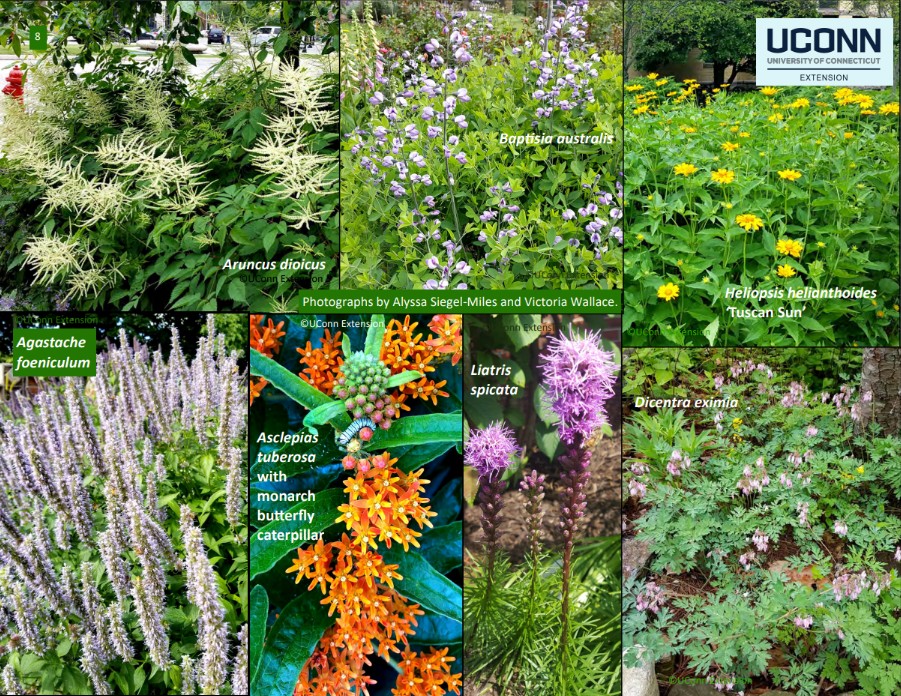
Page 9. NATIVE PERENNIALS FOR GARDEN BEDS
All plants listed are native to northeastern United States.
| BOTANICAL NAME |
COMMON NAME |
FLOWER COLOR |
FLOWER TIME |
MATURE HEIGHT |
WATER NEEDS |
SUNLIGHT NEEDS |
WILDLIFE ATTRACTED |
NOTES *Glossary of abbreviations is on pg. 3 |
DEER RESISTANT |
| Actaea racemosa |
black cohosh |
white | June - July |
4-6’ | M | Part shade, full shade | Architectural texture. Prefers moist, fertile soils. Slow to establish. Shelter from strong winds. Foliage may scorch if soil dries. Butterfly larval host plant (e.g., spring azure, holly blue). |
YES | |
| Aruncus dioicus | goat's beard |
creamy white |
April - May |
4-6' | M W | Full sun, part shade | Thrives in shady, moist spots in borders, woodland edge. Long lasting blooms. Do not allow to dry out. Also, for rain gardens. |
YES | |
| Asclepias tuberosa |
butterfly milkweed |
orange | June - August |
1-2.5’ | D M | Full Sun | Essential food source for Monarch butterfly caterpillars. Good cut flower. May re-seed. Good soil drainage essential. |
YES | |
| Agastache foeniculum |
anise hyssop |
lavender - purple |
June - Sept. |
2-4’ | D M | Full sun | Good cut flower. May re-seed. Good soil drainage is essential. Attracts hummingbirds; nectar supports native bees. |
YES | |
| Baptisia australis |
blue false indigo |
blue, purple |
May - June |
3-4' | D M | Full sun, part shade | Does not respond well to transplanting. Attractive seed pods in fall. Tolerates poor soils. In shade, may require staking. |
YES | |
| Dicentra eximia |
fringed bleeding heart |
rose pink | April - July |
1-1.5’ | M | Part shade, full shade | Prefers moist, rich soils. Good soil drainage is essential for plant survival. Intolerant of wet soils in winter and dry soils in summer. Will self-seed in optimal conditions. |
YES | |
| Geranium maculatum |
wild geranium |
pink, lavender | March - July |
1-3’ | M W | Part shade, full shade | Deadheading prolongs bloom. Native to dry or moist woods. woodland edges; dappled meadows. Thrives under variety of conditions - rich, acidic. Seeds attract doves, bobwhite quail. |
YES | |
| Heliopsis helianthoides |
false sunflower |
yellow | June - August |
3-6' | D M | Full sun | Attracts hummingbirds. Long summer bloom; good cut flow er. Remove spent flowers to extend bloom season. |
||
| Liatris spicata | blazing star | red-purple | July - August |
2-4’ | D M | Full sun | Tolerant of drought, also clay soil. Intolerant of wet soils in winter. Adds architectural texture to the garden. |
NO | |
| Muhlenbergia capillaris |
pink muhly grass |
pink, red | Sept.- Nov. |
2-3’ | D M | Full sun, part shade | Clump forming. Best grouped or en masse for late season color. Tolerates poor soils. May be grown from seed. WS. |
YES | |
| Penstemon digitalis |
beard tongue | white | April - June |
1-3’ | D M | Full sun | Good cut flower. Drought tolerant. Root rot can occur in wet, poorly drained soils. |
YES | |
| Polystichum acrostichoides |
Christmas fern |
N/A | 1-2’ | D M | Part shade, full shade | Clumping fern that will not spread; clumps will increase in size over time. Mass on slopes to combat soil erosion. |
YES | ||
| Scutellaria incana |
downy skullcap |
purplish blue | June - Sept. |
2-3’ | D M | Full sun, part shade | Drought tolerant. Attractive wildflower that creates interest in the garden. Ideal for shady spots. |
YES | |
| Veronicastrum virginicum |
Culver’s root | white, blue |
June - August |
4-7’ | M W | Full Sun | Takes several years to establish. Also used in rain gardens. Deadhead flowers to extend bloom period. Cut back after flowering for new foliage growth and fall bloom. |
NO
|
MANY other plants in this document are also suitable for garden beds.
Back to top
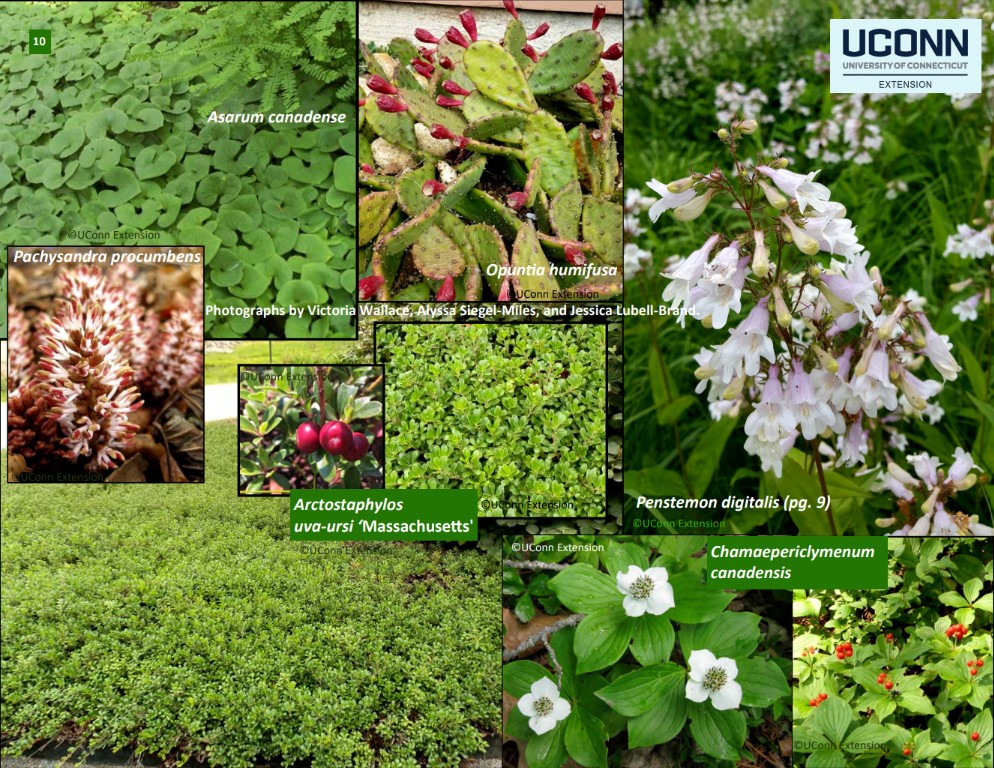
Page 11. LOW-GROWING GROUND COVERS
All plants listed are native to northeastern United States. All are perennials unless otherwise noted.
| BOTANICAL NAME |
COMMON NAME |
FLOWER COLOR |
FLOWER TIME |
MATURE HEIGHT |
WATER NEEDS |
SUNLIGHT NEEDS |
WILDLIFE ATTRACTED |
NOTES *Glossary of abbreviations is on pg. 3 |
DEER RESISTANT |
| Arctostaphylos uva-ursi 'Massachusetts' |
bearberry, kinnikinnick |
white | April - May |
0.5-1‘ | D M | Full sun, part shade | Salt tolerant. Four seasons of interest. Do not fertilize. Roots dislike disturbance. Slow to establish. Requires excellent soil drainage. Likes infertile, acidic, sandy soils and slopes. |
YES | |
| Asarum canadense |
wild ginger | incon-spicuous | April - May |
0.5-1‘ | M W | Part shade, full shade | Low mat-forming; Spreads slowly by rhizomes. Prefers acidic soils, consistent moisture. Moderate deer resistance. |
YES | |
| Chrysogonum virginianum |
green and gold |
yellow | May - October |
0.5-1’ | M W | Part shade, full shade | Spreads vigorously to form an attractive ground cover, but is easily controlled. Prefers moist, acidic, organically rich soils. Grows easily from seed and may self-seed in good conditions. |
NO | |
| Cornus canadensis |
bunchberry | white | May - July |
0.25- 0.75’ |
M | Part shade, full shade | Prefers moist, organically rich, acidic soils in part shade including sun-dappled conditions in close to full shade. Showy foliage in fall. Rabbit resistant. |
YES | |
| Dryopteris marginalis |
marginal shield fern |
N/A | N/A | 1.5-2’ | D M | Full sun, part shade | N/A | Tolerates dry shade once established. Thrives in rocky, woodland settings. Protect from wind. |
YES |
| Iris cristata | dwarf crested iris |
pale blue |
April | 0.5-1‘ | D M | Full sun, part shade | Spreads quickly; forms dense colonies. Snails and slugs may cause damage. Dry to moist soils. Moderate deer resistance. |
YES | |
| Juniperus horizontalis |
creeping juniper |
N/A | N/A | 0.5-1.5’ | D M | Full sun | Evergreen shrub. Drought tolerant. Erosion control. Requires well drained soils. Dark blue, berry-like cones persist in winter. |
YES | |
| Mertensia virginica |
Virginia bluebells |
blue | March - April |
1.5-2’ | M W | Part shade, full shade | One of the easiest spring ephemerals to grow. Dormant in summer; overplant with annuals or perennials (e.g., ferns) |
NO | |
| Opuntia humifusa |
prickly pear | yellow | June - July |
0.5-1‘ | D | Full sun | Syn. Opuntia compressa. Evergreen. Attractive, edible fruit. Grow in rock gardens, stone walls, sandy slopes, dry prairies. |
YES | |
| Packera aurea | golden ragwort |
yellow | April | 1-2’ | M W | Full sun, part shade | Semi-evergreen for moist, shady, rich, acidic areas. Tolerates seasonal flooding. Spreads by seed and roots. |
YES | |
| Pachysandra procumbens |
Allegheny spurge |
white | March - April |
0.5-1’ | D M | Part shade, full shade | Good air circulation beneficial - avoid overhead watering; thin plants periodically. Showy, fragrant flower. Mass on slopes. |
YES | |
| Phlox divaricata | wild blue phlox |
white, purple |
March - May |
0.5-1’ | M | Part shade, full shade | Native to moist, rich, deciduous woods. Flowers attract swallowtails, gray hairstreaks, and western pygmy blue butterflies. | YES | |
| Phlox stolonifera |
creeping phlox |
purple, violet |
July - Sept. |
0.5-1’ | D M | Full sun, part shade | Tolerant of drought, air pollution. Prefers acidic, rich, shady, organic soils, continuous moisture. Spreads by stolon & seed. |
YES |
Back to top
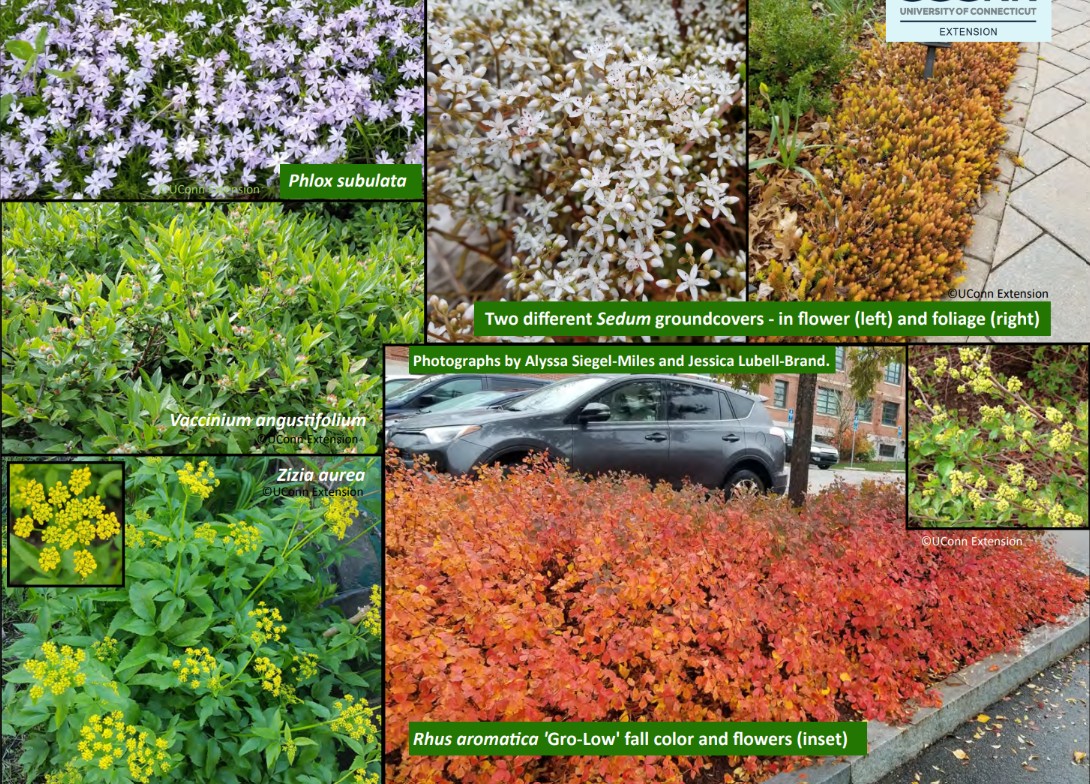
Page 13. LOW-GROWING GROUND COVERS
All plants listed are perennials and native to northeastern United States unless otherwise noted.
| NAME | COMMON NAME |
FLOWER COLOR |
FLOWER TIME |
MATURE HEIGHT |
WATER NEEDS |
SUNLIGHT NEEDS |
WILDLIFE ATTRACTED |
NOTES | DEER RES. |
| Phlox subulata |
moss phlox | purple, pink, red, white |
March - May |
0.5’ | D M | Full sun | Tolerant of salt, drought, erosion, and air pollution. Requires good soil drainage. Grows well in sandy soils, sunny borders, slopes, draped over rock walls. May self-seed. Shear stems after flowering by 1/2 for denser growth and light rebloom. |
YES | |
| Prunus pumila var. depressa |
creeping sand cherry |
white | late May - June |
1.5' | D M | Full sun, part shade | Widely adaptable to full sun sites. Orange fall color. Dark red cherries provide important forage for many animal species. Fruits persist June through August. |
NO | |
| NRhus aromatica 'Gro-Low' |
fragrant sumac |
yellow (small) |
April - June |
1.5-2' | D M | Full sun, part shade | Low-growing shrub. If stems die back, cut dead stems to 6" for regrowth. Drought tolerant. Showy red fruit in fall; fast spreader. |
YES | |
| Ruellia humilis |
wild petunia |
laven der, blue | May - October |
1.5-2’ | M | Full sun, part shade | Blooms throughout summer. Can be an aggressive grower. Readily reseeds. Host plant for larvae of common buckeye butterfly. | NO | |
| Sanguinaria canadensis |
bloodroot | white | March - April |
0.5-0.75’ | M | Part shade, full shade | Spreads rapidly. Mulch with a thin layer of deciduous leaves during the winter. Groundcover for around the base of trees. Seeds dispersed by ants. Rhizome poisonous - may be fatal if ingested. |
NO | |
| Sedum spp. | stonecrop | pink, purple |
August - October |
0.25-0.5’ | D | Full sun | Many groundcover cultivars; most are not native to U.S. Tolerant of rabbits, drought, and air pollution. Soil must be well-drained. |
YES | |
| Trillium grandiflorum |
wood lily | white, pink |
April - June |
1-1.5’ | M | Part shade, full shade | Benefits from mulch in fall. Prefers moist, acidic, humus-rich soil. Spreads slowly by rhizomes. Does not transplant well. |
NO | |
| Uvularia grandiflora |
large flowered bellwort |
yellow | April - May |
1.5-2’ | M | Part shade, full shade | Good cut flower. Effective en masse under trees or along wood margins. Prefers humus-rich soils and good drainage. Benefits from compost and leaf mulch in winter. Favored by deer. |
NO | |
| Vaccinium angustifolium |
lowbush blueberry |
white | May - June |
1-2’ | M | Full sun, part shade | Shrub. Edible fruit. Glossy foliage turns maroon-purple in fall. Ideal soil is moist, high in organic matter, and well-drained, pH must be very acidic (4.5 to 5.5). Use mulch. |
NO | |
| Waldsteinia fragarioides |
barren strawberry |
yellow | April - May |
0.5’ | M | Full sun, part shade | Syn. Geum fragarioides. Evergreen foliage turns bronze in winter. Salt tolerant. Can substitute for grass and aid in transitioning turf areas to ground cover. Spreads slowly by rhizomes. |
YES | |
| Xanthorhiza simplicissima |
yellowroot | purple. insignificant |
April - May |
0.5-2.5’ | D M V | Part shade, full shade | Spreading shrub. Excellent fall color. Performs best in woodlands, moist areas. Drought tolerant. Adapts to wide variety of conditions. Stabilizes slopes. |
YES | |
| Zizia aurea | golden Alexander |
yellow | May - June |
1.5-2’ | M | Full sun, part shade | Showy flowers. Will re-seed in optimal conditions. Beautiful en masse. Attracts beneficial bees, wasps, flies. |
NO |

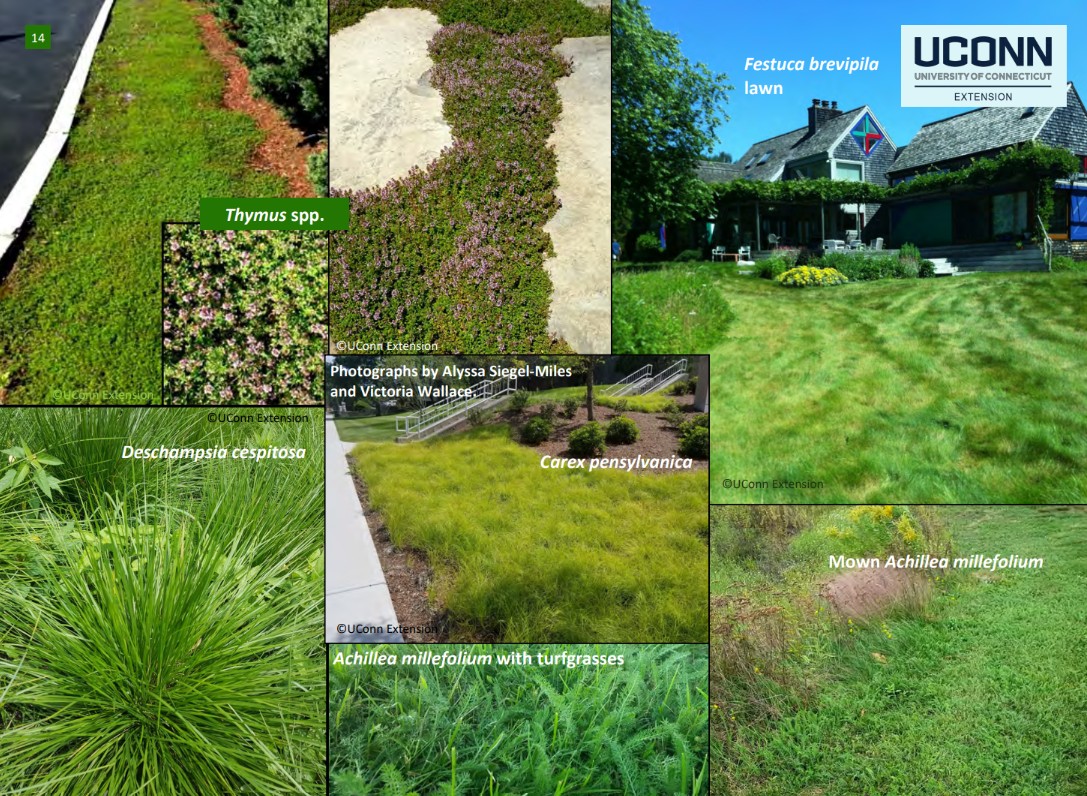
Not adapted to close mowing (less than 3”), but all may be maintained at a 3-4” height of cut, except where noted. perennials and native to northeastern U.S. unless otherwise noted.
| BOTANICAL NAME |
COMMON NAME |
FLOWER COLOR |
FLOWER TIME |
MATURE HEIGHT |
WATER NEEDS |
SUNLIGHT NEEDS |
WILDLIFE ATTRACTED |
NOTES *Glossary of abbreviations is on pg. 3 |
DEER RES. |
| Achillea millefolium |
yarrow | white | June - Sept |
2-3’ | D M | Full sun | Commonly grown as garden ornamental; can persist when mown and maintained as lawn. Mow with rotary mower on high setting. |
YES | |
| Carex stipata | awl sedge | green, golden |
May - June |
1.5-3’ | M W | Full sun, part shade | Tolerates drier conditions in shaded locations. Sprawling habit. spiky seed heads. Beneficial to grasshoppers, birds, ducks. Foliage is eaten by caterpillars of several skippers and other butterflies. |
YES | |
| Carex pensylvanica |
Pennsylvania sedge |
insignificant | May | 1' | D M W | Part sun, full shade | N/A | Lawn substitute for dry soils in shady areas; Can be left unmown or mow 2-3 times a year to 3-4”. Cascading growth habit. Tolerates heavy shade and wet soil. Plugs are best; does not grow well from seed. |
YES |
| Carex praegracilis |
clustered field sedge |
green | May | 2’ | M W | Full sun, part shade | N/A | Salt tolerant. Also useful for meadows, green roofs, bio-swales, erosion control. Tolerates moderate drought, flooding, poor soils, heat, cold, shade and moderate foot traffic. Spreads by rhizomes and may self-seed in optimum conditions. |
YES |
| Deschampsia cespitosa |
tufted hair grass |
gold, silver, purple |
July - Sept. |
2-3’ | M W | Full sun, part shade | Bunch-type grass; clump-forming with a mounding habit. Grows in average, medium, well-drained soils. Tolerates range of soil conditions. Acid soil, salt, and heavy metal tolerant. May retain green color in mild winters. CS. |
YES | |
| Eragrostis spectabilis |
purple lovegrass |
purple red | July - August |
1-2’ | D M | Full sun | Performs best if left unmown in sandy or gravelly loam in hot, dry locations. Very drought tolerant. Excellent late summer color. Excellent dried flower. Crucial food source for many butterflies and native songbirds. WS. |
YES | |
| Festuca brevipila |
hard fescue |
green | May - June |
1-2’ | D M | Full sun, part shade | N/A | Syn. Festuca longifolia. Drought tolerant. Improved drought tolerance if left unmown. Does well in shade or full sun; persists in soils of low fertility. Clump-forming. Not Native to U.S. CS. |
YES |
| Festuca rubra | red fescue |
yellow | May - July |
1-3’ | M | Full sun, part shade | Spreads by rhizome or stolons. Has distinct subspecies; may tolerate mild foot traffic. Slow to recuperate when damaged. Can tolerate lawn height of cut or be left unmown. CS. |
YES | |
| Thymus spp. | thyme | purple | June - Sept. |
0.5’ | D M | Full sun | Evergreen; fragrant foliage. Tolerates low fertility soils. Thrives in sandy or rocky soils with excellent drainage. Can be seeded into a low maintenance/input lawn. Not Native to U.S. |
YES | |
| Trifolium repens ‘Pirouette’ or ‘Pipolina’ |
microclover | white | May - June |
0.25-0.5’ | M | Full sun | Less aggressive than straight species of white clover. Clump-forming with moderate stolon activity. Limited erosion control value. Combine with turfgrasses. Legume (nitrogen fixing); can support reduced fertilizer applications. Not Native to U.S. |
NO |
Back to top
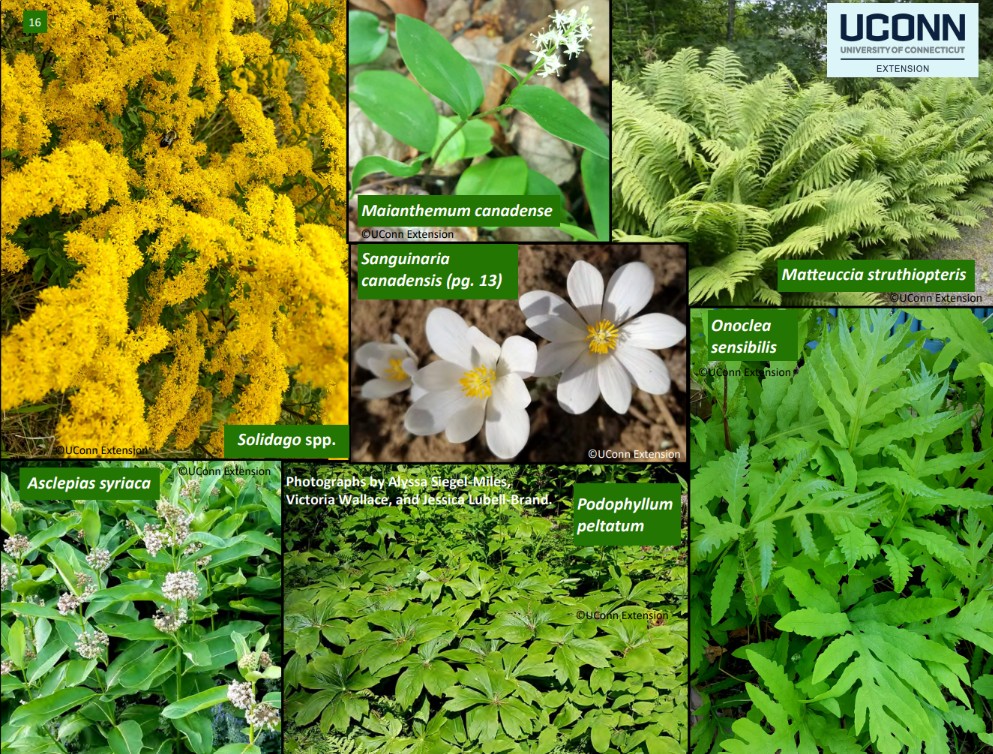
Page 17. AGGRESSIVE GROUND COVERS: SOLUTION PLANTS
These plants function as “living mulch. “ They generally will monopolize a landscape bed, choking out and outcompeting other species (except where noted) which can provide helpful solutions for tough spots! Some are taller than what has traditionally considered “ground covers.” All plants listed are native to northeastern United States.
| NAME | COMMON NAME |
FLOWER COLOR |
FLOWER TIME |
MATURE HEIGHT |
WATER NEEDS |
SUNLIGHT NEEDS |
WILDLIFE ATTRACTED |
NOTES | DEER RES. |
| Anemone canadensis |
windflower | white | April - June |
1-2’ | D M W | Full sun, part shade, full shade | N/A | Spreads vigorously by rhizomes. Most aggressive in sunny, moist soils; grows more slowly in dry, shady locations. Good cut flower. Attracts predatory/parasitoid insects. |
YES |
| Asclepias syriaca |
common milkweed |
purple, white |
June - August |
3-5’ | D M | Full sun | Thrives in poor soils, roadsides, and waste places. Spreads vigorously by rhizomes and seed; forms colonies. Monarch butterfly larvae host plant. Flowers are fragrant. |
YES | |
| Dennstaedtia punctilobula |
hay-scented fern |
N/A | N/A | 1.5-2' | D M V | Full sun, part shade, full shade | N/A | Spreads vigorously by rhizomes; forms colonies and can dominnate. Tolerates full sun if moisture is consistent. Grows in a wide range of soils - dry or poor, rocky soils. Fragrant foliage. |
YES |
| Fragaria virginiana |
meadow strawberry |
white | April - May |
0.5-.75’ | D M V | Full sun, part shade | Edible berries in summer. Prefers full sun and organically rich, sandy loams. Drought tolerant. Use for erosion control on slopes. After fruiting, may go dormant in hot summer months. |
YES | |
| Maianthemum canadense |
Canada mayflower |
white | May - June |
0.5’ | D M W | Part shade, full shade | Spreads by rhizomes; forms carpet-like colonies. Native to deciduous woods, floodplains, and bog margins. Red berries in fall are eaten by birds and small mammals. |
YES | |
| Matteuccia struthiopteris |
ostrich or fiddlehead fern |
N/A | N/A | 3-6’ | M W | Part shade, full shade | N/A | Clumps form a colony over time. Fiddleheads edible. Moist soils best. Plant with spring wildflowers that go dormant (e.g., trilliums, bloodroot, trout lilies, Dicentra spp.). |
YES |
| Onoclea sensibilis |
sensitive fern |
N/A | N/A | 0.5-3’ | M W | Part shade, full shade | N/A | Roots colonize, but are usually shallow. Native to moist woodlands, floodplains, stream banks, swamps, marshes. Shelters salamanders and frogs. |
YES |
| Parthenocissus quinquefolia |
Virginia creeper |
greenish white |
May - August |
30’ | M | Full sun, part shade, full shade | Vine. Ornamental fall foliage and fruit (fruit toxic to humans). Tolerates full shade; best fall leaf color in sun. Groundcover, erosion control on slopes, or climber for fence or large trellis. |
YES | |
| Podophyllum peltatum |
mayapple | white | April - June |
1-2’ | D M W | Full sun, part shade | Rhizomes spread quickly, forming dense mats in damp, open woods. Leaves, roots, seeds poisonous if ingested in large quantities; fruit is edible and used in jams. |
YES | |
| Solidago canadensis |
Canada goldenrod |
yellow | August - October |
4-5’ | D M | Full sun, part shade | Can rapidly colonize an area. Goldenrods are the most beneficial native perennial to native butterflies/moths [4]. |
YES | |
| Solidago rugosa |
rough goldenrod |
yellow | Sept. - October |
3’ | D M V | Full sun, part shade | Can rapidly colonize an area by creeping rhizomes and self-seeding. Goldenrods do not cause allergies or hay fever. |
YES |
Other aggressive ground covers/solution plants: Rhus glabra (31), Rhus typhina (31).
Back to top
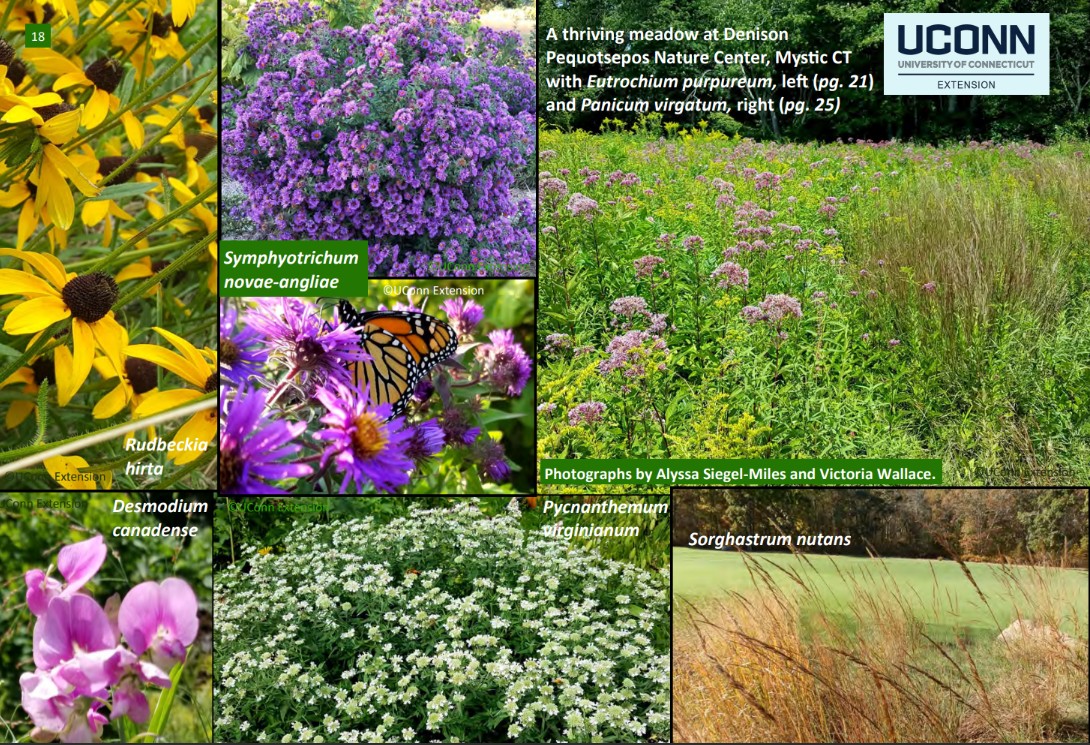
Page 19. NATIVE FORBS FOR MEADOWS
All plants listed are perennials and native to northeastern United States unless otherwise noted.
| BOTANICAL NAME |
COMMON NAME |
FLOWER COLOR |
FLOWER TIME |
MATURE HEIGHT |
WATER NEEDS |
SUNLIGHT NEEDS |
WILDLIFE ATTRACTED |
NOTES *Glossary of abbreviations is on pg. 3 |
DEER RESIST. |
| Andropogon gerardii |
big bluestem |
purplish red | Sept.-February | 4-5' | D M | Full sun | Drought tolerant. Cut stems to base-late winter. Good fall color. Likes infertile soils. Good for erosion control. Self-seeds. WS. |
YES | |
| Coreopsis lanceolata |
lanceleaf coreopsis |
yellow | May - July |
1-2’ | D M | Full sun, part shade | Short-lived perennial in a garden bed setting. Deadhead to extend flowering: cut back hard in late summer when plants become unkempt. Divide every 2-3 years to encourage robustness. |
YES | |
| Desmodium canadense |
showy tick trefoil | rose purple, lavender |
July - August |
2-6 ‘ | M | Full sun, part shade | Fixes nitrogen in the soil (legume). Plentiful flowers. More attractive when planted in large groups, not single specimens. Attracts hummingbirds, butterfly host plant. |
NO | |
| Echinacea paradoxa |
yellow coneflower |
yellow | June - August |
2-3’ | D M | Full sun | Very drought tolerant. Attracts goldfinch and other birds. Echinacea purpurea and E. angustifolia are other good options. |
YES | |
| Liatris scariosa |
northern blazing star |
pink - purple |
August - Sept. |
2-4’ | D M | Full sun | Large, dense flower spikes. Prefers dry, sandy or rocky soils. Adds vertical accent and late summer to fall bloom. |
NO | |
| Monarda punctata |
spotted beebalm |
yellow, purple, white |
June - August |
1-3’ | D M | Full sun | Showy bracts; aromatic foliage. Attracts and supports many pollinators. Good cut flower. Drought tolerant. Best in sandy soils with consistent moisture. Alternate options: M. didyma, M. fistulosa. |
YES | |
| Pycnanthemum virginianum |
American mountain mint |
white | July - Sept. |
2-3’ | M | Full sun, part shade | Fragrant foliage. Self-seeds. Attracts many beneficials, including honeybees, cuckoo bees, sweat bees, solitary wasps, tachinid flies, wedge-shaped beetles, and pearl crescent butterflies. |
YES | |
| Sporobolus heterolepis |
prairie dropseed |
pink, brown |
August - October |
2-3’ | M | Full sun | Adds winter interest. Slow to establish. Can be sown by seed but does not freely self-seed. WS. |
YES | |
| Solidago speciosa |
showy goldenrod |
yellow | July - Sept. |
2-3’ | D M | Full sun, part shade | Attracts numerous pollinators. Does not cause allergies or hay fever and is not overly aggressive like some goldenrods. |
YES | |
| Sorghastrum nutans |
Indian grass |
brown, yellow | Sept.- February |
3-5’ | D M | Full sun | Prefers infertile soils. Attractive blue-green foliage. Orange yellow fall color. Cut stems to ground late winter. Salt tolerant. WS. |
YES | |
| Symphyotrichum novae-angliae |
New England aster |
purple, blue |
August - Sept. |
3-6' | D M W | Full sun | Syn. Aster novae-angliae. Showy, good cut flowers. Nectar source for monarch butterflies. Larval host plant for pearl crescent and checkerspot butterflies. S. lateriflorum is also good for meadows. |
YES | |
| Rudbeckia hirta |
black-eyed Susan |
yellow | June - Sept. |
2-3’ | D M | Full sun, part shade | Biennial (short-lived perennial). Use for early meadow establishment. Self-seeds freely. | YES |
Other meadow plants: Achillea millefolium, Agastache foeniculum, Ageratina altissima, Asclepias spp., Carex praegracilis, Chamaecrista fasciculata, Elymus canadensis, Eutrochium purpureum, Panicum virgatum, Pycnanthemum muticum, Scutellaria incana, Tradescantia ohiensis, Vernonia noveboracensis.
Back to top
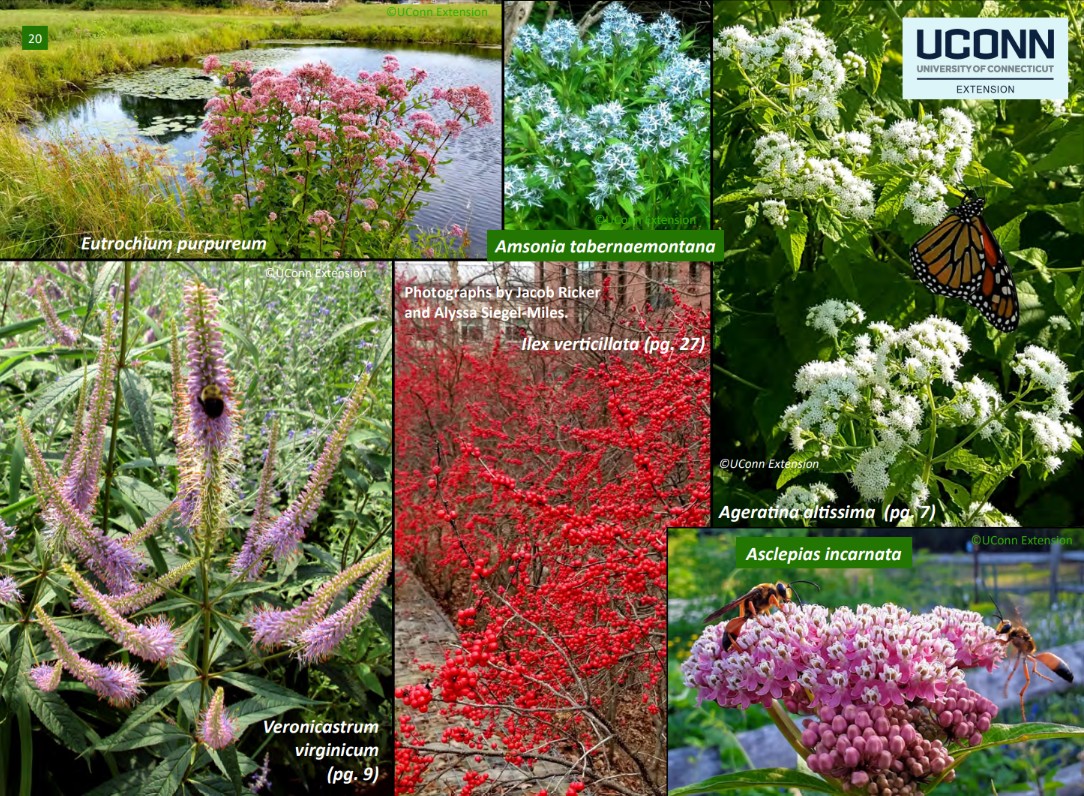
Page 21. NATIVE PERENNIALS FOR RAIN GARDENS
All plants listed are native to northeastern United States.
| BOTANICAL NAME |
COMMON NAME |
FLOWER COLOR |
FLOWER TIME |
MATURE HEIGHT |
WATER NEEDS |
SUNLIGHT NEEDS |
WILDLIFE ATTRACTED |
NOTES | DEER RESIST. |
| Amsonia hubrichtii |
blue star | light blue | April - May |
2-3’ | M | Full sun, part shade | Good fall color. Native to south-central U.S. Also grown in borders, gardens, or open woodlands. Best en masse. 2011 Perennial Plant Association's Plant of the Year. |
YES | |
| Amsonia tabernaemontana |
eastern blue star |
blue | May | 2-3’ | M | Full sun, part shade | Good cut flower and fall color. Tolerates some drought. Native to central U.S. Cut stems after flowering to promote bushy growth. Best flowering in full sun; may require staking in part shade. |
YES | |
| Asclepias incarnata |
swamp milkweed |
white, pink |
July - August |
4-5’ | M W | Full sun | Attracts hummingbirds. Essential food source for monarch butter fly caterpillars. Showy, fragrant, flowers. Deep taproots - best left undisturbed once established. Foliage is slow to emerge in spring. |
YES | |
| Carex crinita | fringed sedge |
green | May - June |
1-3 | M W | Full sun | Useful in moist garden areas or for naturalizing. Tolerant of standing water. Spreads by rhizomes to form large colonies. Also valuable for wetland restoration and soil retention. |
YES | |
| Chelone glabra | white turtlehead |
white w/ pink tinge |
August - October |
2-3' | M W | Part shade | Thrives in moist to wet, rich soils in part shade. Spreads slowly by rhizomes. Also grown in woodland, bog, or wildflower gardens; by ponds or water garden peripheries. |
NO | |
| Chelone lyonii | pink turtlehead |
pink | July - Sept. |
2-4’ | M W | Full sun, part shade | Native to southeastern U.S. Pinch stems in spring to encourage bushiness, especially if in very shady areas. Does not need staking in full sun. Compost enhances growth. Will self-seed in moist soils. |
YES | |
| Eutrochium purpureum |
Joe Pye weed |
mauve pink |
July - Sept. |
5-7' | M W | Full sun, part shade | Syn. Eupatorium purpureum. Prefers moist soils that do not dry out. Cut plants to ground in late winter. Several improved cultivars are available, such as 'Gateway' or E. dubium 'Little Joe' |
NO | |
| Filipendula rubra |
queen of the prairie |
pale pink | June - August |
6-8’ | M W | Full sun | Attracts hummingbirds. Fragrant foliage. Showy, fragrant flowers. Intolerant of drought. |
YES |
Other plants for rain gardens: Ageratina altissima, Aruncus dioicus, Carex stipata, Carex pensylvanica, Carex praegracilis, Clethra alnifolia, Cornus racemosa, Eupatorium perfoliatum, Ilex verticillata, Lindera benzoin, Matteuccia struthiopteris, Packera aurea, Panicum virgatum, Salix discolor, Sanguinaria canadensis, Spiraea alba, Symphyotrichum novae-angliae, Vaccinium corymbosum, Veronicastrum virginicum.
Back to top
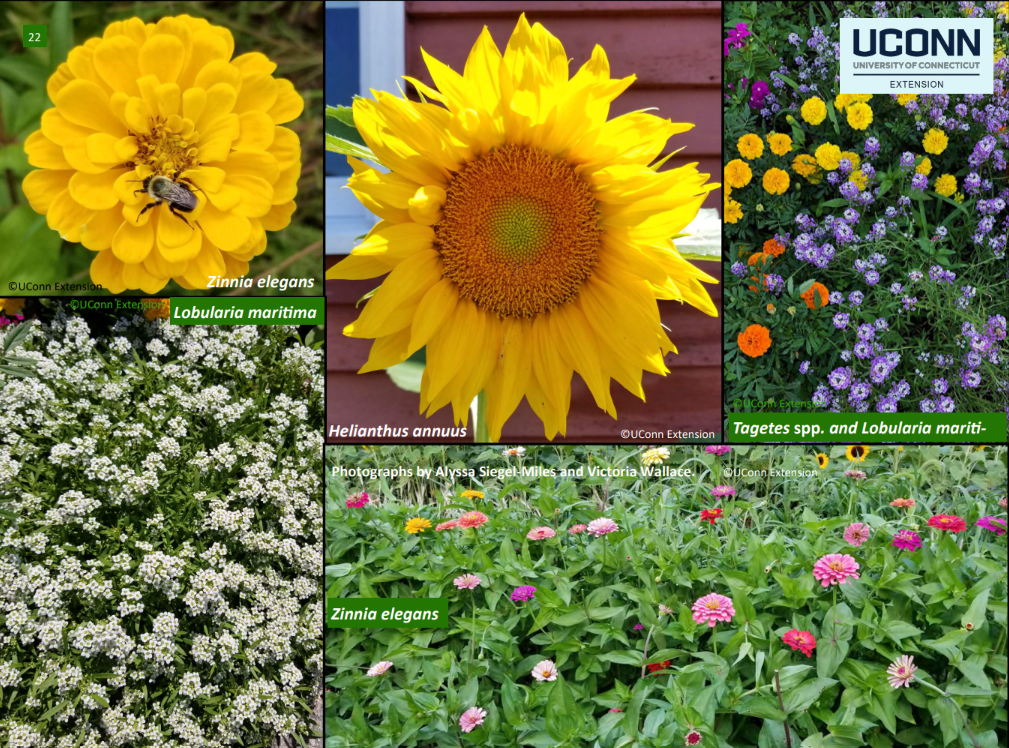
Page 23. ANNUALS FOR BIOLOGICAL CONTROL GARDENS
All plants listed are not native to the U.S., except where noted.
| BOTANICAL NAME |
COMMON NAME |
FLOWER COLOR |
FLOWER TIME |
MATURE HEIGHT |
WATER NEEDS |
SUNLIGHT NEEDS |
WILDLIFE ATTRACTED |
NOTES | DEER RES. |
| Anethum graveolens |
dill | yellow | August - Sept. |
3-5’ | M | Full sun | Attracts lacewings, tachinid flies, hoverflies, and lady beetles. Larval host plant for the black swallowtail butterfly. Fragrant. Edible. Self-seeds aggressively. |
YES | |
| Calendula officinalis |
calendula or pot marigold |
yellow, orange |
May - June |
1-2’ | M | Attracts small native solitary bees. Attracts aphids, providing a food source for beneficials. Fragrant. Edible, somewhat bitter foliage and flowers. May reseed. Start seed indoors or sow directly in garden. |
YES | ||
| Coriandrum sativum |
cilantro | white | May - August |
1.5-2’ | M | Full sun, part shade | Attracts hoverflies and many beneficials. Fragrant. Edible. Attracts swallowtail butterflies. Plants bolt in hot summer weather. Seeds may be planted directly in garden or in pots. |
YES | |
| Foeniculum vulgare |
fennel | yellow | June - July |
4-6’ | D M | Full sun | Attracts hoverflies, ladybugs, lacewings. Fragrant. Edible. Self-seeds freely. Remove spent flowers before seed production to avoid self-seeding. Larval host plant for swallowtail butterfly. | YES | |
| Helianthus annuus |
sunflower | yellow, red | July - August |
3-10’ | D M | Full sun | Attracts hoverflies, ladybugs, lacewings. Tolerates poor, somewhat dry soils. Plant seeds directly in garden; fast grower. Native to North America, including Connecticut. |
YES | |
| Lobularia maritima |
sweet alyssum |
white, pink | April - June |
0.5- 0.75 |
M | Full sun | Attracts hoverflies and other beneficials. Fragrant. Moderate drought tolerance. One of the easiest annuals to grow. May be cut back after first bloom to encourage more flowering. |
YES | |
| Tagetes spp | marigold (yellow) |
yellow | June - frost |
0.5-1’ | M | Full sun | Attracts hoverflies, ladybugs. Attracts spider mites, providing a food source for beneficials. Fragrant. Pinch young plants to promote bushy growth. |
YES | |
| Zinnia elegans |
zinnia | pink, yellow | June - frost |
1-4’ | M | Full sun, part shade | Habitat plant - attracts many beneficial insects. Grows easily in humus-rich, evenly moist, well-drained soils. Pinch young plants to promote compact, bushy form. Maintain good air circulation to prevent fungal leaf diseases. |
YES |
Many beneficial insects rely on plants as a food source (nectar and pollen) or shelter. Many natural enemies are omnivores, requiring nectar and pollen as well as insects in their diet. Habitat and “banker plants” provide alternative food sources for omnivorous beneficial insects to support populations when insect pests are limited.
In order to attract beneficial predators and pollinators to create landscape biodiversity, the inclusion of habitat and banker plants is critical. Landscapes with a diverse selection of plant species that incorporate a variety of flowering plants, with an emphasis on native trees, shrubs, and perennials of varying sizes are less likely to have major pest problems than homogeneous landscapes.
Back to top
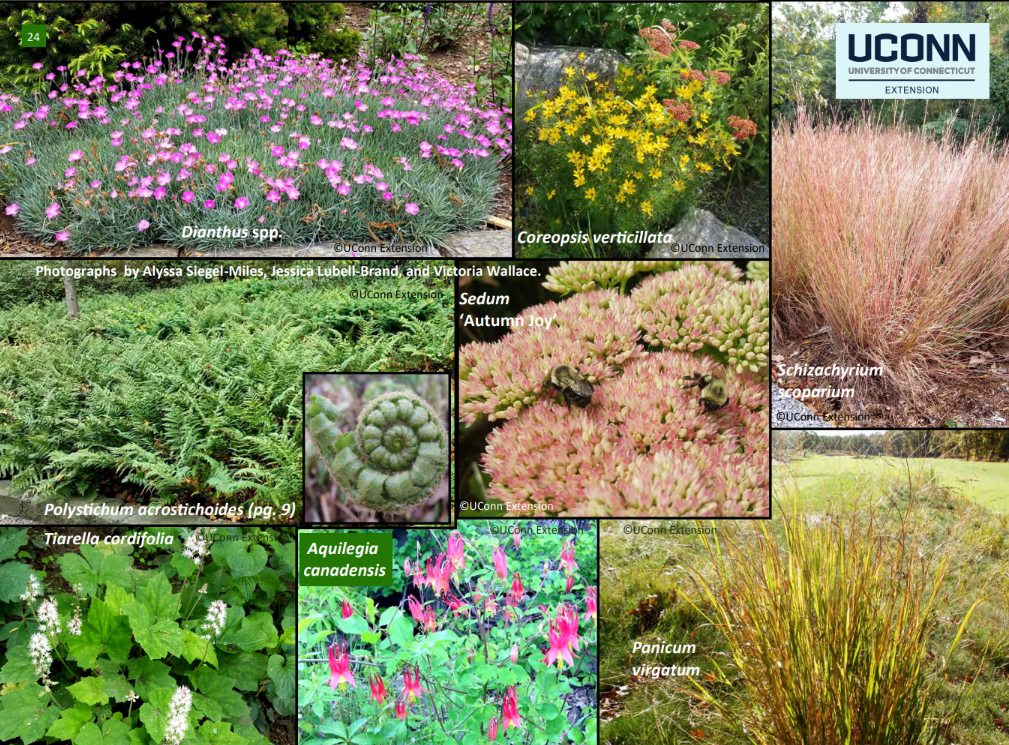
Page 25. SALT TOLERANT & COASTAL-AREA PERENNIALS
All plants listed are native to northeastern United States unless otherwise noted.
| BOTANICAL NAME |
COMMON NAME |
FLOWER COLOR |
FLOWER TIME |
MATURE HEIGHT |
WATER NEEDS |
SUNLIGHT NEEDS |
WILDLIFE ATTRACTED |
NOTES *Glossary of abbreviations is on pg. 3 |
DEER RES. |
| Aquilegia canadensis |
columbine | red, pink, white |
April - June |
1-1.5’ | D M | Part shade | Prefers moist, average to rich soils. Water well during periods of drought. Leaf miners only significant pest. If seen, simply cut foliage to ground and discard. Moderate deer resistance. |
YES | |
| Coreopsis verticillata |
threadleaf tickseed |
yellow | June - Sept. |
2-2.5’ | D M | Full sun, part shade | Drought tolerant. Reblooms in September if sheared lightly in August. Self-seeds. Good plant for areas with poor, dry soils. Attracts beneficial syrphid flies, yellow-collared scape moth. |
YES | |
| Dianthus spp. | cheddar pinks |
pink-red, white |
late June - August |
0.5-1’ | D M | Full sun | Drought tolerant; many cultivars. Makes a good ground cover or front of border plant. Not native to U.S. Mod. deer resistance. |
YES | |
| Iberis sempervirens |
candytuft | white | July - Sept. |
0.5-1’ | D M | Full sun, part shade | Evergreen. Well-drained soil is important for plant health. Slow spreader. Not native to U.S. Moderate deer resistance. |
YES | |
| Limonium carolinianum |
sea lavender |
pale purple |
July - Sept. |
1-2’ | M W | Full sun, part shade | Native habitat is irregularly flooded, high salt marshes. Grows in clay, loam, and sand soils. Moderate deer resistance. |
YES | |
| Panicum virgatum | switchgrass | amber | July - February |
2-4’ | D M W | Full sun, part shade | Attractive as an accent, screen, or massed. Wide range of soil condition tolerance. Attractive amber seedheads. Good fall color. Also appropriate for meadows and rain gardens. WS. |
YES | |
| Puccinellia distans | alkaligrass | green | June - July |
1-2 | M W | Full sun | N/A | Bunching habit. Used for erosion control, roadsides, disturbed sites. Can be left unmown or mown as turf. Extremely salt tolerant; will outcompete other turfgrasses in salty soils. |
NO |
| Schizachyrium scoparium |
little bluestem |
purplish-bronze | August - February |
2-4' | D M | Full sun | Beautiful inflorescence. Cut to the ground in late winter to early spring. Tolerant of sandy or droughty, infertile soils. Bronze orange fall foliage color. WS. |
YES | |
| Sedum 'Autumn Joy' |
autumn joy stonecrop |
pink, copper |
August - Nov. |
2' | D M | Full sun | Late season resource for pollinators. Divide every 3-4 years to maintain compact growth habit. Older plants may split in center if not divided. Not native to U.S. |
YES | |
| Spartina patens | saltmeadow cordgrass |
yellow | April - May |
1-3’ | W | Full sun | Used for beach front stabilization. Native habitat includes salt marshes, sea beaches, edges of wetlands. May also be grown in freshwater environments; the size of the plant will be larger. |
NO | |
| Solidago sempervirens |
seaside goldenrod |
yellow | August - October |
1-6’ | D M | Full sun | Sandy soils. Does not spread aggressively. Native to coastal dunes, maritime wet grasslands, tidal marshes. |
YES | |
| Tiarella cordifolia |
foam-flower | white, pink |
May | 0.5-1' | M | Part shade | Forms attractive ground cover - grow en masse. Good fall color. Maintain even, steady moisture; do not allow to dry out or become water-logged. Spreads by stolons and seed. |
YES |
Other salt tolerant plants: Achillea millefolium, Andropogon gerardii, Arctostaphylos uva-ursi, Eutrochium purpureum, Phlox subulata, Prunus serotina, Sorghastrum nutans, Waldsteinia fragarioides
Back to top
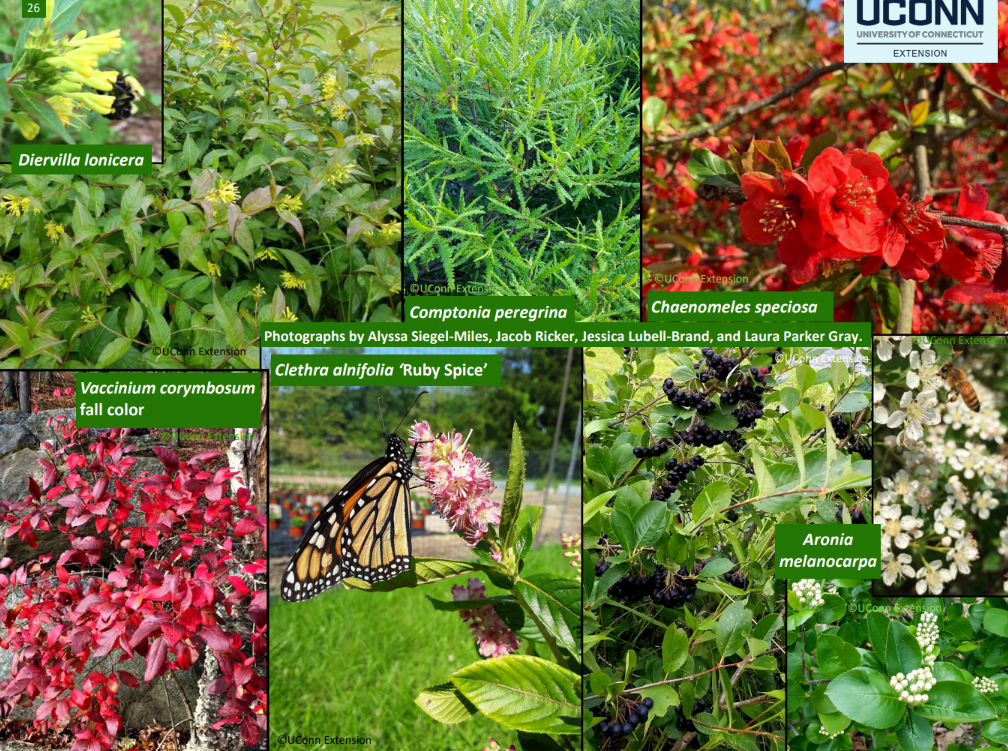
Page 27. SALT TOLERANT AND COASTAL-AREA SHRUBS
All plants listed are native to northeastern United States unless otherwise noted.
| BOTANICAL NAME |
COMMON NAME |
FLOWER COLOR |
FLOWER TIME |
MATURE HEIGHT |
WATER NEEDS |
SUNLIGHT NEEDS |
WILDLIFE ATTRACTED |
NOTES | DEER RES. |
| Aronia arbutifolia |
red chokeberry |
white-pink | April | 6-10' | M | Full sun, part shade | Suckers form colonies; can be removed to prevent spread if desired. Excellent fall color; edible red fruit in winter. Mod. deer resistance. |
YES | |
| Aronia melanocarpa |
black chokeberry |
white | May | 3-6' | M W | Full sun, part shade | Tolerates many soils types, including wet; root suckers form colonies. Used for hedges, rain gardens, naturalizing. Excellent fall color. |
NO | |
| Baccharis halimifolia |
groundsel bush |
white | August - October |
6-12’ | D M | Full sun, part shade | Prefers sandy soil. Silvery, plume-like flat seed pods in fall. Showy fruit. Dioecious. Fast grower. Short-lived; wood is brittle. Self-seeds. |
NO | |
| Cephalanthus occidentalis |
buttonbush | white | June | 5-12' | M W | Full sun, part shade | Grows well in wet soils. Adapts to wide range of soils except dry. Pruning unnecessary. Fruit attractive in winter. Mod. deer resistance. |
YES | |
| Chaenomeles speciosa |
flowering quince |
orange, red, pink |
March-April | 3-10' | D M | Full sun, part shade | Blooms on old growth. Prune to shape as needed, in spring after flowering. Avoid heavy pruning. Not native to U.S. |
YES | |
| Clethra alnifolia |
summer-sweet | white; pink |
July - August |
4-8' | D M W | Full sun, part shade | Prefers part shade and moist, rich acidic soil. Fragrant flowers; good fall color. Moderate deer resistance. |
YES | |
| Comptonia peregrina |
sweetfern | yellow (small) |
April - May |
2-5' | D M | Full sun, part shade | Thrives in dry, infertile soils. Difficult to transplant; best container grown. Good for naturalizing and embankments. Fragrant foliage. |
YES | |
| Cornus racemosa |
gray dogwood |
white | May - June |
10-15' | D M W | Full sun, part shade | Most drought tolerant of the native shrub dogwoods. Spreads by root suckers to form thickets. Good fall color. |
NO | |
| Diervilla lonicera |
bush honeysuckle |
yellow | June - July |
3-4' | D M | Full sun, part shade | Good fall color. Spreads quickly; root suckers may be transplanted. Prune, if needed, right after flowering. Fruit valuable for songbirds. |
YES | |
| Hypericum prolificum |
shrubby St. John's wort |
yellow | June - August |
3-5’ | M | Full sun, part shade | Tolerant of aerial salt spray. Tolerates both brief flooding and mild drought. Adapts to many soil conditions. Butterfly larvae host plant. |
YES | |
| Ilex verticillata | winterberry | greenish-white | June - July |
6-10' | M W | Full sun | Prefers moist, rich, acidic soils. Dioecious - both male and female needed for showy red fruit production. Moderate deer resistance. |
YES | |
| Morella pensylvanica |
bayberry | yellow-green | May | 5-10' | D M W | Full sun, part shade | Tolerates drought, erosion, wet soils. Roots form suckers. Best en masse. Showy fruit-winter interest. Dioecious. Widely adaptable. |
YES | |
| Prunus maritima |
beach plum | white | April - June |
6-10’ | D M | Full sun | Dense, suckering. Edible fruit in August. Native to coastal, sandy, infertile soils. Short-lived species. Protect from insects and diseases. |
NO | |
| Vaccinium corymbosum |
highbush blueberry |
white | May - June |
6-12' | D M W | Full sun | Native to swamps but does well in dry, acidic, poor, sandy soils. Use mulch. Edible fruit. Good fall color. Can be used as a hedge. |
NO | |
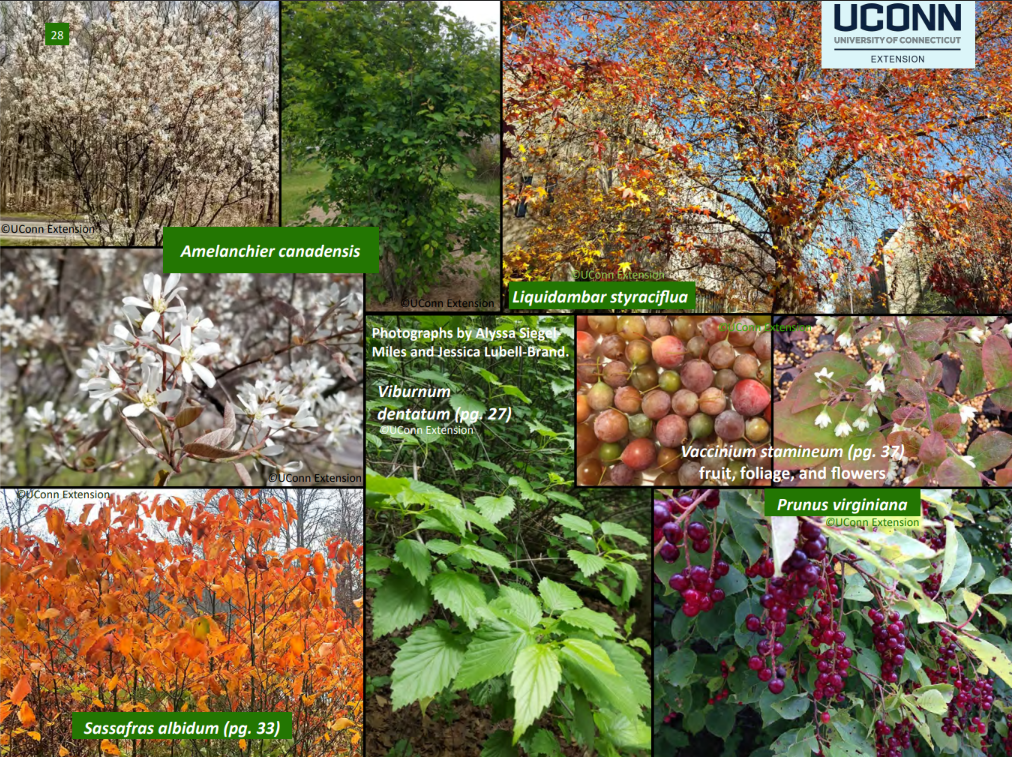
| Viburnum dentatum |
northern arrowwood |
white | May - June |
6-10' | M | Full sun, part shade | Adaptable; forms colony. Showy fruit. High susceptibility to Viburnum leaf beetles. Monitor for eggs after the first frost in fall or winter. |
YES |
Back to top

Page 29. SALT TOLERANT AND COASTAL-AREA TREES
All plants listed are native to northeastern United States unless otherwise noted.
| BOTANICAL NAME |
COMMON NAME |
FLOWER COLOR |
FLOWER TIME |
MATURE HEIGHT |
WATER NEEDS |
SUNLIGHT NEEDS |
WILDLIFE ATTRACTED |
NOTES | DEER RES. |
| Amelanchier arbore |
downy serviceberry |
white | March-April | 15-25' | M | Full sun, part shade | Remove root suckers to produce a more tree like form; otherwise will become shrubby. Attractive fall color, fragrant flower; edible red berries. Moderate deer resistance. | YES | |
| Amelanchier canadensis |
shadblow serviceberry |
white | April-May | 25-30' | M | Full sun, part shade | Attractive fall color, fragrant flower. Edible red berries. Tolerates air pollution. Multi-stemmed tree or large shrub. Larval host for striped hairstreak butterfly. Moderate deer resistance. | YES | |
| Amelanchier laevis |
Allegheny serviceberry |
white | April | 15-40' | D M | Full sun, part shade | Attractive fall color, fragrant flower; edible red berries. Prefers moist, well-drained, neutral to slightly acidic soils, but is adaptable to dry, poor, alkaline, compacted soils. | YES | |
| Chamaecyparis pisifera |
Japanese false-cypress |
3-20' | M | Full sun, part shade | N/A | The species (60' x 20') is rarely available in the nursery trade, but many small, medium, and large cultivars, from 3' to 20' tall, are available. Wind tolerant. Not native to U.S. | NO | ||
| Cupressus nootkatensis 'Pendula' |
weeping Alaskan cedar |
35' | M | Full sun, part shade | N/A | Syn. Chamaecyparis nootkatensis. Evergreen. Grow in average to acidic, well-drained soils. ‘Pendula' more common in the trade than the species. Royal Hort. Society & Cary Award winner. Native to N.W. U.S. | NO | ||
| Ginkgo biloba | ginkgo | green | April | 50-80' | D M | Full sun | N/A | Tolerant of a wide range of soil conditions. Dioecious - fruit from females have unpleasant odor. Good fall color. Not native to U.S. | YES |
| Gleditsia triacanthos f. inermis |
honey-locust | green-yellow, white |
May-June | 30-70' | D M | Full sun | Good street and parking lot tree. Tolerant of drought, air pollution, clay soil. F. inermis is a thornless and nearly seedpod-free variety. Native to southeast U.S. | YES | |
| Juniperus communis |
common juniper |
variable | D M | Full sun | Evergreen. Drought tolerant. Showy fruit. Grows in nutrient-poor soils. Wind tolerant. Select disease-resistant cultivars. | YES | |||
| Juniperus virginiana |
eastern red-cedar |
30-65' | D M | Full sun | Evergreen. Adapts to poor, droughty soils; pH adaptable. Very tough; screening, naturalizing, coastal planting. Best drought resistance of any conifer native to U.S. Moderate deer resistance. | YES | |||
| Liquidambar styraciflua |
sweet gum | yellow-green | April - May |
60-80’ | M | Full sun | Excellent shade, lawn or park tree. Tolerate a wide range of soils, including poor drainage and occasional flooding. Good fall color. Spiky fruit may be considered messy. Takes time to establish. | NO | |
| Prunus virginiana |
chokecherry | white | April - May |
20-30’ | D M | Full sun, part shade | Often forms thickets; parts of plant are toxic to animals. Tolerates salt spray. Prefers rich, moist soils, but will grow under a wide variety of soil types. Good fall color. Best flowering in full sun. | NO | |
| Quercus alba | white oak | yellow-green | May | 50-80' | D M | Full sun, part shade | Prefers rich, moist, acidic, well-drained soils. Tolerant of drought, rocky or clay soils. Large shade tree, street or lawn tree. Needs a large space in which to grow. Brown to dark red fall color. | NO |
Back to top

Page 31. TOUGH NATIVE TREES FOR CT LANDSCAPES
All plants listed are native to northeastern United States unless otherwise noted.
| BOTANICAL NAME |
COMMON NAME |
FLOWER COLOR |
FLOWER TIME |
MATURE HEIGHT |
WATER NEEDS |
SUNLIGHT NEEDS | WILDLIFE ATTRACTED |
NOTES | DEER RES. |
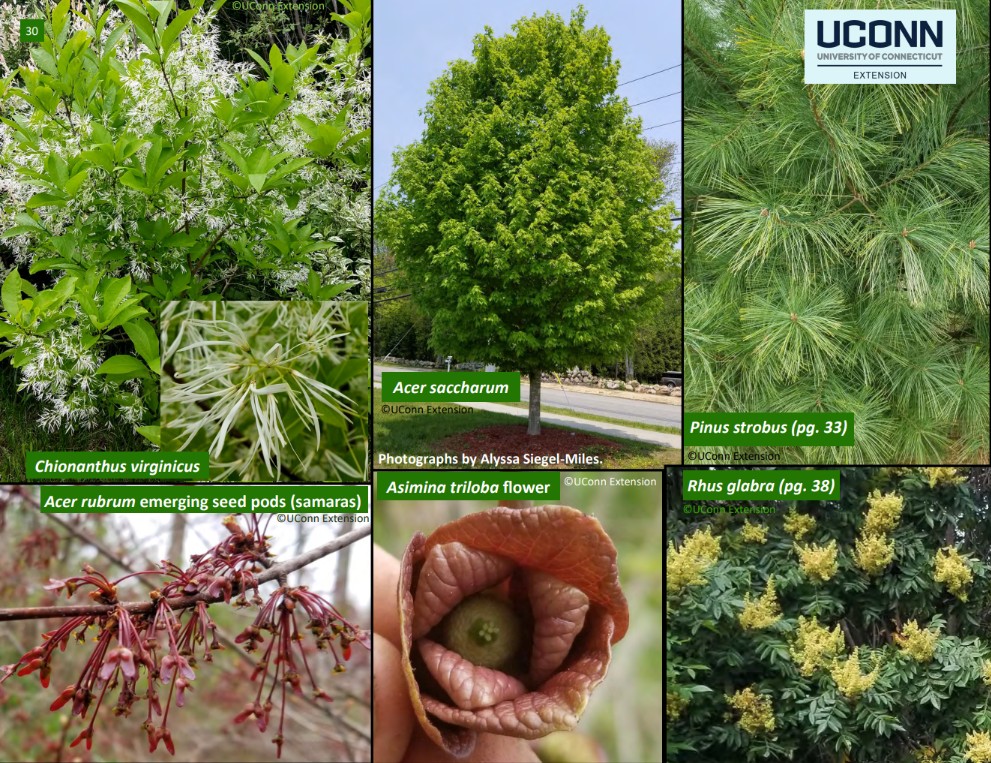
| Acer rubrum | red maple | red | March - April |
40-80' | D M W | Full sun, part shade | YES | ||
| Notes: Adaptable; tolerant of many conditions. Relatively fast growing. Red-orange showy fall color. Ornamental bark. Shallow roots. | |||||||||
| Acer saccharum |
sugar maple | yellow-green | April | 40-90’ | M | Full sun, part shade | |||
| Notes: Great fall color. Requires root space; great for parks. High heat, pollution, compaction intolerant. Native maples are important early food sources for bees; host plants to 284 caterpillars. | |||||||||
| Asimina triloba | pawpaw | purple | May | 15-30’ | M W | Full sun, part shade | YES | ||
| Notes: Edible fruit; tastes like banana/custard. Will spread by suckers. More than one (genetically distinct) plant required for fruit set. | |||||||||
| Betula lenta | sweet birch | brown, green |
April - May |
40-70’ | M | Full sun, part shade | Best in deep, rich, moist, acidic soils, in full sun; tolerates light shade. Sensitive to soil compaction. Good fall color (yellow). |
YES | |
| Betula nigra | river birch | brown, green |
April - May |
40-70' | M W | Full sun, part shade | Most adaptable, heat tolerant birch. Tolerates poor drainage. Ornamental bark provides winter interest. Less prone to storm damage than other native birches. Native to southeast U.S. |
YES | |
| Betula populifolia |
gray birch | brown, green |
April | 20-40 | M W | Full sun, Part shade | Ornamental bark provides winter interest. Intolerant of high heat, pollution. Fast growing; short-lived. Spreads by suckers. Alternate option to consider: Betula papyrifera. |
YES | |
| Carpinus caroliniana |
ironwood | white, green |
April | 20-30' | M | Part shade, full shade | Slow-growing. Prefers fertile, moist, acidic soil. Attractive bark. Sensitive to drought, heat, compaction. Mod. deer resistance. |
YES | |
| Carya ovata | shagbark hickory |
yellow green | April - May |
70-90' | M | Full sun, part shade | Adaptable to sand, clay. Showy, edible fruit. Good fall color. Deep taproot. Large trees may produce litter-twig, leaf, fruit (nut) drop. |
NO | |
| Cercis canadensis |
redbud | purple pink | April - May |
20-30' | M W | Full sun, part shade | Showy flowers appear before foliage. Prefers moist, well-drained soils. Avoid very dry, hot locations. Use as specimen or in small groups. Protect from strong wind. Good fall color (yellow). |
NO | |
| Chamaecyparis thyoides | Atlantic white cedar |
30-50' | M W | Full sun, part shade | N/A | Evergreen, narrow, columnar tree. Prefers full sun; sandy, peaty, moist to wet soils. Bluish-green needles. Preferred food for deer. |
NO | ||
| Chionanthus virginicus |
American fringetree |
white | May - June |
12-20’ | M | Full sun, part shade | Small tree or large shrub. Air pollution tolerant. Adapts well to urban settings. Fragrant flowers. Good fall color (yellow). Dioecious. Fruit Aug.-Sept. when both male and female plants present; valued by birds. Male flowers showier. Native to Southern U.S. |
NO | |
| Cornus alternifolia |
pagoda dogwood |
white | May - June |
15-25’ | M | Full sun, part shade | Small tree or large shrub. Fragrant flowers. Part shade best. Good fall color. Attractive horizontal branching. |
NO | |
| Cornus florida | dogwood | white, pink |
April - May |
15-30’ | M | Full sun, part shade | Prefers cool, moist, acidic soil and part shade. Select disease resistant cultivars. Ornamental fruit, bark - 4 season interest. Good fall color (red). Leaf litter decomposes rapidly, improving soil. Used for abandoned strip mines and urban forestry projects. |
YES | |
| Fagus grandifolia |
American beech |
yellow green | April - May |
50-80’ | M | Full sun, part shade | Best growth in moist, well-drained, acidic soils. Intolerant of wet or compacted soil. Prefers sun; will tolerate shade. Golden bronze foliage in fall. Forms colonies via root suckers in the wild. |
YES | |
Back to top

Page 33. TOUGH NATIVE TREES FOR CT LANDSCAPES
All plants listed are native to northeastern United States unless otherwise noted.
| BOTANICAL NAME |
COMMON NAME |
FLOWER COLOR |
FLOWER TIME |
MATURE HEIGHT |
WATER NEEDS |
SUNLIGHT NEEDS |
WILDLIFE ATTRACTED |
NOTES | DEER RES. |
| Ilex opaca | American holly |
white | May | 15-30' | M | Full sun, part shade | Evergreen. Slow growing. Dioecious. Females have attractive red berries. Male that blooms at same time needed for fruit set. |
YES | |
| Juglans nigra | black walnut | yellow green | May - June |
75-100’ | M | Full sun | Ornamental, edible nuts mature in autumn (large crops typically on 15+ yr. old trees). Allelopathic. Nut litter can be messy. |
NO | |
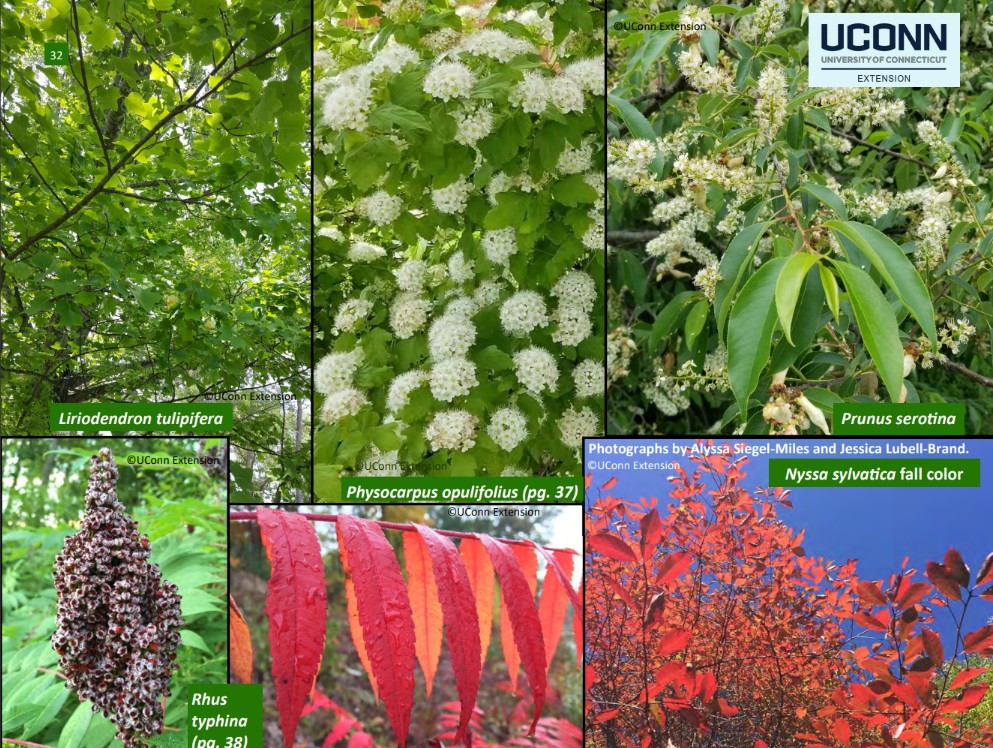
| Liriodendron tulipifera |
tulip tree | yellow, orange |
May - June |
70-90’ | M | Full sun | Large shade, lawn tree. Not recommended as a street tree. Fast-growing; susceptible to limb breakage in storms. Good fall color. | YES | |
| Magnolia virginiana |
sweetbay magnolia |
white | May - June |
10-35’ | D M V | Full sun, part shade | Soil must be acidic. Fragrant foliage, flowers; fruit and foliage ornamental. Not a heavy bloomer. Good specimen tree. |
YES | |
| Nyssa sylvatica | black tupelo |
yellow green | May - June |
30-50’ | M W | Full sun, part shade | Adaptable to varying conditions. Tolerates brief flooding. Good lawn or street tree. Slow growing. Site in location suitable for eventual size; difficult to transplant. Dioecious. Good fall color. |
NO | |
| Ostrya virginiana |
hop-hornbeam | red brown, green |
April | 25-40’ | D M | Full sun, part shade | Native habitat is dry woodland understory. Tolerates dry soils in part shade, once established. Slow growing. Avoid roadside– NOT salt tolerant. Fruit appears similar to fruit of hops. Ornamental bark. |
YES | |
| Oxydendrum arboreum |
sourwood | white | June - July |
25-30’ | M | Full sun, part shade | Good specimen, lawn tree. Excellent red fall color. Not pollution or drought tolerant. Slow growing. Native to southeastern U.S. |
YES | |
| Pinus strobus | eastern white pine |
50-80’ | M | Full sun, part shade | Evergreen. Prefers moist, well-drained, slightly acidic soil. Good specimen for parks or other large spaces. Fast-growing. |
YES | |||
| Prunus serotina |
black cherry | white | May | 60-90’ | D M | Full sun | Exceptional wildlife value; butterfly larval host. Fast-growing. adaptable. Edible fruit matures in August. Fragrant foliage. Used for reclamation of surface my spoil. Will self-seed. |
NO | |
| Quercus bicolor |
swamp white oak |
yellow green | April - May |
50-60’ | D M W | Full sun | Good lawn or street tree. Some drought tolerance but prefers swampy, low spots. Tolerates compaction and temporary flooded conditions. Good fall color. Oaks may be considered messy. |
NO | |
| Quercus rubra | northern red oak |
yellow green | May | 60-100' | D M W | Full sun, part shade | Best growth in well-drained, slightly acidic, sandy loam. Tolerates urban conditions: dry, acidic soil; air pollution; salt. One of the most shade tolerant and quick-growing oaks; can be transplanted. |
NO | |
| Quercus velutina |
black oak | yellow green | April - May |
50-60’ | D M | Full sun | All oaks have exceptional wildlife value. Good lawn or street tree. Slow growing. Oaks have a taproot; most are difficult to transplant. |
NO | |
| Sassafras albidum |
sassafras | yellow green | April - May |
30-60’ | D M | Full sun, part shade | Aromatic. Long tap root; difficult to transplant. Spreads by suckers. may colonize. Allelopathic. Dioecious. Excellent fall color. |
YES | |
| Thuja occidentalis |
arborvitae | 20-50' | M | Full sun, part shade | Evergreen. Best in full sun. Easily transplanted. Susceptible to drought injury. Avoid exposed, windy sites. Air pollution, heat tolerant when sited correctly. Protect young plants from deer. |
NO | |||
| Tilia americana |
American linden |
white, yellow |
June | 50-80’ | D M | Full sun | Wide-spreading branches form dense crown. Fragrant, nectarrich flowers. Best growth in moist, well-drained, loamy soils | NO |

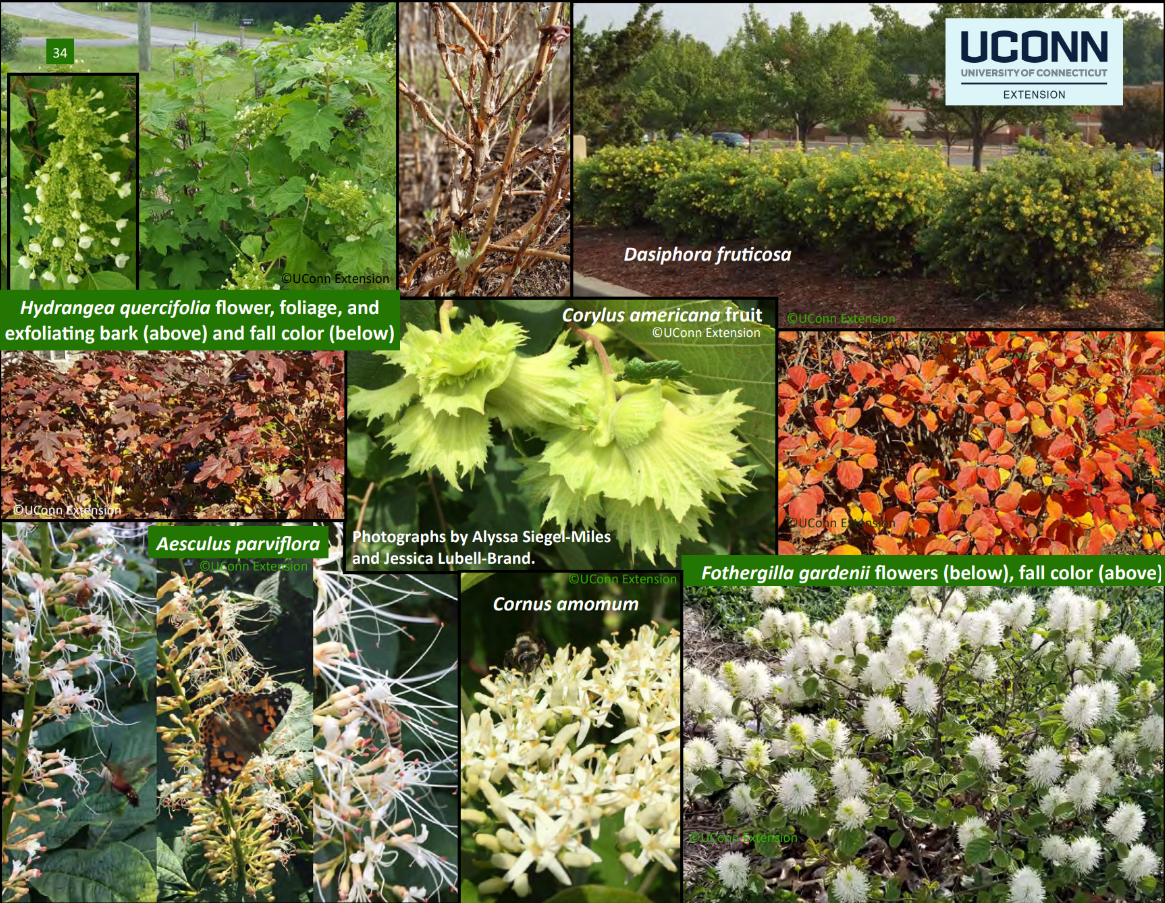
Page 35. TOUGH NATIVE SHRUBS FOR CT LANDSCAPES
All plants listed are native to northeastern United States unless otherwise noted.
| BOTANICAL NAME |
COMMON NAME |
FLOWER COLOR |
FLOWER TIME |
MATURE HEIGHT |
WATER NEEDS |
SUNLIGHT NEEDS |
WILDLIFE ATTRACTED |
NOTES | DEER RES |
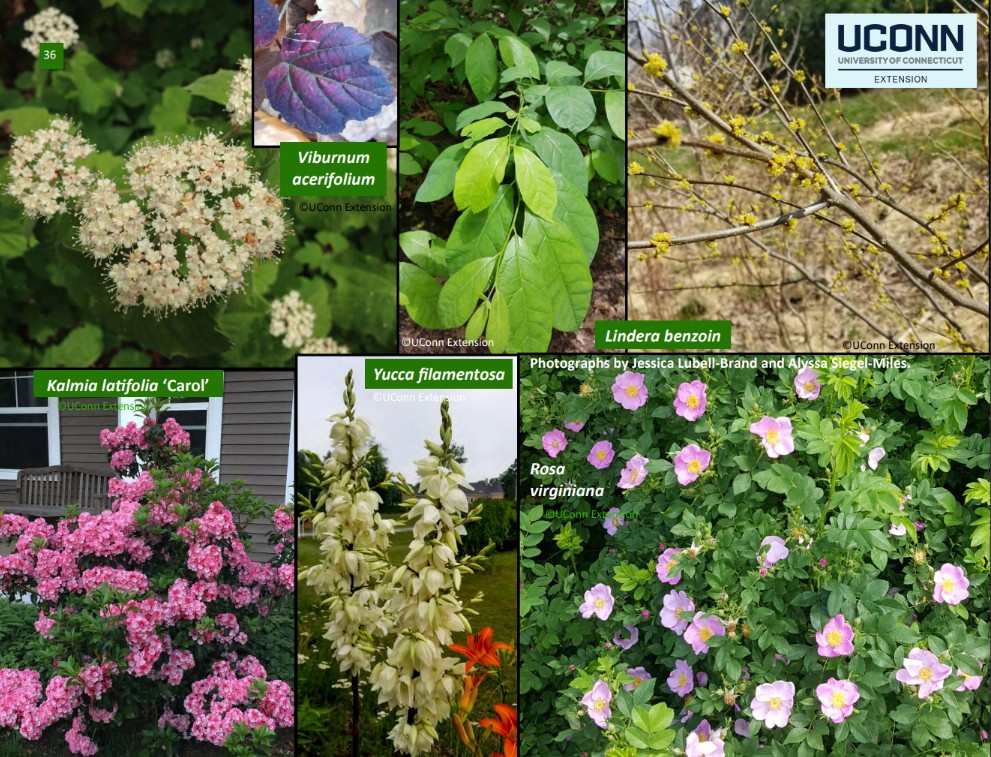
| Kalmia latifolia |
mountain-laurel | white, pink, red |
late May - June |
5-12’ | M | Full sun, part shade | Evergreen. Solution plant for dry, acidic shade locations. Requires a cool, moist, acidic, organic soil for best performance. Avoid windswept sites. CT state flower. |
YES | |
| Leucothoe fontanesiana |
dog hobble, drooping laurel |
white | May | 2-3’ | D M | Part shade, full shade | Evergreen. Good fall color; winter interest. Spreads by suckers; forms colonies. Erosion control; stabilizes banks. Provide winter mulch. Alt. option: L. axillaris. Native to southeast U.S. |
NO | |
| Lindera benzoin |
spicebush | yellow | March - April |
6-12' | M W | Full sun, part shade | Used as hedge, in rain gardens, woodland borders. Good fall color (best in full sun). Butterfly larval host plant. Fragrant. |
YES | |
| Lonicera canadensis |
American honeysuckle |
yellow | April - June |
5-8’ | M | Full sun, part shade | Valuable pollinator support species. Thrives in fertile, well-drained soil. Used in restoration of natural areas. | NO | |
| Myrica gale | sweet gale | yellow | March - May |
3’ | D M W | Full sun, part shade | Dense; candelabra shoots. Scented lime green foliage. Found in wet areas but performs well in much drier soils. Dioecious. |
NO | |
| Physocarpus opulifolius |
eastern ninebark |
white, pink |
May - June |
5-8’ | D M | Full sun, part shade | Attractive fall color and bark. Insect, disease resistant. Mass in borders; use as hedge. Erosion control. Mod. deer resistance. |
YES | |
| Rhododendron maximum |
rosebay rhodo-dendron |
pink, white |
June - July |
5-15' | M | Part shade, full shade | Evergreen. Maintain moist soil; well-drained soil essential. Shallow root system; mulch recommended to retain moisture. Alternate option: R. viscosum. |
NO | |
| Rosa virginiana |
Virginia rose | pink | June - August |
5-6' | D M | Full sun, part shade | Good choice for dry, sandy locations. Rose hips edible; persist into winter. Good fall color. Alternate option: R. palustris. |
NO | |
| Sambucus canadensis |
elderberry | white | June - July |
5-12’ | M W | Full sun, part shade | Good as informal hedge or massed. Attractive, edible fruit. Spreads by root suckers. Provides erosion control. |
NO | |
| Spiraea alba | meadow-sweet | white | June - August |
3-4’ | M W | Full sun, part shade | Good for naturalistic landscaping. Native to wet meadows. swamps. Butterfly larval host. Alternate option: S. tomentosa. |
YES | |
| Vaccinium stamineum |
deerberry | white | April - June |
3-6’ | D M | Full sun, part shade | Bluish foliage, red fall color. Dense mounded habit. Adaptable to dry, infertile full sun sites. Showy fruit. Drought tolerant. Moderate deer resistance. |
YES | |
| Viburnum acerifolium |
maple leaf viburnum |
white | June | 3-6’ | D M | part shade, full shade | Maple-like leaves. Black fruits; good fall color. Colonizing. Can be used as hedge. Prefers moist loams; tolerates wide range of soils. |
NO | |
| Viburnum cassinoides |
witherod viburnum |
creamy white |
May - June |
5-12’ | M W | Full sun, part shade | Less susceptible to viburnum leaf beetle than many other native viburnums. Can be hedged. Fragrant flower. Good fall color and persistent fruit. Alternates: V. nudum, V. trilobum. |
NO | |
| Yucca filamentosa |
Adam's needle |
creamy white |
June - July |
4-8’ | D M | Full sun | Fragrant, spectacular flowers. Architectural foliage. Use in parking lots, rock gardens, borders. Salt tolerant. Native to southeast U.S. |
NO |
Back to top
PLANTS FOR RECLAMATION AREAS
Plants listed have the ability to prevent soil erosion, fix nitrogen, improve soils, and/or extract toxins from the soil. All are native to N.E. U.S. except where noted.
| BOTANICAL NAME |
COMMON NAME |
FLOW. COLOR |
FLOWER TIME |
MAT. HEIGHT |
WATER NEEDS |
SUNLIGHT NEEDS |
WILDLIFE ATTRACTED |
NOTES *Glossary of abbreviations is on pg. 3 |
DEER RES. |
| Agrostis gigantea |
red top | silver-red | June - July |
2-3’ | M W | Full sun | Perennial grass. Valuable species to recapture very acidic sites, land polluted by heavy metals, such as mine spoils. and locations with poor soil quality. Provides erosion control. Not Native to U.S. |
YES | |
| Bouteloua curtipendula |
sideoats grama |
purplish | July - August |
1.5-2.5’ | D M | Full sun, part shade | Perennial grass. Tolerates wide range - sandy to clay soils. Good erosion control. Self-seeds in in optimum growing conditions. Attractive inflorescence into fall. Good fall color. Also forage grass. |
YES | |
| Elymus canadensis |
Canada wild rye |
green | July - Sept. |
2-5’ | D M | Full sun, part shade | Perennial grass. Self-seeds. Good ground cover for dry, sunny slopes. Foliage and flower/seed spikes lend aesthetic interest. CS. |
YES | |
| Eupatorium perfoliatum |
American boneset |
white | July - Sept. |
4-6’ | M W | Full sun, part shade | Perennial. Needs constant moisture. Pair with native grasses; colonizes moist, recently disturbed sites. Quick growth stabilizes the soil surface. |
YES | |
| Festuca ovina | sheep fescue |
green | May - June |
1-2’ | D M | Full sun, part shade | Perennial grass. Bunch-type. Does well in full sun or shade. Drought tolerant; improved drought tolerance when left unmown or planted in shade. Tolerates soils of low fertility. Not Native to U.S. CS. |
YES | |
| Scolochloa festucacea |
tall fescue | green | May - June |
2-3’ | D M W | Full sun | Perennial grass. Syn. Festuca arundinacea. Dense root system minimizes soil erosion. Establishes quickly. Does well in sandy, dry soils; strong drought and heat tolerance. Can tolerate wet soils. Good salt tolerance and roadside value. Not native to U.S. CS. |
YES | |
| Rhus typhina; Rhus glabra |
staghorn sumac. smooth sumac |
greenish - white |
June - July |
10-20’ | D M | Full sun, part shade | Shrub. Showy fruit provides winter interest and supports beneficial wildlife. Excellent fall color. Aggressively forms thickets by self-seeding and root suckering. Dioecious. Provides erosion control on slopes or in hard-to-cover areas with poorer soils. |
YES | |
| Salix discolor |
pussy willow |
green - yellow |
March - April |
6-15' | M W | Full sun, part shade | Shrub. Dioecious. Male trees produce showy catkins on leafless stems in early spring. Cost-effective stabilizer for disturbed landscapes, phytore mediation, erosion control, and biomass production. Also useful for garden settings. Nectar-rich, early season flowers for many pollinators. |
YES | |
| Salix nigra | black willow |
greenish - yellow |
March - April |
30-60’ | M W | Full sun, part shade | Tree. Tolerates flooding, silting. Shallow, spreading root system stabilizes soils; effective for erosion control. Prefers full sun. Highly resistant to several toxic metals; accumulated more metals than other species . Not recommended for residential landscapes-weak wood, pests. |
||
| Senna hebecarpa |
wild senna | yellow | July - August |
4-6’ | M | Full sun | Perennial. Versatile. Attractive flower, foliage, and seed pods in fall. Good fall color. Horizontal root system provides strength against winds. Can be used as a hedge. Host plant for sulphur butterflies. Fixes nitrogen. |
YES |
Other Plants for Reclamation Areas: Alnus incana ssp. rugosa, Asclepias syriaca, Carex crinita, Chamaecrista fasciculata, Cornus amomum, Cornus florida, Cornus racemosa, Dactylis glomerata, Festuca rubra, Lolium perenne, Lonicera canadensis, Lotus corniculatus, Panicum virgatum, Parthenocissus quinquefolia, Prunus serotina, Quercus rubra, Schizachyrium scoparium, Sorghastrum nutans
Back to top
PASTURE CROPS
Not native to U.S. unless noted. Proper fertilization is imperative to maintaining high quality forage in pastures. Performing a soil test before selecting and planting pasture plants is essential to accurately determine the nutrients needed and pH of the soil. Information about soil testing is available at www.soiltest.uconn.edu.
| BOTANICAL NAME |
COMMON NAME |
FLOWER COLOR |
FLOWER TIME |
MATURE HEIGHT |
WATER NEEDS |
SUNLIGHT NEEDS |
WILDLIFE ATTRACTED |
NOTES *Glossary of abbreviations is on pg. 3 |
| Bromus biebersteinii |
meadow brome |
green | June | 2-5’ | D M | Full sun, part shade | Perennial grass. Pasture, hay; highly palatable. Adapted to broad range of soil conditions. Thrives in fertile, well-drained soils. Good erosion control. CS. |
|
| Dactylis glomerata |
orchard grass |
green | May - Sept. |
1.5-4’ | D M W | Full sun, part shade | Perennial grass. Quick spring establishment. Valuable for high nutritional yield. Recovers quickly after grazing or mowing. More coarse, less palatable as it matures. Mixes well with legumes. Maintain soil pH 6.0-7.0. CS. |
|
| Lolium perenne (forage-type) |
perennial ryegrass |
green | May - July |
1-2' | M W | Full sun | Perennial grass. Quick establishment; high yield. Valuable for grazing, hay, or silage and soil stabilization. Good source of protein. Wide range of adaptability; thrives on fertile, well-drained soils. Compatible with legumes. |
|
| Lotus corniculatus |
birdsfoot trefoil |
yellow | June - Sept. |
0.5-2’ | D M | Full sun, part shade | Perennial legume. Green chop, hay, and pasture. Seed in combination with grass. Non-bloating. Less productive than alfalfa on fertile well-drained soils; performs well on soils too shallow or too poorly drained for alfalfa. Also used in roadside mixtures to help with soil stabilization. May become weedy or invasive if not properly managed. |
|
| Medicago sativa |
alfalfa | purple, yellow |
May - October |
2-3’ | D M | Full sun | Perennial legume. Harvested as hay; nutritious forage. Grown with grasses. Caution required due to high bloat hazard. Prevent self-seeding; potential invasiveness. Deep taproot loosens compacted soil; also good cover crop. For soil pH > 6.5. Moderate salt tolerance. |
|
| Phleum pratense |
timothy | green | July | 2-4' | M W | Full sun | Perennial grass. Thrives in cool, moist areas. Tolerates acidity, wetness, and some flooding. Avoid sandy soils. Best pH 5.4-6.2. Use for hay, silage and pasture. Harvest for hay before blooming to preserve protein quality. Grow with alfalfa, trefoil, or clover. Also used for erosion control. CS. |
|
| Poa pratensis (forage-type) |
Kentucky bluegrass |
green | May - July |
1-2.5’ | M W | Full sun | Perennial grass. Rhizomes form dense sod. Highly palatable. Tolerates close and frequent grazing; a component of continuously grazed permanent pastures. Heat limits production in summer. Provides erosion control. CS. |
|
| Trifolium hybridum |
alsike clover |
pale pink |
June - Sept. |
2-4’ | M W | Full sun, part shade | Perennial legume. NOT for horses. Bloat potential for cattle. Uses: hay, pasture, cover crop - soil improvement. Preferred for very wet or acidic soils. Grows well in mixtures with low growing grasses (e.g., timothy), red clover. |
|
| Trifolium pratense |
red clover | pink purple | May - Sept. |
0.5-2' | M W | Full sun, part shade | Biennial legume or short-lived perennial. Quick-growing, high quality forage. Maximum yields in soil with pH of 6.0+. Will grow moderately well in slightly acid and poorly drained soils. Thick, well-branched taproot. Select disease resistant varieties. May be planted alone or with grasses. May be planted as a cover crop under silage corn. Should be inoculated. |
Other plants for pastures: Agrostis gigantea, Avena sativa, Bouteloua curtipendula, Elymus canadensis, Fagopyrum esculentum, Festuca ovina, Scolochloa festucacea (forage-type), Secale cereal, Sorghum bicolor (forage-type), Trifolium incarnatum, Trifolium repens, Triticum aestivum.
Back to top
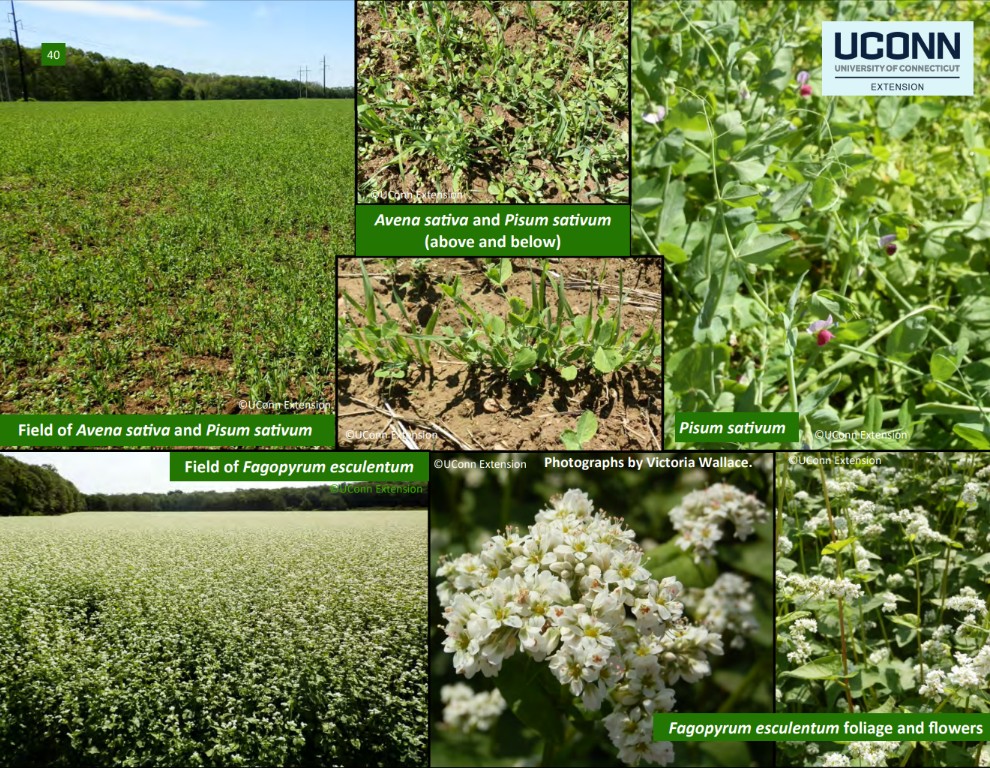
Page 41. COVER CROPS
All cover crops listed are not native to the U.S. Cover crops are used to slow erosion, improve soil health, enhance water availability, smother weeds, help control pests and diseases, increase biodiversity and bring a host of other benefits to a farm, home, vegetable garden, or other growing area. Most cover crops must be cut down when they begin to flower to prevent them from spreading unwanted seed. Legume cover crops are used to: fix atmospheric nitrogen for use
by subsequent crops, reduce or prevent erosion; produce biomass and add organic matter to the soil; and attract beneficial insects.
| BOTANICAL NAME |
COMMON NAME |
FLOWER COLOR |
FLOWER TIME |
MATURE HEIGHT |
WATER NEEDS |
SUNLIGHT NEEDS |
WILDLIFE ATTRACTED |
NOTES *Glossary of abbreviations is on pg. 3 |
| Avena sativa | oats | green - blue |
summer | 1-4’ | D M | Full sun | Annual. Suppresses weeds, stabilizes soil, pulls up excess nutrients, adds biomass. Mixes well with clover, pea, vetch, other legumes or other small grains. For winter cover, sow by early Sept. CS. |
|
| Fagopyrum esculentum |
common buckwheat |
white | July – Sept. |
5' | M | Full sun, part shade | Annual. Quick-growing green manure. Grown as grain crop, soil improver, wildlife cover, weed suppressor, topsoil loosener. Rejuvenates low fertility soils. Sow late May-July; till 1 month after germination, after flowering. WS. |
|
| Pisum sativum |
field peas | purple, white |
spring or fall |
3-4’ | M | Full sun, part shade | Annual. Legume. High nitrogen fixer. Sow in spring or fall to reduce weeds. Grow alone or mixes well with vetch, oats, or rye; grasses provide vertical support. Flowers provide early and long-blooming nectar for bees. SA or WA. |
|
| Raphanus sativus |
oilseed radish |
white, pale violet |
June - August |
0.5-1’ | D M | Full sun | Annual. Reduces compaction. Long taproot aerates soil, draws nutrients to the surface. Use as alternative to tillage. Avoid using in close rotation with other brassica family crops (increased pests, disease pressure). |
|
| Secale cereale |
cereal ryegrass |
green | May-July | 6’ | D M | Full sun, part shade | Annual. Very hardy; can be seeded later into fall than other cover crops. Grows well in sandy, infertile, or acidic soil. Pair with a winter annual legume to offset nitrogen intake. Prevents soil erosion and adds organic matter. Do not allow to set seed (seeds ripen Aug-Sept). CS. |
|
| Sorghum bicolor x S. bicolor var. sudanese |
sorghum-sudangrass | yellow, brown |
August - October |
5-12’ | D M | Full sun | N/A | Annual. Most heat and drought-tolerant cover crop for Northeast U.S. Requires warm soil to germinate. Large biomass producer; reduces compaction; weed suppressor. Mow when stalks 3-4’ to encourage deeper root growth. |
| Trifolium incarnatum |
crimson clover |
red | May | 1–3' | D M | Full sun | Annual. Legume. Fast, vigorous grower. Nitrogen source, soil builder, erosion prevention, ground cover, forage. Grows well in combination with rye, vetches, red clover, black medic. 70-90 days to maturity. WA. |
|
| Trifolium repens |
white clover |
white | May - June |
0.25-0.5’ | D M W | Full sun, part shade | Perennial. Legume. Dutch white clover most commonly available by seed. Spreads aggressively by stolons and seed. Popular for home gardens. |
|
| Triticum aestivum |
wheat | green | June-July | 5’ | D M | Full sun, part shade | Annual. Widely used for temporary pasture crop. Do not allow to set seed (seeds ripen Aug-Sept). CS. |
|
| Vicia villosa | hairy vetch | purple | April - October |
10’ | D M | Full sun | Annual. Legume. Nitrogen source, weed suppressor, topsoil conditioner. Sow spring, late summer or fall. Grow alone or mix with grain, grass, or field peas. Vigorous spring growth of fall-seeded vetch out-competes weeds. SA or WA. |
Other cover crops: Elymus canadensis, Lotus corniculatus Medicago sativa, Senna hebecarpa, Trifolium hybridum, Trifolium pratense.
Back to top
Inclusion in this document does not equate endorsement. Those vendors that are listed as having “natives available” also sell non-native species.
| COMPANY NAME | ADDRESS | PHONE | WEBSITE | PRODUCTS |
| Atlantic Golf & Turf | 27 Industrial Blvd., Turners Falls, MA | (413) 863-4444 | atlanticgolfandturf.com | Wholesale. Seed. Natives available. |
| Ballek’s Garden Center | 90 Maple Ave., East Haddam, CT | (860) 873-8878 | balleksgardencenter.org | Retail. Container plants. Natives available. |
| Bell Nurseries | 1301 Hartford Tpke., North Haven, CT | (203) 248-5086 | bellnurseriesct.com | Retail. Container plants. Natives available. |
| Blue Moon Farm Perennials | 173 Saugatucket Rd., Wakefield, RI | (401) 284-2369 | bluemoonfarmperennials.com | Retail. Container plants. Primarily natives. |
| Broken Arrow Nursery | 13 Broken Arrow Rd., Hamden, CT | (203) 288-1026 | Welcome to Our Nursery Broken Arrow Nursery | Retail. Container plants. Natives available. |
| Canterbury Horticulture | 351 Brooklyn Rd., Canterbury, CT | (866) 287-0893 | anterburyhorticulture.com | Wholesale. Container plants. Natives available. |
| Eden’s Natives | Tolland, CT | (860) 325-2012 | EdensNativeNursery on FB | Retail. Container plants. Local eco-type natives. |
| Earth Tones Native Plant Nursery | 212 Grassy Hill Rd., Woodbury, CT | (203) 263-6626 | earthtonesnatives.com | Retail. Container plants. Exclusively natives. |
| Ernst Seeds | 8884 Mercer Pike, Meadville, PA | (1-800) 873-3321 | Ernst Conservation Seeds offers hundreds of species of native & naturalized seeds & live plant materials | Retail. Seed. Natives available. |
| Farmer’s Daughter | 716 Mooresfield Rd., S. Kingstown, RI | (401) 792-1340 | thefarmersdaughterri.com | Retail. Seed & container plants. Natives available. |
| F.M. Brown’s | 205 Woodrow Ave., Sinking Spring, PA | (1-800) 334-8816 | fmbrown.com | Retail. Seed. Conservation grasses; cover crops. |
| Garden in the Woods | 180 Hemenway Rd., Framingham, MA | (508) 877-7630 | nativeplanttrust.org | Retail. Container plants. Exclusively natives. |
| Judge’s Farm Perennials | 3 Old Shore Rd., Old Lyme, CT | (860) 434-0822 | Judge's Farm – Premium Wholesale Plants | Wholesale. Container perennials. Natives available. |
| Lavoie Horticulture | East Granby, CT | (413) 355-0200 | lavoiehorticulture.com | Retail. Seed and container plants. Natives available. |
| Monrovia | 41 Floydville Rd., Granby, CT | (860) 844-6051 | monrovia.com | Wholesale. Container plants. Natives available. |
| Nasami Farm | 128 North St., Whately, MA | (413) 397-9922 | nativeplanttrust.org | Retail. Container plants. Exclusively natives. |
| Native | 2940 Redding Rd., Fairfield CT | (203) 658-7475 | anativeplantnursery.com | Retail. Container plants. Exclusively natives. |
| Natureworks | 518 Forest Rd., Northford, CT | (203) 484-2748 | naturework.com | Retail. Container plants. Natives available. |
| New England Wetland Plants | 820 West St., Amherst, MA | (413) 548-8000 | newp.com | Wholesale. Seed & container plants. Natives focus. |
| North Creek Nurseries | 388 North Creek Rd., Landenberg, PA | (610) 255-0100 | northcreeknurseries.com | Wholesale. Container plants & plugs. Natives focus. |
| Perennial Harmony Garden Center | East Lyme, CT | (860) 961-4439 | facebook.com/perennialharmony | Retail. Landscaping. Natives available. |
| Planters’ Choice Nursery | Newtown, CT and Watertown, CT | (203) 426-4037 | planterschoice.com | Wholesale. Container plants. Natives available. |
| The Plant Group Perennial Nursery | 117 Pond Rd., Route 207, Franklin, CT | (1-800) 864-2670 | plantgroupnursery.com | Wholesale. Container perennials. Natives available. |
| Prides Corner Farms | 122 Waterman Rd., Lebanon, CT | (1-800) 437-5168 | pridescorner.com | Wholesale. Container plants; B&B. Natives available. |
| Rhody Native | Kingston, RI | (401) 874-5807 | rhodynative.org | Wholesale. Retail options. Exclusively natives. |
| Sam Bridge Nursery & Greenhouse | 437 North St., Greenwich, CT | (203) 869-3418 | sambridge.com | Retail. Container plants. Natives available. |
| Sprucedale Gardens | 20 E. Quasset Rd., Woodstock, CT | (860) 974-0045 | sprucedalegardens.com | Retail. Container plants. Natives available. |
| Summer Hill Nursery | 888 Summer Hill Rd., Madison, CT | (203) 421-3055 | summerhillnursery.com | Wholesale. Container plants. Natives available. |
| Toadshade Wildflower Farm | 53 Everittstown Rd., Frenchtown, NJ | (908) 996-7500 | toadshade.com | Retail. Mail-order container plants. Exclusiv. natives. |
| Warner Nursery | 76 Riverside Rd., Simsbury, CT | (860) 651-0204 | warnernursery.com | Retail. Container plants. Natives available. |
| Wild Seed Project | Portland, Maine; info@wildseedproject.net | wildseedproject.net | Retail. Seed. Exclusively natives. | |
| Winterberry Gardens | 2070 West St., Southington, CT | (860) 378-0071 | winterberrygardens.com | Retail. Container plants. Natives available. |
Back to top
BIBLIOGRAPHY AND RESOURCES
WEBSITES:
UConn Integrated Pest Management Program. ipm.cahnr.uconn.edu
UConn Home and Garden Education Center. homegarden.cahnr.uconn.edu
UConn College of Agriculture, Health and Natural Resources Plant Database. hort.uconn.edu
CT NEMO. Rain gardens; stormwater management. nemo.uconn.edu
Center for Land Use Education and Research. clear.uconn.edu
CT Sea Grant. seagrant.uconn.edu
CT Agricultural Experiment Station. Pollinator Resources. portal.ct.gov/CAES/Publications/Publications/Pollinator-Information
Pollinator Pathways CT Native Plant Lists. pollinator-pathway.org
Native Plant Trust Plant Search. plantfinder.nativeplanttrust.org/Plant-Search
Go Botany. Simple and Advanced Plant ID. gobotany.nativeplanttrust.org/
Fire Effects Information System (FEIS). Index of Species Information. feis-crs.org/feis
World Flora Online. A Working List of All Known Plant Species. wfoplantlist.org
North Carolina Extension Gardener Plant Toolbox. plants.ces.ncsu.edu
Rhody Native; Rhode Island Native Plant Society. rinhs.org/projects-and-publications/rhody-nativetm
U.S. Department of Agriculture, Natural Resources Conservation Center Plants Database. plants.sc.egov.usda.gov
CT Botanical Society. ct-botanical-society.org
Sustainable CT. sustainablect.org
Audubon Native Plant Database. audubon.org/plantsforbirds
CT Northeast Organic Farming Association. ctnofa.org/ecotypeproject
Plants for Pollinators. University of Minnesota. Department of Horticultural Sciences. Display and Trial Garden. plantsforpollinators.weebly.com
Illinois Wildflowers. illinoiswildflowers.info
Lady Bird Johnson Wildflower Center. wildflower.org
Missouri Botanical Garden Plant Finder. missouribotanicalgarden.org
Sustainable Agriculture Research & Education. Cover Crops for Sustainable Crop Rotations. sare.org/resources/cover-crops
[1] Cornell University, Managing Viburnum Leaf Beetles. cals.cornell.edu/insect-diagnostic-laboratory/factsheets#pest
Penn State Extension. Rain Garden Plants. extension.psu.edu/trees-lawns-and-landscaping/home-gardening/eco-friendly-gardening
NewCROP, the New Crop Resource Online Program. Center for New Crops & Plant Products. Purdue University. hort.purdue.edu/newcrop
Plant Spacing Calculator. midwestgroundcovers.com/plant/calculator
BOOKS AND ARTICLES:
Barrett, J. 2011. Connecticut Coastal Planting Guide. Connecticut Sea Grant, University of Connecticut. seagrant.uconn.edu
Burghardt, K. T., D. W. Tallamy, and W. G. Shriver. 2009. Impact of Native Plants on Bird and Butterfly Biodiversity in Suburban Landscapes. Conservation Biology. Vol. 23, No. 1 (Feb.,
2009), pp. 219-224. JSTOR, jstor.org/stable/29738707.
Clausen, R. R. 2013. 50 Beautiful Deer-Resistant Plants. Timber Press. Portland, OR; London, UK. Print.
Dole, C.H. Ed. 2003. The Butterfly Gardener's Guide. Brooklyn Botanic Garden. Brooklyn, NY. Print.
Dunne, N. Ed. 2009. Great Natives for Tough Places. Brooklyn Botanic Garden. Brooklyn, NY. Print. bbg.org/gardening/handbook/great_natives_for_tough_places
Fiedler, A., et al. 2007. Attracting Beneficial Insects with Native Flowering Plants. Michigan State U. Extension.
[2] Kuzovkina, Yulia A. and M. F. Quigley. 2001. Willows Beyond Wetlands: Uses of Salix L. Species for Environmental Projects. Department of Horticulture and Crop Science, The Ohio
State University, 2001 Fyffe Court, Columbus, OH 43210, U.S.A. www.researchgate.net/publication/226165275_Willows_Beyond_Wetlands_Uses_of_Salix_L_Species_for_Environmental_Projects
[3] Kuzovkina, Yulia A., M. Knee, and M. F. Quigley. 2004. Cadmium and Copper Uptake and Translocation in Five Willow (Salix L.) Species. International Journal of Phytoremediation, 6:3, 269-287. www.tandfonline.com/doi/full/10.1080/16226510490496726
Lubell-Brand, J. 2013. Native Shrubs: Guide to Landscape Uses. University of Connecticut, Storrs, CT. cipwg.uconn.edu
MacDonagh, P. and N. Hallyn. 2010. Native seed mix design for roadsides. St. Paul, MN: Minnesota Department of Transportation, Research Services Section.
Marinelli, J. Ed. 2008. The Wildlife Gardener's Guide. Brooklyn Botanic Garden. Brooklyn, NY. Print.
Rainer, T. and C. West. 2015. Planting in a Post-Wild World. Timber Press. Portland, OR. Print.
Salon, P. A. and C.F. Miller. 2012. A guide to conservation plantings on critical areas for the Northeast. Washington, D.C.: U.S. Dept. of Agriculture, Natural Resources Conservation Service. nrcs.usda.gov/Internet/FSE_PLANTMATERIALS/publications/nypmspu11417.pdf
Siegel-Miles, A., P. Picone, V. Wallace, and S. Tomis. 2026 Native Perennial, Tree and Shrub Availability List. 20 pp. ipm.cahnr.uconn.edu/connecticut-native-availability
Stoner, K. A Citizens’ Guide to Creating Pollinator Habitat in Connecticut. Connecticut Agricultural Experiment Station.
[4] Tallamy, D. 2009. Bringing Nature Home: How You Can Sustain Wildlife with Native Plants, Updated and Expanded. Timber Press. Portland, OR. Print.
Withrow-Robinson, B. and R. Johnson. 2006. Selecting native plant materials for restoration projects. Oregon State University Extension Service. EM 8885-E. November 2006.
Xerces Society for Invertebrate Conservation. Pollinator Plants. xerces.org/sites/default/files/2018-05/17-051_03_XercesSoc_PollinatorPlants_Northeast-Region_web-4page.pdf
Zimmerman, Catherine B. 2010. Urban & Suburban Meadows: Bringing Meadowscaping to Big and Small Spaces. Silver Spring, MD: Matrix Media. Print.