The western flower thrips (WFT), Frankliniella occidentalis, is a difficult to control pest for greenhouse growers. Their small size (1/16 inch) and tendency to remain hidden in flower buds makes it difficult to detect the thrips before severe feeding damage is evident. Thrips feed by piercing plant cells with their mouthparts and feeding on the exuded plant juices. This collapse of plant cells may result in deformed flowers, leaves and shoots. Silvery-flecked scars or small black "fecal" spots may be seen on the expanded leaves. In addition to direct feeding injury, WFT may vector (spread) two closely related tospoviruses; impatiens necrotic spot virus (INSV) and tomato spotted wilt virus (TSWV), to uninfected plants. Rapid development of resistance to many commonly used insecticides has also made thrips difficult to control. The target audience of this fact sheet is commercial greenhouse growers.
Biological Controls
Predatory mites, predatory bugs, entomopathogenic (causing disease in insects) nematodes and entomopathogenic fungi can all be used in your biological control program. Dalotia coriara and Stratiolaelaps scimitus that are primarily used against fungus gnat larvae will also feed upon thrips pupae found in the growing media. (Previous names are Atheta coriaria and Hypoaspis miles, respectively.) See Biological Control of Fungus Gnats for more information.
Neoseiulus (Amblyseius) cucumeris
Neoseilus (Amblyseius) cucumeris is a small, generalist predatory mite that feeds upon young 1st instar thrips larvae. Second instar thrips are too large for the predatory mites to kill. However, Canadian researchers found that the second instar thrips spend less time feeding (about 30% in this study) even if they aren’t killed so that thrips-feeding damage to plants was reduced.
Because N. cucumeris only preys on the young thrips larvae, it is important to start releases preventively, at planting, before thrips are detected. N. cucumeris also eats pollen, and preys upon spider mites, broad mites, and cyclamen mites. Adult predatory mites live for about 3 weeks. Their development from egg to adult takes 8 days at 77 ˚F and 11 days at 68 ˚F.
N. cucumeris is available in slow release mini-sachets that consist of bran, whitish mold mites (that feed upon the bran), and N. cucumeris which prey upon the mold mites. N. cucumeris is sold with a carrier containing mold mites as a food source. Food storage mites or mold mites are white, covered with fine hairs, and move more slowly than the fast-moving tan, predatory mites (see photo). Sachets should contain about one predatory mite to 10 mold or food storage mites.
Even though there are food mites in the sachets, the predatory mites will move into the crop to prey on the thrips. Predatory mites should emerge from the sachets into the crop for 4 to 6 weeks. Place 1 mini-sachet per hanging basket or 1 to 4 mini-sachets per shuttle tray.
Research has shown that these mini-sachets are best placed in the plant canopy where they are protected from bright sunlight. If the mini-sachets are placed in bright sunlight, high temperatures and low relative humidity in the sachets adversely affects the reproduction and egg hatch of the predatory mites. (Eggs will shrivel and die at low relative humidity). If mini-sachets are placed within the plant canopy, the temperature peaks less, and there is higher relative humidity needed for the reproduction of these predatory mites.
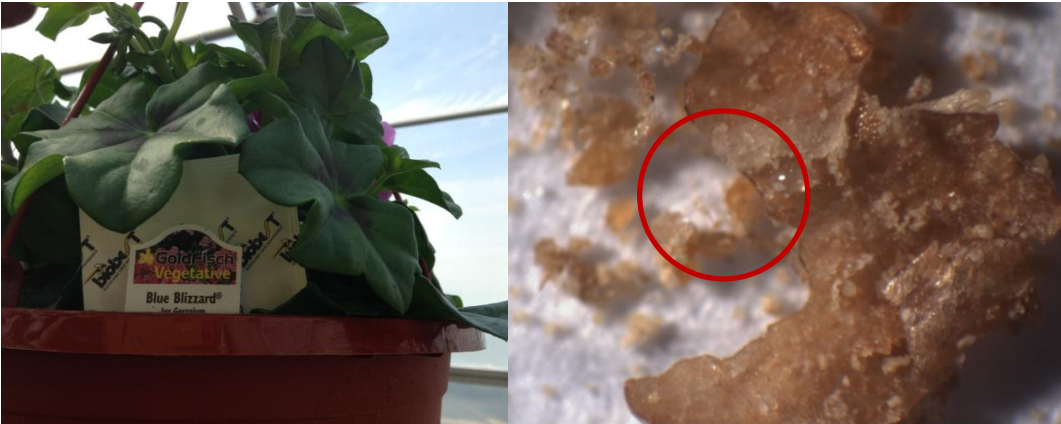
N. cucumeris is also available in bulk with a bran carrier that can be placed on the foliage or with a vermiculite carrier so that the mites can be blown onto the plant foliage with a mite blower in propagation houses.
Tips for Using Neoseiulus (Amblyseius) cucumeris
- If using mites with a carrier, rotate and shake tube slightly to distribute the mites evenly in the bran before release.
- If using mini-sachets, check periodically for living predatory mites (N. cucumeris will be tan in color. The storage mites will be white). Empty the contents of the sachet on a piece of white paper. N. cucumeris also tend to move more quickly.
- Place mini-sachets in the plant canopy so they are shaded.
- Optimum conditions are temperatures between 75 and 85˚ F and relative humidity levels greater than 65% (ideally 75%).
- Consult with your supplier for information on recommended release rates.
Amblyseius swirskii (Swirski mite)
The generalist predatory mite, Amblyseius swirskii, feeds upon thrips, whiteflies, broad mites, spider mites and pollen in the absence of prey. Both A. swirskii and N. cucumeris feed upon first instar thrips larvae, however, A. swirksii is more expensive than N. cucumeris.
Researchers compared the releases of N. cucumeris to A. swirskii and found that during winter conditions (short days) both species reduced thrips and controlled heavy thrips feeding damage on chrysanthemum. So, it is more economical for growers to use N. cucumeris under winter conditions.
During summer conditions with higher temperatures, light intensity and long days, releases of A. swirksii resulted in more predation of thrips and egg-laying than releases of N. cucumeris. Consider releases of A. swirskii during warm summer temperatures (70 ˚F to 80˚ F) and a relative humidity of 70 %. This generalist predatory mite is available in an inert carrier, in a breeding system with an inert carrier and storage mites, as individual sachets or as sachets in ribbons or strips. Consult with your supplier for recommended release rates. They are not suitable for use on greenhouse tomatoes.
Stratiolaelaps scimitus
Stratiolaelaps scimitus is a soil-dwelling predatory mite that feed upon pupal stages of thrips in the soil as well as fungus gnat larvae. A single preventive release to the media at planting is generally recommended to supplement control with N. cucumeris.
Orius (Minute Pirate Bugs) (Orius species)
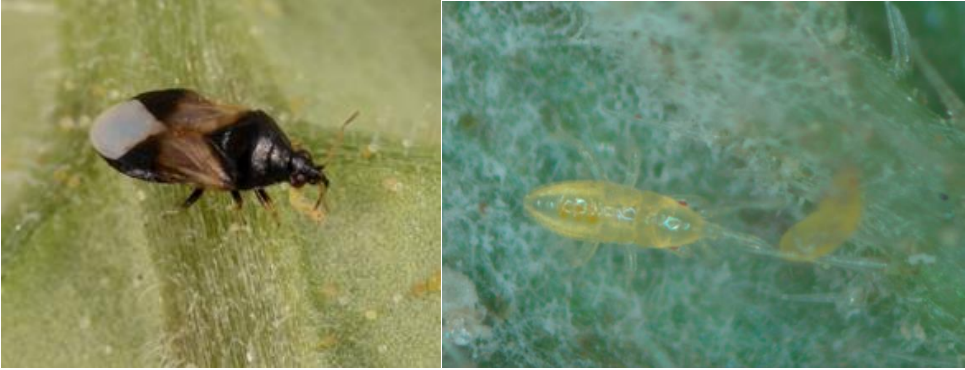
Orius species commonly known as minute pirate bugs or insidious flower bugs feed upon both larval and adult thrips, aphids, spider mites and other small arthropods. Minute pirate bugs need pollen as a food source and can be slow to establish (up to 8 to 10 weeks) limiting their effectiveness in shorter-term ornamental crops. Orius have been successfully used in a variety of crops but they are not suitable for use on greenhouse tomatoes.
Both adults and nymphs are predacious and eat all stages of thrips. Look for the orange to brown nymphs on plant leaves and adult Orius in open flowers. All life stages move quickly. The adults are good flyers and can move throughout a greenhouse to locate their prey. In April, start checking thrips banker plants to see that the minute pirate bugs are reproducing. Tap plants over a white sheet of paper, to look for the bright orange nymphs on the banker plants.
Orius is most effective at temperatures between 68 and 85 ˚F. Orius species are commercially available as adults and nymphs mixed with inert materials that can be shaken over plants.
Tips for Using Orius
- Available as adults and nymphs in an inert carrier mixture.
- Shake over plants, especially in hot spots of thrips activity and over thrips banker plants.
- Release in the early morning or late evening when greenhouse vents are closed.
- Avoid releases in bright sunlight.
- Consult with your supplier on recommended release rates.
Steinernema feltiae
Drench applications of the beneficial nematode, S. feltiae, against fungus gnat larvae can also be used against thrips pupae in growing media. Start with a drench application to the growing medium followed by weekly spray or sprench applications. Apply nematodes in the early morning or late evening to avoid desiccation (from ultra-violet light) and when thrips mobility is generally slow. Use blackcloth curtains to minimize ultra-violet (UV) light and heat exposure. See Beneficial Nematodes: An Easy Way to Begin Using Biological Controls in the Greenhouse for more information.
In summary, predatory mites, predatory bugs, and entomopathogenic nematodes may be incorporated into a biological control program for western flower thrips.
Disclaimer for Fact Sheets The information in this document is for educational purposes only. The recommendations contained are based on the best available knowledge at the time of publication. Any reference to commercial products, trade or brand names is for information only, and no endorsement or approval is intended. UConn Extension does not guarantee or warrant the standard of any product referenced or imply approval of the product to the exclusion of others which also may be available. The University of Connecticut, UConn Extension, College of Agriculture, Health and Natural Resources is an equal opportunity program provider and employer.