Introduction
Botrytis blight is one of the most common diseases in the greenhouse. A wide range of plants including greenhouse ornamentals, vegetables and herbs are susceptible. Botrytis can occur during all stages of production from propagation to shipping. The target audience of this factsheet is commercial greenhouse growers.
Favorable Conditions
Air currents and splashing water can easily disseminate the spores. In general, germination of spores and infection is dependent on a film of moisture for 8 to 12 hours, relative humidity of 93% or greater and temperatures between 55° and 65°F. Infection can occur through natural openings or wounds. After infection, colonization of plant tissues can occur at temperatures up to 70°F.
Symptons
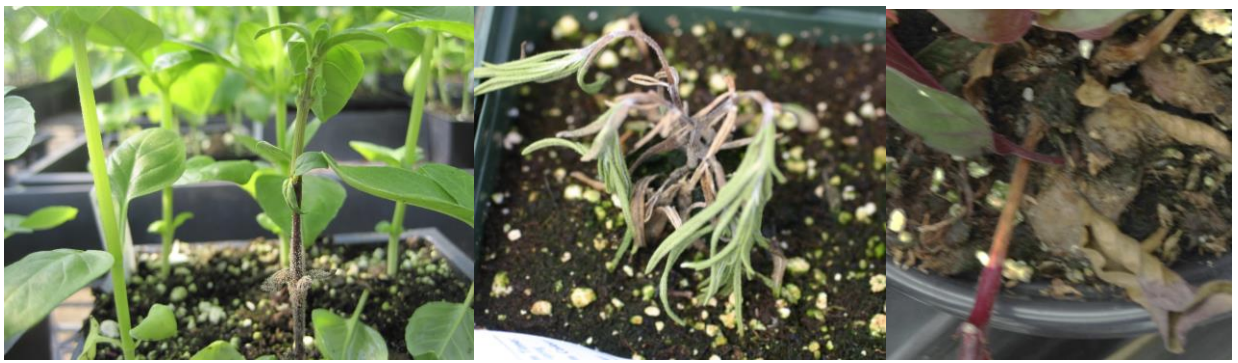
Botrytis can cause leaf and flower spot and blights, stem cankers, damping off and cutting root rot. Plants may be attacked at any stage, but the new tender growth, and freshly injured tissues are most susceptible. Botrytis blight produces characteristic gray fuzzy appearing spores on the surface of infected tissues. However, spores only develop under humid conditions.
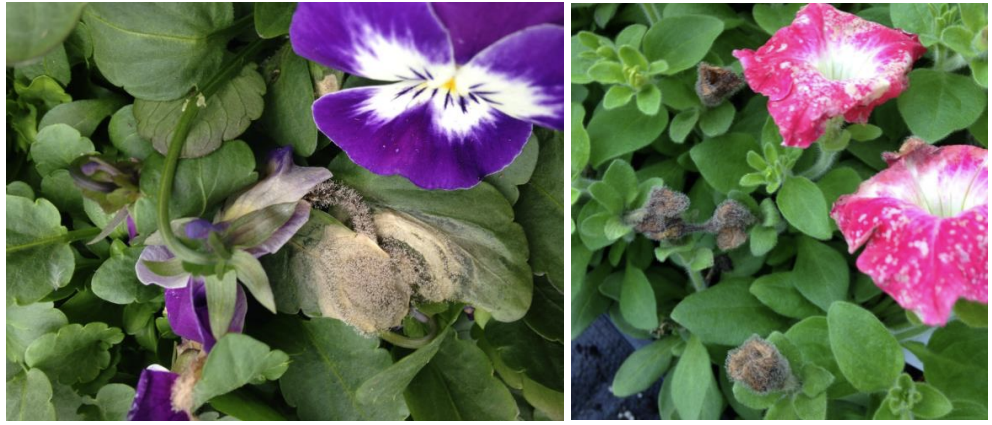
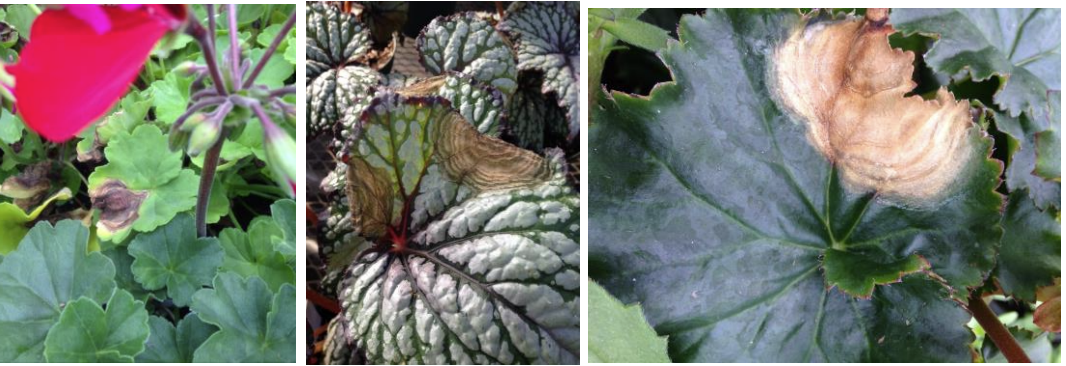
Leaf spots may develop a zonate pattern. Spots may develop where shedding flowers drop onto leaves below. Tan stem cankers can develop from blighted leaves on basil, rosemary, fuchsia, poinsettia, and other plants.
Scouting
Concentrate scouting in areas where crop is closely spaced with poor air circulation, and on crops with more tender plant tissues or susceptible white-flowering crops. Look for dieback, tan stem cankers (especially near a wound), and gray fuzzy appearing spores during humid conditions.
Management
Management is challenging due to Botrytis abilities to survive as a saprophyte, rapidly invade host plants, and produce abundant spores that are easily moved within the greenhouse on air currents. Botrytis diseases can only be managed by a combination of methods including manipulation of environmental conditions (reducing humidity and duration of leaf wetness), sound cultural practices and proper use of fungicides. Fungicides alone cannot control Botrytis and this pathogen has a long history of fungicide resistance.
Follow Proper Sanitation Practices
- Control weeds and remove plant debris before and during production.
- Dispose of diseased plants and debris in a plastic trash bag. Keep the bag closed to help prevent spreading spores to uninfected plants as the bag is removed from the greenhouse.
- Cover trash cans to prevent the airborne spread of spores from diseased plant tissue.
- Avoid growing ornamental hanging baskets above especially susceptible crops or cultivars. The spent flowers dropping on plants below serve as an energy source for the fungus helping to encourage the development of Botrytis blight.
Follow Sound Cultural Practices
- Always water in the morning to reduce the length of time the leaves stay wet after irrigating to prevent foliar diseases. Rising temperatures during the day will evaporate water from the foliage, so the leaves stay dry.
- Avoid watering when the water will sit on leaf surfaces for long periods at the end of the day.
- Provide adequate spacing of plants and use wire mesh benches to help to improve air circulation.
- Proper plant nutrition and height management techniques help to prevent lush, overgrown plants thereby reducing humidity within the canopy.
- Avoid excess nitrogen fertility.
- Follow proper planting and transplanting schedules to avoid holding plants any longer than necessary before their sale.
- Calcium chloride has been shown to reduce susceptibility of petunia flowers to Botrytis blight. Care must be taken regarding the source and rate applied to avoid spray damage.
Specific Tips to Reduce Humidity Levels in the Greenhouse
- Warm air holds more moisture than cool air. During warm days, the greenhouse air is more humid. As the air cools in the evening, the moisture-holding capacity drops until the dew point is reached. Water then begins to condense on surfaces.
- Reduce humidity by exhausting the moist air and replacing it with cooler outside air that is drier.
The method and time to heat and vent depend upon the heating and ventilation system used in the greenhouse.
- In greenhouses with vents, turn the heat on and crack the vents open about one inch. The moist humid air escapes from the vents.
- In greenhouses with fans, activate the exhaust fans for a few minutes and then heat the greenhouse to raise the air temperature. Then, shut off the fans.
- A clock can be set to activate the fans. The cooler, outside air will lower humidity levels as it is warmed in the greenhouse.
- A relay may be needed to lock out the furnace or boiler until the fan shuts off so that flue gases are not drawn back into the greenhouse. (This will also help to prevent air pollution damage (ethylene or sulfur dioxide) to sensitive seedlings.)
- Heat and vent two or three times per hour in the evening after the sun goes down and early in the morning at sunrise.
- Heating and venting can be effective even if it is cool and raining outside.
Air movement, even in a closed greenhouse, helps reduce moisture on the plant surfaces and surrounding the plants. Using horizontal airflow (HAF) can also reduce condensation. HAF fans keep the air moving in the greenhouse, helping to minimize temperature differentials and cold spots where condensation occurs. Moving air is continually mixed. The mixed air along the surface does not cool below the dew point so does not condense on plant surfaces.
Selective Use of Fungicides
Repeated applications of fungicides with the same mode of action (FRAC Group) can result in resistant populations of Botrytis. Widespread resistance to thiophanate-methyl (FRAC 1) has been reported from isolates collected in 1997 from Connecticut greenhouses. Isolates with resistance to iprodione (FRAC 2) were also collected but were not as common. Multiple resistance was also common. Resistance to fenhexamid (Decree) (FRAC 17) has also been reported from isolates in the Northeast. Avoid making more than two consecutive applications with the same fungicide or products with the same mode of action. Product labels often have specific guidelines for resistance management.
The use of tank mixes of fungicide mixtures with different FRAC codes and rotations among different FRAC codes are critical for resistance management. Biological fungicides can also be part of a resistance management plan. However, they must be used preventatively for Botrytis management.
Botrytis blight is best management with proper environmental management combined with cultural controls. Use fungicides carefully as needed. See New York and New England Management Guidelines for Greenhouse Floriculture and Herbaceous Ornamentals for more information regarding use on commercial greenhouse floriculture and ornamental crops. At the end of the crop cycle, when crops are in flower, care must be exercised in selecting fungicides to avoid leaving unsightly residues or inadvertently damage the sensitive flowers.
For information on Botrytis blight and stem canker on greenhouse tomatoes, see Battling Botrytis Blight and Stem Canker on Greenhouse-Grown Tomatoes and the latest edition of the New England Vegetable Management Guide.
For more information on Botrytis blight on herbs, see Some Selected Fungicides Labeled for Use on Herb Bedding Plants on the UConn Greenhouse IPM website under herbs transplants.
Disclaimer for Fact Sheets: The information in this document is for educational purposes only. The recommendations contained are based on the best available knowledge at the time of publication. Any reference to commercial products, trade or brand names is for information only, and no endorsement or approval is intended. UConn Extension does not guarantee or warrant the standard of any product referenced or imply approval of the product to the exclusion of others which also may be available. The University of Connecticut, UConn Extension, College of Agriculture, Health and Natural Resources is an equal opportunity program provider and employer.