Scouting & Observations
- Two-Spotted Spider Mites
- Potato Aphids
- Tomato Fruitworms
- Tobacco Hornworms
- Fulvia Leaf Mold
- Stemphylium Gray Leaf Spot
- Verticillium Wilt
- Alternaria (Early Blight) on Tomatoes
- Sunscald on Peppers
- Tomato Fruit Cracking
- Sweet Corn Pest Tracking
- Continue to be on the lookout for potato leafhoppers; Asiatic garden beetles; small insects such as aphids and flea beetles on brassica crops under row covers; and cucurbit powdery mildew.
Two-Spotted Spider Mites
The photos above show an extremely severe infestation of two-spotted spider mites. In the center and right photo you can see active adult mites, translucent round egg spheres, and developmental nymphs. Their reproductive cycle speeds up drastically in warm, dry weather.
Two-spotted spider mites feed on plant sap causing numerous yellow or white tiny, granulated spots on tomato leaves. As feeding progresses, plant leaves will look browner in color as the leaves dry up and may even curl. Spider mites will also create webbing as population size grows.
Encourage natural enemies like lady beetles, lacewings, minute-pirate bugs, and predatory thrips. Use miticides like abamectin, bifenazate, or sulfur-based products, ensuring thorough coverage of leaf undersides. Rotate miticides with different modes of action to prevent resistance. Consult New England Vegetable Management Guide for spray options.
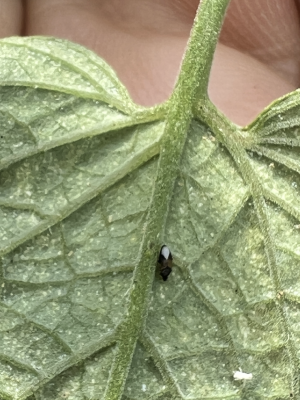
Photo of an adult minute pirate bug (Orius species, commonly known as the insidious flower bug), measuring about 3 mm long with a distinct black-and-white wing pattern. It is a beneficial insect that actively feeds on tiny pests like thrips, spider mites, aphids, and insect eggs. While harmless to plants, they can occasionally deliver a sharp, minor pinch to human skin when handled or if they land on skin looking for moisture during late summer, but they don’t transmit any diseases to humans.
Potato Aphids
While most people associate aphids with being green, the potato aphid commonly produces distinct pink or reddish color variants on solanaceous crops like tomatoes. They feed by sucking vital sap from the plant's leaves and stems. A small cluster is generally harmless, but larger populations can stunt the new growth and cause the leaves to curl.
When aphids molt, they leave behind white cast skins. This can sometimes lead to a misdiagnosis of white flies. To ensure you haven’t overlooked an aphid population, be sure to scout the underside of tomato leaves for insects with small pear-shaped bodies.
Aphids can transmit viruses that can lead to infections and long-term damage. Encouraging natural predators such as ladybugs, lacewings and parasitic wasps can provide effective control. Check the New England Vegetable Management Guide for specific guidance on insect management by crop type.
Tomato Fruitworm
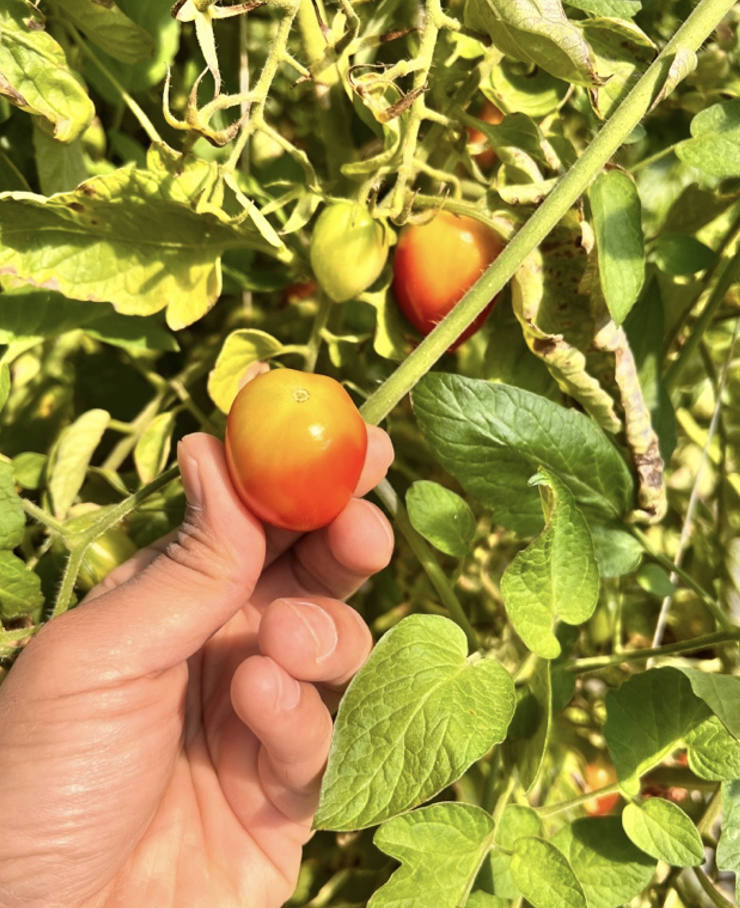
Recent field scouts indicate that damaging populations of tomato fruitworm (TFW) are on the rise. TFW, also known by its more common name the corn earworm, feed directly on tomato fruit. They enter as larva and can cause damage to three or four tomatoes by the time of full maturity. In addition to tomatoes and corn, this insect is also known to feed on tomatillos, peppers, beans, peas, okra, along with other field crops.
Products containing spinosad will help control fruitworm populations but timing is critical as chemical sprays will not impact TFW once they are inside a fruit. Damaged fruit will ripen prematurely. Control of TFW populations is important to minimize secondary pests like mites or aphids. See the New England Vegetable Management Guide for spray options.
Tobacco Hornworm
Continue to be on the lookout for tobacco and tomato hornworms (tobacco hornworm has a red/pink horn; tomato hornworm has a black or blue horn). Since the leaf-colored hornworms create a decent camouflage, large pellet-like fecal droppings on the plastic mulch under the plant, the defoliation of leaves with only bare stems remaining, or surface feeding scars on green fruit can indicate a nearby hornworm. Caterpillar infestations usually begin in July and may extend through September.
The adult tomato hornworms are large moths, predominantly gray or gray-brown with lighter markings. Their hairy, robust abdomens have yellow spots. They are commonly referred to as sphinx, hawk, or hummingbird moths. The wingspread may reach five inches.
Spot treat areas within a high tunnel using selective insecticides to preserve natural enemies and avoid secondary pest outbreaks (i.e. aphids). Products containing BT (e.g. Dipel and XenTari) are effective and should be rotated for resistance management. These products must be ingested so apply in the evening or early morning before larvae are actively feeding. Adherence will improve with use of approved spreader-sticker.
Fulvia Leaf Mold
Humid environments (relative humidity greater than 85%) in combination with tomato plants rapidly growing in to denser plantings (so air circulation is reduced) creates the perfect environment for leaf mold. As a result, leaf mold known by the scientific name Passalora fulva and previously known as Fulvia fulva or Cladosporium fulva, is commonly found in high tunnels. The fungus can cause leaves to yellow and reduce overall yield.
To control leaf mold, it is critical to improve airflow and reduce humidity by venting and pruning. Additional recommendations include:
- Removing infected foliage can slow the spread of disease from leaf to leaf and plant to plant.
- Avoid excessive nitrogen fertilization.
- Remove diseased leaves, place them in a plastic bag, and destroy.
- At the end of the crop cycle, remove and destroy all plant residue.
For the following season, consider using resistant cultivars and certified disease-free seed.
Spray options for greenhouse and high tunnel tomatoes can be found using the New England Vegetable Management Guide.
Stemphylium Gray Leaf Spot (GLS)
High humidity or water on leaf surfaces is required for the spread of Stemphylium spore germination and infections. Spots on leaves begin small, light brown, and somewhat circular to irregular in shape. Larger spots may become cracked. Symptoms start to appear within two to five days of infection. It most commonly occurs in high tunnels where higher temperatures and humidity are favorable to disease development.
When selecting which varieties to grow, you can choose tomato varieties with resistance to GLS. Avoid overhead watering as much as possible. Since Stemphylium survives on crop debris as a saprophyte, crop rotation will also help control the spread of the disease along with the sterilization of equipment at the end of the season. Checkout our fact sheet on this!
Verticillium Wilt
Verticillium wilt is caused by two species of a soil-borne fungi. It infects eggplants, peppers, tomatoes, cucurbits, and many other crops. A yellowing of lower leaves followed by wilting is the first sign of disease. Lesions have a characteristic V-shaped pattern which is widest at the leaf margin. Symptoms can appear on one side of the plant or on one side of a leaf (a more prevalent symptom in eggplant and tomatoes). When the stems of infected plants are cut lengthwise, the vascular tissue exhibits a brown discoloration.
Verticillium species can persist in the soil for many years in the absence of susceptible plants. Follow a 4-5 year crop rotation with non-solanaceous and non-cucurbit crops to reduce inoculum levels in fields. Include grain crops in the rotation. Control weeds as many weeds are susceptible to Verticillium. Remove and destroy infected plant material after harvest. There are no effective chemical controls, however, some resistant or tolerant eggplant varieties exist.
Alternaria (Early Blight) in Tomatoes
Extended periods of wetness from fog or dew as nighttime temperatures begin to drop is creating an opportune environment for fungal infections. Alternaria, also referred to as Early Blight of tomato, can cause lesions to form on tomato leaves. They first appear as small brown to black lesions on older foliage, and the tissue surrounding the lesion may become yellow. As the number of lesions grows, the entire leaf can become chlorotic. As the lesions themselves grow, they often develop concentric rings like a bull’s eye or target-spot. In addition to reducing plant vitality, fruits can also be infected by causing them to rot.
Bacterial Leaf Spots in Peppers
One of the most destructive pests of pepper crops growing in Connecticut is bacterial leaf spot (BLS). Bell pepper varieties are particularly vulnerable to this disease, although under favorable conditions, more tolerant varieties of hot or sweet peppers may show varying degrees of susceptibility. The bacteria can be introduced on infected seed or arrive on transplants. It cannot survive in the soil for extended periods, but will live through the winter on the residue of solanaceous crops (especially peppers and tomatoes), on weeds in the nightshade family and on the roots of wheat.
The bacteria may enter leaves through natural openings or abrasions. The presence of water on the leaf surface is important in the infection process and thus, the first symptoms usually occur on the margins or tips of leaves where droplets accumulate. Once inside the plant, the bacteria reproduce rapidly and move through the vascular system, congesting and killing tissue. Symptoms may develop in as little as five days or not show up for six or more weeks.
BLS affects all aboveground parts of the plant. Spots on leaves appear as brown irregular-shaped areas of dead leaf tissue. These spots start out less than 1/4 inch in diameter, grow in size and accumulate in number until the infected leaves drop off. In a severe outbreak, plants will drop 50 to 100% of their foliage, leaving the fruit exposed to the sun and vulnerable to sunscald. Plant stems and branches develop elongated, raised, light-brown cankers. Fruit may develop light-colored, raised, wart-like spots that eventually darken to brown or black.
Good sanitation and preventative practices are essential to minimize the risk of initial infection and reduce the amount of bacteria present early in the disease cycle. If detected in the early stages, when just a few localized plants show symptoms, remove or bury all diseased specimens and symptomless plants for 10 or more feet in all directions. Always work in infected sections of pepper fields last and disinfect machinery after completing the job. Deep plow crop residues after final harvest to speed decomposition of infected tissues.
Sunscald on Peppers
From 2006 to 2023, the average UV index in July has averaged 9 (on a scale of 13), the highest rating of the year, indicating very high to extreme sun exposure. While pepper crops like the heat, intense sunlight and UV radiation, especially on fruit that isn’t protected by the plant’s leaf canopy, can put the fruit at risk of sunscald. Sunburn is not only damaging to the affected fruit, but it also opens the door to pathogens infecting the entire plant. Other crops that are particularly susceptible to sunscald include tomatoes, cucumbers, eggplant, pumpkins, and squash. Leaves may also be impacted by intense sun. The damage can be identified by bleaching or browning.
Shading is the best protection against sunscald. Be mindful of plants that may have fallen over and add trellising so the fruit can benefit from foliar shade. When selecting varieties, seek out cultivars with thicker plant canopies.
Tomato Fruit Cracking
Fruit cracking is a common physiological disorder that affects the appearance and marketability of vegetables, particularly tomatoes, peppers, and eggplants. Radial cracks are deep, lengthwise splits that extend outward from the stem end and are often severe enough to make fruit unmarketable.
Deep cracks not only reduce market quality but also provide entry points for secondary pathogens, increasing the risk of fruit rot. When high temperatures (above 85°F) are followed by low temperatures (below 50°F), this stress can weaken fruit skin elasticity and increase cracking risk. The same can be said for sustained high temperature leading to continual fruit growth that can outpace the skin's ability to stretch. Heirloom varieties and large-fruited tomatoes (such as beefsteaks) are more prone to cracking compared to the hybrids which are often bred for resistance to cracking.
For further reading, check out our fact sheet on this.
Sweet Corn Pests - Trap Count Update
| Location | CEW (avg per night) | ECB - NY | ECB - IA | ECB - III |
| Shelton | 15 | 1 | 1 | 0 |
| Berlin | 2.7 | 1 | 0 | 0 |
Spray Interval for Corn Earworm:
 View our Sweet Corn Pest ID Guide.
See the New England Vegetable Management Guide for management strategies for all sweet corn insect pests.
Continue to be on the lookout
The following pests that were covered in the previous pest alerts and are still relevant in current conditions:
- Potato leafhoppers (besides beans, potatoes, and peppers, they were seen in cucumber field causing hopperburn)
- Asiatic garden beetles
- Check for small insect such as aphids and flea beetles on brassica crops under row covers
- Cucurbit powdery mildew
Save These Dates!

2026 New England Vegetable & Fruit Conference
December 15, 16, 17, 2026
Manchester, New Hampshire

2027 UConn Extension Vegetable and Small Fruit Growers Conference
Tuesday, January 12th, 2027
UConn Student Union, Storrs, CT
Stay in touch with us
- Share what you see: We're here to assist with identification, management strategies, and guidance on best practices. Send us a photo/message via iMessage at 959-929-1031.
- Facebook Group: UConn Extension moderates a private Facebook group specifically for commercial vegetable producers. It is a space to share photos of insects and diseases you find in your fields, ask questions, share ideas, and stay engaged with growers across the state.
Join the "UConn Extension - Vegetable IPM" Facebook Group - Schedule a consultation: Would you benefit from meeting with an Extension Specialist at your farm to provide insight on pest or disease identification, management strategies, and more? If so, please contact our Vegetable Extension Specialist, Shuresh Ghimire, to setup a farm visit. Contact him at shuresh.ghimire@uconn.edu or 860-870-6933.
Contact Information
Shuresh Ghimire, Vegetable Extension Specialist: shuresh.ghimire@uconn.edu
Nicole Davidow, Vegetable Extension Outreach Assistant: nicole.davidow@uconn.edu
Vegetable IPM Office Phone Number:
860-870-6933
Vegetable IPM Cell Phone Number:
959-929-1031 (feel free to text/iMessage photos)
Any reference to commercial products, trade or brand names is for information only, and no endorsement or approval is intended. Always read the label before using any pesticide. The label is the legal document for product use. Disregard any information if it is in conflict with the label. UConn Extension does not guarantee or warrant the standard of any product referenced or imply approval of the product to the exclusion of others which also may be available. The University of Connecticut, UConn Extension, College of Agriculture, Health and Natural Resources is an equal opportunity program provider.