Stemphylium Gray Leaf Spot
Author: Matthew DeBacco
Reviewed by: Shuresh Ghimire, Ph.D.
Associate Extension Educator
Extension Vegetable Specialist
Date of Publication: July 1, 2026
Introduction
Four Stemphylium species, S. lycopersici, Stemphylium solani, Stemphylium vesicarium, and Stemphylium botryosum f. sp. lycopersici, that are necrotrophic fungi can cause tomato gray leaf spot disease (GLS). High humidity or free water on leaf surfaces is required for spore germination and infection. Spots on leaves were small, light brown, and somewhat circular to irregular in shape. Some larger spots were cracked. Symptoms start to appear within two to five days of infection.
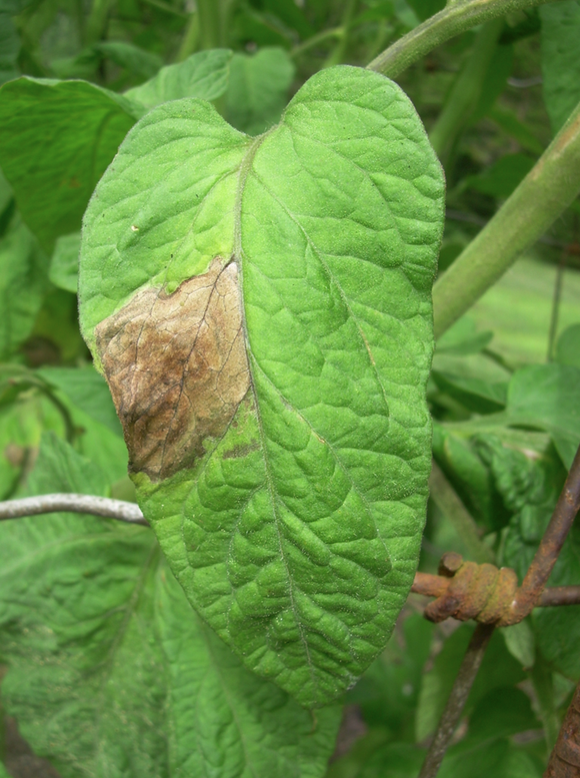
Identification of Disease
The currently accepted idea is that cherry and grape tomatoes are more susceptible than other types, however based on growers’ observations, while it did show up on all of the cherry varieties, it did not seem to really have many negative impacts in regard to overall plant performance and yield. Most commonly occurs (or is first seen) in high tunnels with the higher temperatures and humidity being favorable for disease development.
Not to Be Confused with:
Septoria- tends to be more circular spots with an inner circle of a lighter shade of brown. In addition the leaf will typically yellow.
Transmission:
Via air current (wind) and splashing water. Can also be seed-born. Stemphylium survives on crop debris as a saprophyte.
Prevention
Variety Selection
Cornell University maintains a list of disease-resistant tomato varieties. Many options, simply look for resistance to Gray Leaf Spot.
Example varieties that also have resistance to other diseases include:
Sweet Treats F1 (Cherry)
Jelly Bean Red F1 (Grape)
Oribustar (Grape)
Grandma’s Pick F1 (Heirloom)
BHN-410 F1 (Roma)
Davinci (Saladette)
Rootstock Resistant varieties
Arnold F1 (rootstock)
Estamino F1 (rootstock)
Cultural
Crop rotation
Avoid overhead watering
Sterilize equipment at the end of the season
Consult New England Vegetable Management Guide for a list of labeled products.
References
Connecticut Agricultural Experiment Station. (2019). Stemphylium gray leaf spot of tomato. https://portal.ct.gov/-/media/caes/documents/publications/fact_sheets/plant_pathology_and_ecology/2019/stemphylium-gray-leaf-spot-of-tomato.pdf?la=en
Cornell University. (n.d.). Stemphylium gray leaf spot of tomato. https://blogs.cornell.edu/livegpath/gallery/tomato/stemphylium-gray-leaf-spot-of-tomato/
North Carolina State University. (n.d.). Gray leaf spot of tomato. https://content.ces.ncsu.edu/gray-leaf-spot-of-tomato
University of Florida. (n.d.). Gray leaf spot. https://plantpath.ifas.ufl.edu/u-scout/tomato/gray-leaf-spot.html
Kumar, P., & Kumar, R. (2022). Management of gray leaf spot of tomato caused by Stemphylium lycopersici under protected cultivation. International Journal of Economic Plants, 9(2), 100-105. https://www.researchgate.net/publication/360836474_Management_of_gray_leaf_spot_of_tomato_caused_by_Stemphylium_lycopersici_under_protected_cultivation
Consult and follow pesticide labels for registered uses. To avoid potential phytotoxicity problems, spot test before widespread use. No discrimination is intended for any products not listed.
The information in this document is for educational purposes only. The recommendations contained are based on the best available knowledge at the time of publication. Any reference to commercial products, trade or brand names is for information only, and no endorsement or approval is intended. UConn Extension does not guarantee or warrant the standard of any product referenced or imply approval of the product to the exclusion of others which also may be available. The University of Connecticut, UConn Extension, College of Agriculture, Health and Natural Resources is an equal opportunity program provider and employer.