Spider Mites
Author: Matthew DeBacco
Reviewed by: Shuresh Ghimire, Ph.D.
Associate Extension Educator
Extension Vegetable Specialist
Date of Publication: June 29, 2026
Introduction
The two-spotted spider mite (Tetranychus urticae) are tiny arachnids that prefer warm, dry conditions where they can reproduce rapidly. The damage to the plant tissue is a result of feeding on the plant sap, which can lead to widespread damage quickly. While they can be found in fields, they are more commonly seen in protective structures that limit rain splash on the leaves and elevate the growing environment temperatures.
Symptoms
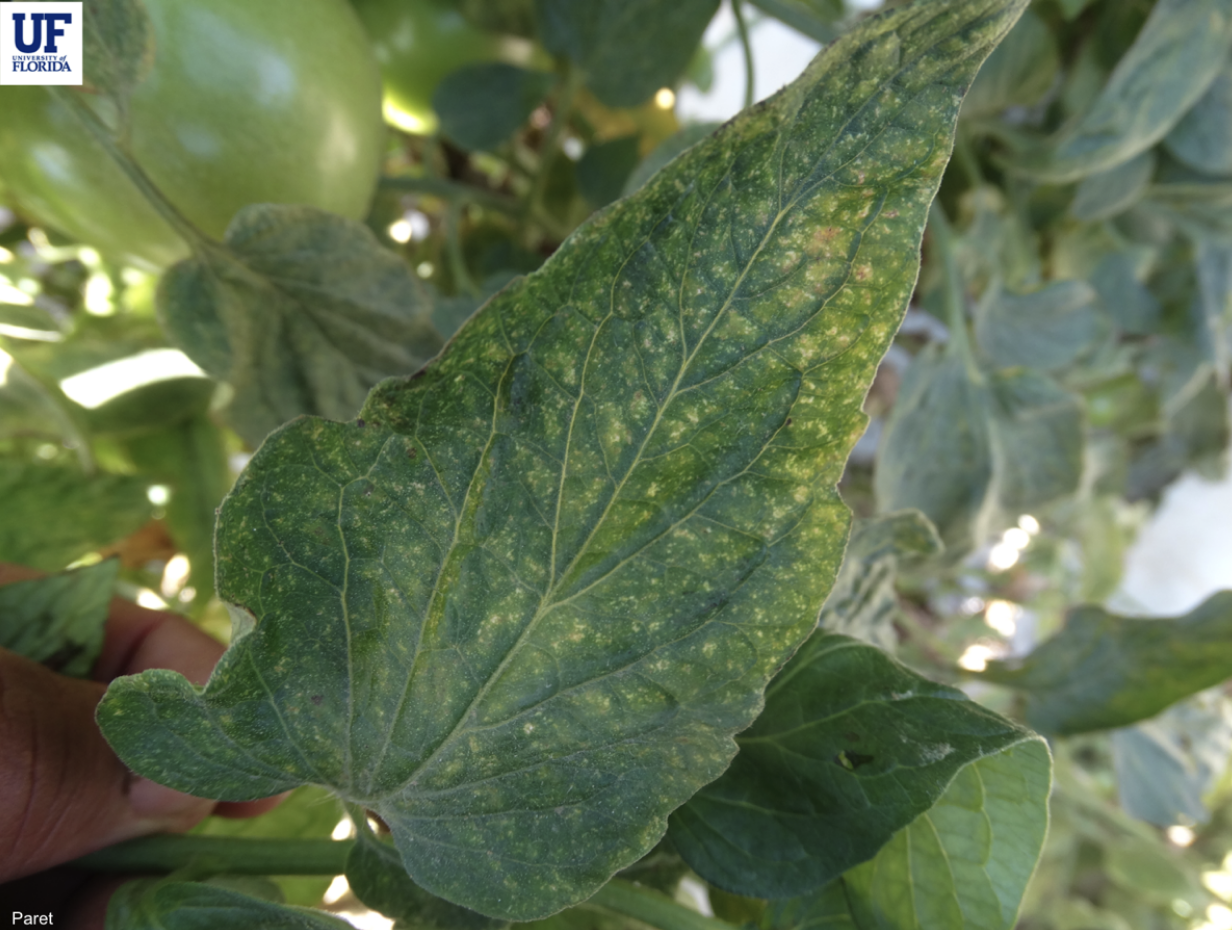
Leaf damage from feeding is likely the first thing growers will notice due to the mites small size. The leaves will have a small stippling of white to yellow coloration that will often be mottled or speckled due to the initial feeding. As this progresses, the leaves will take on a browner coloration as they dry-up and may even curl.
When the spider mites go unnoticed and their numbers become high, there can be webbing found on the undersides of the leaves which aids the mites as a physical barrier from the outside.
When temperatures are above 80F and the humidity is below 90%, this is when reproduction rate will be the greatest making control difficult.
Host Crops:
Eggplant, potatoes, beans, cucumbers, melons, watermelons, sweet corn, peppers, and soybeans.
Note: It seems that husk cherries or ground cherries are a plant favorite for these mites.
Identification of Insects
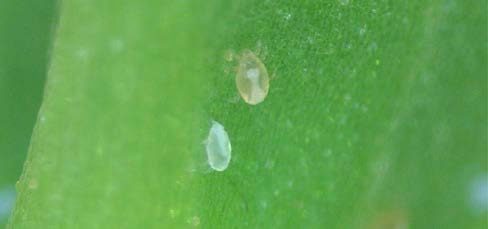
Keep in mind that the mites themselves are very small 1/50” (0.5mm) so the use of a hand lens of at least 10x is advised with 30x recommended. The mites have an oval body and eight legs and are typically yellowish-green with two dark spots on either side of their body. Exact coloration can vary slightly depending on the life stage being observed with the larvae having six legs compared to the nymphs and adults having eight, however it will be hard to count the legs in the field. The eggs are very tiny 0.14mm round diameter transparent to pale yellow in color laid on the undersides of the leaves.
Other than direct on plant observations, shaking plants onto a flat clean sheet of white paper can help to see them as initial black dots that will move. There is also the webbing to look for as this is a key aspect of high mite numbers.
Focus your attention to the undersides of the leaves to try and catch them early keying in on areas that exhibit upper leaf stippiling.
Management
Cultural
When bringing new plants into a growing area, provide regular inspections of the new plants.
Biological
Encourage natural enemies like lady beetles (Stethorus spp.), lacewings, and predatory thrips.
Mechanical Approaches
Physically spraying plants with high pressure water can help to dislodge the mites and reduce the populations.
Conventional Spray Products
Use miticides like abamectin, bifenazate, or sulfur-based products, ensuring thorough coverage of leaf undersides. Rotate miticides with different modes of action to prevent resistance.
Organic Spray Products
Insecticidal soaps or horticultural oils (ex. neem oil) are effective with minimal impact on beneficials but require direct contact with mites and repeat applications.
Consult New England Vegetable Management Guide for specific crop insect management section.
References
Agriculture Victoria. (n.d.). Twospotted mite. Retrieved July 6, 2025, from https://agriculture.vic.gov.au/biosecurity/pest-insects-and-mites/priority-pest-insects-and-mites/twospotted-mite
Cornell University. (n.d.). Two-spotted spider mites. Retrieved July 6, 2025, from https://cals.cornell.edu/field-crops/soybeans/insects-of-soybeans/two-spotted-spider-mites
Iowa State University Extension and Outreach. (n.d.). Twospotted spider mites. Retrieved July 6, 2025, from https://crops.extension.iastate.edu/encyclopedia/twospotted-spider-mites
James, D. G. (2002). Selectivity of the acaricide, bifenazate, and aphicide, imidacloprid, to the predatory mite Neoseiulus fallacis and its prey, Tetranychus urticae (Acari: Phytoseiidae, Tetranychidae). Journal of Entomological Science, 37(3), 283–285. https://doi.org/10.18474/0749-8004-37.3.283
Missouri Botanical Garden. (n.d.). Spider mites. Retrieved July 6, 2025, from https://www.missouribotanicalgarden.org/gardens-gardening/your-garden/help-for-the-home-gardener/advice-tips-resources/insects-pests-and-problems/insects/mites/spider-mites
Park, Y.-L., & Lee, J.-H. (2002). Leaf cell and tissue damage of cucumber caused by two-spotted spider mite (Acari: Tetranychidae). Journal of Economic Entomology, 95(5), 952–957. https://doi.org/10.1603/0022-0493-95.5.952
University of California Agriculture and Natural Resources. (n.d.). Spider mites: Integrated pest management for home gardeners and landscape professionals. Retrieved July 6, 2025, from https://ipm.ucanr.edu/PMG/PESTNOTES/pn7405.html
University of Delaware Cooperative Extension. (n.d.). Two-spotted spider mites. Retrieved July 6, 2025, from https://www.udel.edu/academics/colleges/canr/cooperative-extension/fact-sheets/two-spotted-spider-mites/
University of Florida IFAS Extension. (n.d.). Spider mite damage. Retrieved July 6, 2025, from https://plantpath.ifas.ufl.edu/u-scout/tomato/spider-mite-damage.html
University of Kentucky Department of Entomology. (n.d.). Spider mites. Retrieved July 6, 2025, from https://entomology.ca.uky.edu/ef310
University of Massachusetts Amherst. (n.d.). Two-spotted spider mite. Retrieved July 6, 2025, from https://www.umass.edu/agriculture-food-environment/vegetable/fact-sheets/two-spotted-spider-mite
University of Minnesota Extension. (n.d.). Spider mites. Retrieved July 6, 2025, from https://extension.umn.edu/yard-and-garden-insects/spider-mites
Consult and follow pesticide labels for registered uses. To avoid potential phytotoxicity problems, spot test before widespread use. No discrimination is intended for any products not listed.
The information in this document is for educational purposes only. The recommendations contained are based on the best available knowledge at the time of publication. Any reference to commercial products, trade or brand names is for information only, and no endorsement or approval is intended. UConn Extension does not guarantee or warrant the standard of any product referenced or imply approval of the product to the exclusion of others which also may be available. The University of Connecticut, UConn Extension, College of Agriculture, Health and Natural Resources is an equal opportunity program provider and employer.