Southern Blight
Author: Matthew DeBacco
Reviewed by: Shuresh Ghimire, Ph.D.
Associate Extension Educator
Extension Vegetable Specialist
Date of Publication: July 1, 2026
Introduction
Southern blight caused by Sclerotium rolfsii, a soil-borne fungus can impact more than just tomatoes. Peppers, cucumbers, onions, lettuce, carrots, and parsley are also susceptible. Growers recognize this disease due to the rapid wilting and yellowing that occurs at the soil line with water-soaked lesions that expand quickly and girdle the stem. Warm and moist conditions that follow a dry spell can encourage the formation of this disease. Low hanging fruits that have soil contact are likely to develop wet rot and decay rapidly.
Symptoms
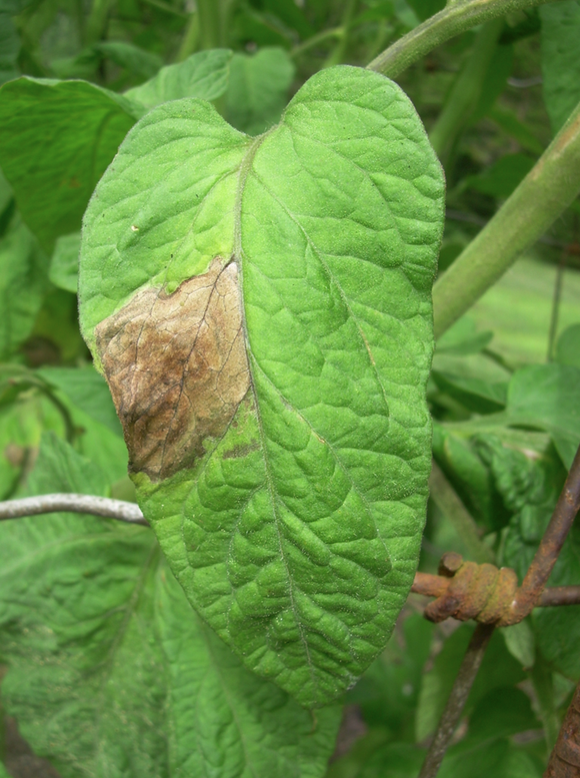
Southern blight is typically first seen in leaves that will experience rapid wilting and yellowing that can quickly progress to permeant wilting and ultimately, plant death. Inspecting the stem near the soil line would likely yield water-soaked lesions that can expand and result in girdling of the stem. When humidity is high, a white cotton looking mycelium can form along with small sclerotia that turns a tan to brown color that looks similar to mustard seeds as they are 1-2 mm in diameter. Fruit that is low hanging or has had soil contact may develop this rot.
Southern blight manifests through rapid wilting and yellowing or browning of tomato leaves, often culminating in plant death. Initial symptoms include water-soaked lesions on the stem at or near the soil line, which expand rapidly to girdle the stem, causing sudden and permanent wilting. Under high humidity, white, cottony mycelium forms on the stem and surrounding soil, with small, round sclerotia (1–2 mm in diameter, initially white, turning tan to brown, resembling mustard seeds) developing on the mycelium. Low-hanging or soil-contacting fruit may develop wet rot, leading to rapid decay without an initial offensive odor. These symptoms distinguish Southern Blight from bacterial wilt, which lacks fungal growth, and Sclerotinia blight, which lacks uniform sclerotia.
Host Crops: Solanaceae family (Tomatoes, Peppers, Eggplant)
Identification of Disease
The optimum temperatures for Southern Blight (Sclerotium rolfsii) are from 77 to 95°F (25–35°C) and when these temperatures are followed by a warm rain after a period of hot and dry weather, this can encourage disease development. The fungus thrives in moist, aerobic, acidic (pH 2-5) soils with a light texture. This can persist in soils for up to 5 years even without a host plant species with typically the upper 2-3” containing the highest amount of inoculum.
Before infecting plants, the sclerotia will germinate and colonize organic debris. Then soil becomes infected along with tools and possible irrigation water which can lead to high build-up of the fungus which makes this difficult to control.
As the name Southern Blight implies conditions that resemble tropical regions encourage the disease formation.
Not to Be Confused with:
Bacterial Wilt- In contrast, Southern Blight shows white mycelial growth
Prevention
Variety Selection
Using resistant rootstocks such as Solanum sisymbriifolium cultivars like Maxifort, Big Power, or Beaufort can reduce disease incidence and improve yields in infested fields.
Cultural
pH above 7 will inhibit disease formation.
Rotating with non-host crops (Ex. Corn, sorghum, gains) for 2 to 3 years to reduce the amount of sclerotia.
Sanitize tools in a 1:9 bleach solution to reduce the chance of further spread.
While a challenge, soil solarization or deep tilling may have some effectiveness since the fungus concentrates in the top 3 inches of soil.
Spray Products
Consult New England Vegetable Management Guide for a list of labeled products.
References
North Carolina State University Extension. (n.d.). Southern blight of vegetable crops. https://content.ces.ncsu.edu/southern-blight-of-vegetable-crops
Oklahoma State University Extension. (n.d.). Southern blight of tomato. https://extension.okstate.edu/programs/digital-diagnostics/plant-diseases/southern-blight-of-tomato.html
Purdue University. (n.d.). Tomato diseases. Agricultural Economics, Purdue University. https://ag.purdue.edu/department/arge/swpap/tomato-diseases.html
University of California Agriculture and Natural Resources. (n.d.). Southern blight in tomato. https://ipm.ucanr.edu/agriculture/tomato/southern-blight/#gsc.tab=0
Consult and follow pesticide labels for registered uses. To avoid potential phytotoxicity problems, spot test before widespread use. No discrimination is intended for any products not listed.
The information in this document is for educational purposes only. The recommendations contained are based on the best available knowledge at the time of publication. Any reference to commercial products, trade or brand names is for information only, and no endorsement or approval is intended. UConn Extension does not guarantee or warrant the standard of any product referenced or imply approval of the product to the exclusion of others which also may be available. The University of Connecticut, UConn Extension, College of Agriculture, Health and Natural Resources is an equal opportunity program provider and employer.