Pythium Rot
Author: Matthew DeBacco
Reviewed by: Shuresh Ghimire, Ph.D.
Associate Extension Educator
Extension Vegetable Specialist
Date of Publication: July 1, 2026
Introduction
The tomato Pythium species, which cause disease are an oomycete (not true fungi) thriving in wet soils and affecting tomato plants at various growth stages. While this can be a concern for any grower, fields that are poor draining or overwatered will be at increased risk for developing this disease.
Symptoms
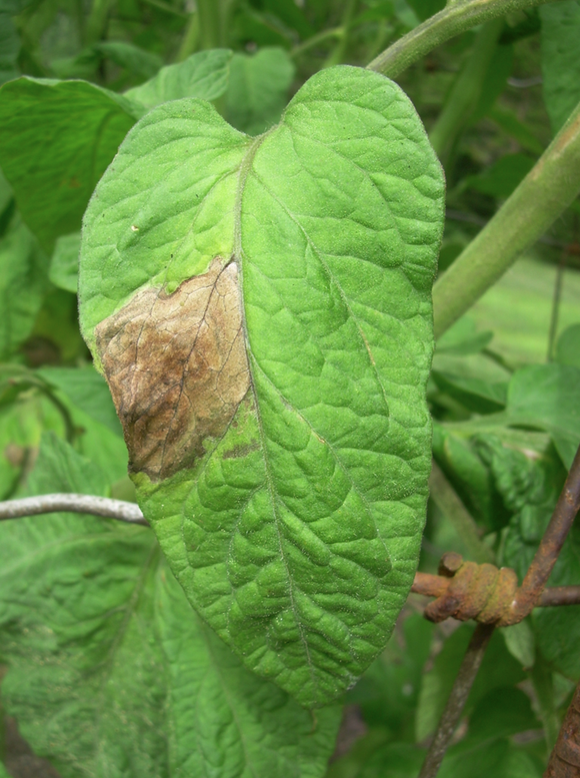
While the Pythium pathogen can impact all stages of plant development, this is a soil-based disease. When it infects plants early, this is called damping-off, which is evident when the seeds rot before germinating or emerging or when a seedling collapses with a water-soaked stem lesion. Inspecting the roots will typically result in the discovery of roots with a brown coloration that is in a state of decay. Growers will often first notice the infected plant wilting with stunted growth. Infected fruits will have water-soaked lesions, often with white mycelial growth, reducing yield, quality and storage life.
Host Crops: Solanaceae family (Tomatoes, Peppers, Eggplant) and Cucurbits
Identification of Disease
Pythium species are oomycetes, characterized by cellulose cell walls and coenocytic hyphae that thrive in wet, poorly drained conditions. This pathogen can spread through contaminated soil, water, or plant material. The life cycle includes both asexual and sexual reproduction, with oospores serving as resting structures that can survive in soil for years. When the environmental conditions become favorable, (typically 55–77°F with moisture) the oospores will germinate to produce sporangia, which release motile swimming zoospores. Upon coming in contact with a host plant, these zoospores will infect by germinating and penetrating the roots and stems.
Transmission:
Since this is a swimming pathogen, simple water films can provide the conditions to result in this disease spreading quickly from one plant to another.
Prevention
Cultural
Improve soil drainage
Maintain good soil aeration
Avoid multiple field irrigation from a known infected source
Sterilize soil
Avoid planting in cool condition
Reduce soil splash onto plant/fruit
Biological
Trichoderma (Rootshield)
Bacillus subtilis (ex. Cease) or Trichoderma harzianum (ex. RootShield) can suppress Pythium root rot, with efficacy varying by cultivar and conditions
Streptomyces isolates have shown promise in controlling P. aphanidermatum in tomato seedlings.
Mechanical Approaches
Steam sterilization of soil can reduce pathogen levels but may be impractical for some operations.
Chemical Products
Mefenoxam, fludioxonil can be used as seed treatments, soil drenches, or foliar sprays to control Pythium. Consult New England Vegetable Management Guide for a list of labeled products.
References
Abdelzaher, H. M. A., Elsharouny, E. E., & Abdel-Monem, A. M. (2022). First report of Pythium aphanidermatum infecting tomato in Egypt and its control using biogenic silver nanoparticles. ResearchGate. https://www.researchgate.net/publication/327249252_First_report_of_Pythium_aphanidermatum_infecting_tomato_in_Egypt_and_its_control_using_biogenic_silver_nanoparticles
Clemson University. (2021). Tomato diseases & disorders. Home & Garden Information Center. https://hgic.clemson.edu/factsheet/tomato-diseases-disorders/
Cornell University. (n.d.). Symptoms of Pythium on tomato plant. Vegetable MD Online. http://vegetablemdonline.ppath.cornell.edu/DiagnosticKeys/TomWlt/Pythium_Tom.htm
Farr, D. F., & Rossman, A. Y. (2021). First report of crown and root rot caused by Pythium aphanidermatum on tomato in Italy. Plant Disease, 105(10), 2246. https://doi.org/10.1094/PDIS-10-20-2246-PDN
Minchinton, E. J., Tesoriero, L. A., & Petkowski, J. E. (2023). Diversity and pathogenicity of Pythium species associated with reduced yields of processing tomatoes in Victoria, Australia. PhytoFrontiers, 3(2), 432–440. https://doi.org/10.1094/PHYTOFR-10-22-0119-R
Mondani, L., Chiusa, G., & Battilani, P. (2022). First report of Pythium ultimum causing damping-off on tomato in Italy. Plant Disease, 106(8), 1614. https://doi.org/10.1094/PDIS-08-21-1614-RE
Royal Brinkman. (n.d.). Pythium: Symptoms and control in greenhouse horticulture. Retrieved from https://royalbrinkman.com/knowledge-center/crop-protection-disinfection/diseases/pythium
Sharma, S. K., & Lebeda, A. (2024). Pythium-induced damping-off disease and its management in tomato (Solanum lycopersicum L.): A review. ResearchGate. https://www.researchgate.net/publication/379404184_Pythium-induced_damping-off_disease_and_its_management_in_tomato_Solanum_lycopersicum_L_A_review
University of California Agriculture and Natural Resources. (n.d.). Damping-off: Phytophthora spp., Pythium spp., Rhizoctonia spp.. UC IPM. https://ipm.ucanr.edu/agriculture/tomato/damping-off/
University of Massachusetts Amherst. (2013). Pythium fruit rot. Center for Agriculture, Food, and the Environment. https://www.umass.edu/agriculture-food-environment/vegetable/fact-sheets/pythium-fruit-rot
University of Massachusetts Amherst. (n.d.). Pythium fruit rot. Center for Agriculture, Food, and the Environment. https://www.umass.edu/agriculture-food-environment/vegetable/fact-sheets/pythium-fruit-rot
Vallino, M., Irico, L., Gaffuri, F., Ghignone, S., Borriello, R., & Bianciotto, V. (2021). Root rot caused by Pythium spp. in tomato: First report in greenhouse hydroponic culture in Italy and efficacy of Azoxystrobin in disease control. Agronomy, 11(5), Article 846. https://doi.org/10.3390/agronomy11050846
Zitter, T. A. (n.d.). TOMATO: Damping Off (Pythium and Rhizoctonia species) [Photograph]. Vegetable MD Online, Cornell University. https://bpb-us-e1.wpmucdn.com/blogs.cornell.edu/dist/1/7446/files/202cur1/02/TomPythium.jpg

Consult and follow pesticide labels for registered uses. To avoid potential phytotoxicity problems, spot test before widespread use. No discrimination is intended for any products not listed.
The information in this document is for educational purposes only. The recommendations contained are based on the best available knowledge at the time of publication. Any reference to commercial products, trade or brand names is for information only, and no endorsement or approval is intended. UConn Extension does not guarantee or warrant the standard of any product referenced or imply approval of the product to the exclusion of others which also may be available. The University of Connecticut, UConn Extension, College of Agriculture, Health and Natural Resources is an equal opportunity program provider and employer.