Late Blight of Tomato
Author: Matthew DeBacco
Reviewed by: Shuresh Ghimire, Ph.D.
Associate Extension Educator
Extension Vegetable Specialist
Date of Publication: June 29, 2026
Introduction
Tomato late blight is caused by the oomycete (water mold) Phytophthora infestans. Tomatoes, potatoes, and other Solanaceae plants are susceptible to this disease. Symptoms include gray-green, water-soaked spots on leaves, stems, and fruit, enlarging into dark blotches. Cool wet weather favors the development of this disease that contributed to the Irish Potato Famine with newer strains since the 1990s, like the A2 strain, may increase severity and fungicide resistance.
Due to the severity and concern for this disease spreading, there are monitoring and forecasting models to routinely check to know what disease pressure you are may be experiencing:
Monitor the late blight forecast model
NEWA weather forecasting models
The forecast model is based on the temperature, rainfall, and duration of humidity over 90% during the same time period.
According to University of Maine: Severity values accumulate if environmental conditions are favorable for the late blight pathogen. Disease is predicted to occur 7-10 days after 18 severity values have accumulated.
Symptoms
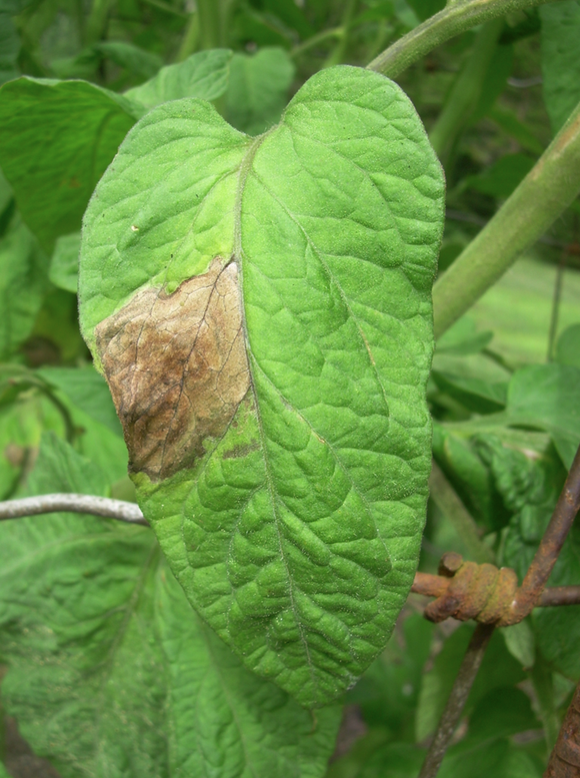
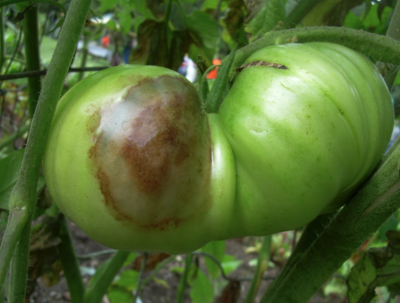
Growers will notice on the leaves, irregular, water-soaked spots that turn dark brown or black and can expand rapidly with white fungal growth in humid conditions. However, infection can also be seen on the stems which develop brown lesions that may not have a distinct line of delineation with the actual fruit showing firm, sunken, greasy-looking spots.
Late blight spreads by wind or water splash from plant to plant and field to field.
Host Crops: Solanaceae family (tomatoes, peppers, eggplant)
Identification of Disease
Late blight caused by Phytophthora infestans reproduces both asexually and sexually that thrives in moderate temperatures (60-80F) with moist conditions (humidity at or above 90%). Sporangia germinate at 64-75°F, zoospores are released at 46-64°F, and mycelia grow optimally at 73°F. Epidemics are triggered by cool nights, warm days, mists, and rains, with infection occurring in about 10 hours under ideal conditions.
Asexual reproduction occurs from the production of sporangia that germinate directly in warm conditions (70-79°F or 21-26°C) or release zoospores in cooler conditions (64-72°F or 18-22°C). The zoospores can swim short distances in water to infect plants and the sporangia travel in the air, facilitating long-distance spread.
Sexual reproduction is not common in the USA (more commonly found in Europe and South America), but when it does occur the oospores form thick-walled resting spores that can survive in plant debris or soil.
Not to Be Confused with:
Early blight: Look for concentric rings that are similar to a transverse cut of a tree. Infection points tend to be smaller than Late Blight
Buckeye Rot: Is soilborne and mainly impacts localized fruit on or near the ground.
Prevention
Variety Selection
True resistant varieties do not exist. Some varieties are more tolerant to late blight. For example, Mountain Merit, Black Krim, Green Zebra, Damsel, Juliet, and Plum Regal.
Cultural
Crop rotation away from solanaceous crops, with special concern for fields that have had infected potatoes as the tubers can provide a below ground source of potential inoculum.
Biological
Bacillus amyloliquefaciens strain D747 (DoubleNickel 55): 0.25 to 3.0 lb/A; PHI 0d, REI 4 h, Group BM02. Suppression only. For improved control, mix or rotate with a chemical fungicide.
Mechanical Approaches
Sanitation of stakes and any other materials that are reused from one year to the next.
Airflow can be influenced by plant spacing both in-row and between rows. In high tunnels pruning can also help improve this airflow.
Conventional Spray Products
- amoxadone plus cymoxanil (Tanos): 8.0 oz/A; PHI 3d, REI 12h, Groups 11 & 27. Must be tank-mixed with an appropriate contact fungicide from a different FRAC Group and alternated with a fungicide from a different FRAC Group after 1 application.
- fluopicolide (Presidio 4SC): 3.0 to 4.0 fl oz/A; PHI 2d, REI 12h, Group 43. Must be tank mixed with a fungicide from a different FRAC Group.
- propamocarb HCl (Previcur Flex): 0.7 to 1.5 pt/A; PHI 5d, REI 12h, Group 28.
Organic Spray Products
- copper hydroxide (Kocide 3000): 0.75 to 1.75 lb/A; PHI 0d, REI 48h, Group M01. Do not apply in a spray solution having a pH less than 6.5 or tank mix with Aliette.
- polyoxin D zinc salt (OSO 5%SCOG aka VeggieTurbo 5 SCOG): 6.0 to 13.0 fl oz/A; PHI 0d, REI 4h, Group 19. Suppression only.
References
Hortsense. (n.d.). Tomato late blight. College of Agricultural, Human, and Natural Resource Sciences, Washington State University. https://hortsense.cahnrs.wsu.edu/fact-sheet/tomato-late-blight/
Integrated Pest Management Program. (n.d.). Late blight. University of California Agriculture and Natural Resources. https://ipm.ucanr.edu/agriculture/tomato/late-blight/#gsc.tab=0
Lucid Central. (n.d.). Tomato late blight. Plant Protection and Quarantine, University of Queensland. https://apps.lucidcentral.org/pppw_v12/text/web_full/entities/tomato_late_blight_261.htm
North Carolina State Extension. (n.d.). Tomato late blight. College of Agriculture and Life Sciences, North Carolina State University. https://content.ces.ncsu.edu/tomato-late-blight
University of Maine Cooperative Extension. (n.d.). Late blight of tomato and potato (Publication No. 2418). https://extension.umaine.edu/publications/2418e/
University of Massachusetts Amherst. (n.d.). Solanaceous: Late blight. Center for Agriculture, Food and the Environment. https://www.umass.edu/agriculture-food-environment/vegetable/fact-sheets/solanaceous-late-blight
Vegetable Pathology Lab. (n.d.). Tomato late blight. Department of Plant Pathology, University of Wisconsin-Madison. https://vegpath.plantpath.wisc.edu/diseases/tomato-late-blight/
Consult and follow pesticide labels for registered uses. To avoid potential phytotoxicity problems, spot test before widespread use. No discrimination is intended for any products not listed.
The information in this document is for educational purposes only. The recommendations contained are based on the best available knowledge at the time of publication. Any reference to commercial products, trade or brand names is for information only, and no endorsement or approval is intended. UConn Extension does not guarantee or warrant the standard of any product referenced or imply approval of the product to the exclusion of others which also may be available. The University of Connecticut, UConn Extension, College of Agriculture, Health and Natural Resources is an equal opportunity program provider and employer.