Tomato Gray Mold
Author: Matthew DeBacco
Reviewed by: Shuresh Ghimire, Ph.D.
Associate Extension Educator
Extension Vegetable Specialist
Date of Publication: June 16, 2026
Introduction
Gray mold, also known as Botrytis blight, is a fungal disease caused by Botrytis cinerea. It affects tomato plants, particularly in environments with high humidity and cool temperatures, such as greenhouses or during wet weather. This disease can impact leaves, stems, flowers, and fruit, leading to significant crop damage if not managed.
Symptoms
Gray mold thrives in conditions with high humidity (>90%) and temperatures between 65–75°F, often entering plants through wounds, dead tissue, or fading flowers. It can survive in plant debris, making sanitation crucial. With optimal infection occurring when there is free water on plant surfaces for 4–6 hours, such as from dew, rain, fog, or overhead irrigation.
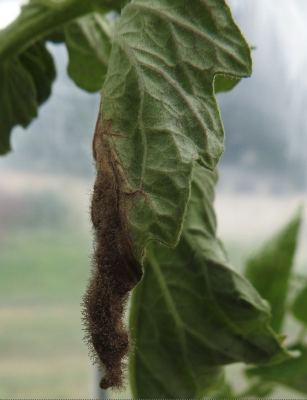
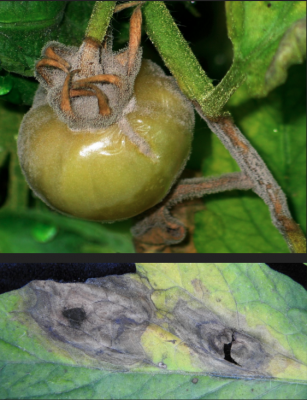
Gray mold appears as a grayish-white, fuzzy mold on infected plant parts. Tan to brown lesions on leaves and stems, which can expand and cause wilting. Brown, dying flowers, which can spread infection to fruit. Soft, watery rot on fruit, often with whitish rings called "ghost spots," reducing market quality.
Host Crops: Solanaceae family (Tomatoes, Peppers, Eggplant)
Identification of Disease
A dense, velvety and fluffy gray-brown spore mass on infected tissue that is very fragile by nature, so when it is disturbed causes the release of a cloud of spores, which is how this disease spreads. This process is favored by humid conditions.
On leaves, tannish brown lesions appear, which can lead to irregular or V-shaped brown blotches, starting at the leaf margins and progressing inward, potentially causing dieback as infection moves through petioles to the main stem.
Flowers can be a common point of entry which can also lead to fruit infection, which is evident by a pale, soft, watery rot, often with the skin rupturing near the center of the decayed area. These symptoms can occur both on the plant and during post-harvest storage.
Not to Be Confused with:
Late Blight- Does not have the fuzzy appearance.
Vectors
The fungus Botrytis cinerea spreads through spores carried by wind, rain, or air currents.
Management
There are no known tomato varieties with resistance to botrytis blight.
Cultural:
Ensure good air circulation; this can be accomplished by plant to plant and row to row spacing and also continual pruning of plants.
Biological:
Using the entomopathogenic fungus Metarhizium anisopliae, which has shown significant efficacy against B. cinerea in greenhouse and post-harvest settings. Studies indicate up to 84.24% control on detached leaves and 72.38% on whole plants, with a 78% reduction in fruit mold at a 10% treated concentration.
Chemical:
Conventional Spray Products
penthiopyrad (Fontelis): 26.0 to 24.0 fl oz/A; PHI 0d, REI 12, Group 7
Organic Spray Products
potassium bicarbonate (MilStopOG aka PB 133OG): 1.25 to 5.0 lb/100 gal water; PHI 0d, REI 1h, Group NC. Use the solution within 12 hours of preparation. See the label for small volume application rates.
See the New England Vegetable Management Guide for a more comprehensive list of fungicides for gray mold control.
References
Agriculture Victoria. (n.d.). Grey mould in greenhouse tomato crops. Retrieved June 28, 2025, from https://agriculture.vic.gov.au/biosecurity/plant-diseases/vegetable-diseases/grey-mould-in-greenhouse-tomato-crops
Cornell University. (n.d.). Tomato: Gray mold. Retrieved June 28, 2025, from https://blogs.cornell.edu/livegpath/gallery/tomato/tomato-gray-mold/
NC State Extension. (n.d.). Botrytis gray mold of tomato. Retrieved June 28, 2025, from https://content.ces.ncsu.edu/botrytis-gray-mold-of-tomato
Ohio State University. (n.d.). Botrytis grey mold: Advanced. Retrieved June 28, 2025, from https://u.osu.edu/hightunneldiseasefacts/tomato-diseases/botrytis-grey-mold/advanced/
Purdue University. (n.d.). Gray mold of tomato. Retrieved June 28, 2025, from https://ag.purdue.edu/department/arge/swpap/gray-mold-tomato.html
Sarven, M. S., Hao, Q., Deng, J., Yang, F., Wang, G., Xiao, Y., & Xiao, X. (2020). Biological Control of Tomato Gray Mold Caused by Botrytis Cinerea with the Entomopathogenic Fungus Metarhizium Anisopliae. Pathogens (Basel, Switzerland), 9(3), 213. https://doi.org/10.3390/pathogens9030213
University of California Statewide IPM Program. (n.d.). Gray mold. Retrieved June 28, 2025, from https://ipm.ucanr.edu/agriculture/tomato/gray-mold/#gsc.tab=0
Consult and follow pesticide labels for registered uses. To avoid potential phytotoxicity problems, spot test before widespread use. No discrimination is intended for any products not listed.
The information in this document is for educational purposes only. The recommendations contained are based on the best available knowledge at the time of publication. Any reference to commercial products, trade or brand names is for information only, and no endorsement or approval is intended. UConn Extension does not guarantee or warrant the standard of any product referenced or imply approval of the product to the exclusion of others which also may be available. The University of Connecticut, UConn Extension, College of Agriculture, Health and Natural Resources is an equal opportunity program provider and employer.