Early Blight of Tomato
Author: Matthew DeBacco
Reviewed by: Shuresh Ghimire, Ph.D.
Associate Extension Educator
Extension Vegetable Specialist
Date of Publication: June 16, 2026
Introduction
Early blight, also known as Alternaria, is a fungal disease caused by Alternaria solani. This will typically start in the lower leaves of the plant and progress where it can infect the stems of the plant and fruit. If this pathogen comes in contact with a seedling it can kill the seedling from girdling of the stem.
Symptoms
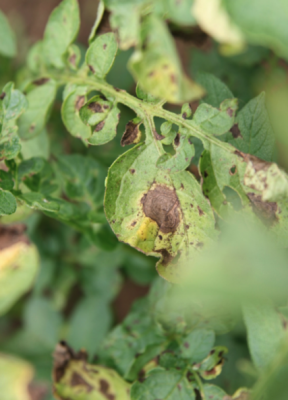
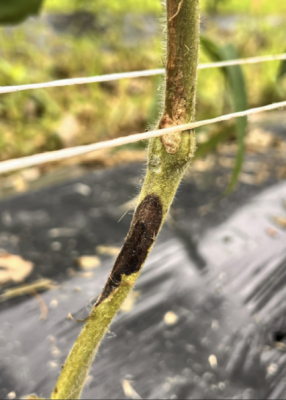
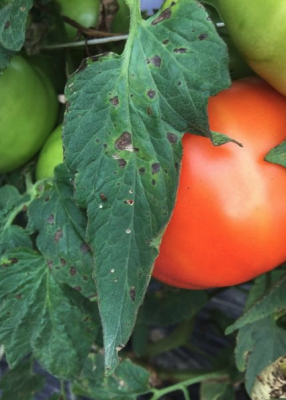
Commonly found early in the season, but can occur at any point during the growing season, early blight will start on the lower leaves as dark brown spots that start small and grow larger. The stems and fruit may also develop symptoms with dark sunken lesions that will also exhibit the concentric rings. On the stem, the infected area may be more elongated than would be seen on the leaves or fruit.
Host Crops: Solanaceae family (tomatoes, peppers, eggplant)
Identification of Disease
One key visual aspect to this disease is to look at the medium to larger sized brown lesions that appear on the leaves. The presence of “tree rings” is a key distinguishing feature of this disease.
Plants exposed to warm (59–80°F, optimal 82–86°F), humid weather with heavy dew or rain will increase the odds of infection. Leaf wetness is required for spore germination that can take about one week under favorable conditions.
Not to Be Confused with:
Septoria Leaf Spot: This will not have the concentric rings and the lesions will be smaller.
Bacterial Spot: Has small 1/16” spots that will have a water soaked appearance.
Vectors
Rain splash of soil onto leaves, wind, insects and animals can all spread early blight in season.
Infected seeds and debris from previous years infected plant material can carry over the disease in the soil since it can over winter.
Prevention
Variety Selection
| Geranium Kiss (Cherry) | Brandywine (Heirloom) | Darkstar (deep purple) (slicer) |
| Green Doctors Frosted (Cherry) | Chiapas (Heirloom) | Defiant F1 (slicer) |
| Jasper F1 (Cherry) | Coyote Cherry (Heirloom) | Gold Medal (slicer) |
| Matt’s Wild (Heirloom) (Cherry) | Marnero F1 (Heirloom) | Iron Lady F1 (slicer) |
| Mountain Magic F1 (Cherry) | Finger Lakes Round Paste (Plum) | Mt. Fresh Plus F1 (slicer) |
| Summer Sweetheart (Compari) (Cherry) | Indigo Rose (Plum) | Mountain Merit F1 (slicer) |
| Super Sweet 100 F1 (Cherry) | Juliet F1 (Plum) | Old Brooks (slicer) |
| Tommy Toe (Heirloom) (Cherry) | Plum Regal F1 (Roma) (Plum) | Seiger (slicer) |
| Honey Bunch F1 (Grape) | Verona F1 (Plum) | Stellar F1 (slicer) |
| Valentine F1 (Grape) | Brandywise (slicer) | Wisconsin 55 (slicer) |
| Aosta Valley (Heirloom) | Cloudy Day F1 (slicer) | Submarine (rootstock) |
Mechanical Approaches
Hot water seed treatment
Conventional Spray Products
Protectant fungicides like chlorothalonil, mancozeb, or copper-based products on a 7–10 day schedule.
Organic Spray Products
Copper-based products
References
Apps.lucidcentral.org. (n.d.). Tomato early blight. Pacific Pests, Pathogens & Weeds - Fact Sheets. https://apps.lucidcentral.org/ppp_v9/text/web_full/entities/tomato_early_blight_211.htm
Integrated Pest Management, University of California. (n.d.). Early blight. UC IPM: Agriculture: Tomato. https://ipm.ucanr.edu/agriculture/tomato/early-blight/
Maine Organic Farmers and Gardeners Association. (n.d.). Early blight. MOFGA. https://www.mofga.org/resources/fact-sheets/early-blight/
North Carolina State University Extension. (n.d.). Early blight of tomato. NC State Extension Publications. https://content.ces.ncsu.edu/early-blight-of-tomato
University of Connecticut, College of Agriculture, Health and Natural Resources. (n.d.). Early blight management in fresh market tomatoes. UConn IPM. https://ipm.cahnr.uconn.edu/early-blight-management-in-fresh-market-tomatoes/
University of Minnesota Extension. (2023). Early blight in tomato and potato. https://extension.umn.edu/disease-management/early-blight-tomato-and-potato
Consult and follow pesticide labels for registered uses. To avoid potential phytotoxicity problems, spot test before widespread use. No discrimination is intended for any products not listed.
The information in this document is for educational purposes only. The recommendations contained are based on the best available knowledge at the time of publication. Any reference to commercial products, trade or brand names is for information only, and no endorsement or approval is intended. UConn Extension does not guarantee or warrant the standard of any product referenced or imply approval of the product to the exclusion of others which also may be available. The University of Connecticut, UConn Extension, College of Agriculture, Health and Natural Resources is an equal opportunity program provider and employer.