Brown Marmorated Stink Bugs
Author: Matthew DeBacco
Reviewed by: Shuresh Ghimire, Ph.D.
Associate Extension Educator
Extension Vegetable Specialist
Date of Publication: June 29, 2026
Introduction
The Brown Marmorated Stink Bug (BMSB), Halyomorpha halys, is an invasive pest that can target a variety of different crops with their piercing-sucking mouthparts. The deformities to the plants are caused by the insects injecting digestive enzymes into the plant.
Symptoms
Feeding on immature fruit resembles prick marks that are surrounded by light discolored spots. As the fruit ripens these spots can become whitish or yellow and approximately ½ inch in diameter. This area may be slightly sunken and contribute to reduced fruit quality.
The nymphs can feed on leaves which will be evident by stippling that is about 1/8” in diameter and can provide access points for pathogens.
Host Crops: Tomatoes, peppers, sweet corn, beans, eggplant and Swiss chard are all favorites. However, asparagus, broccoili, cauliflower and cucumbers can also be fed on by the Brown Marmonrated Stink Bugs.
Identification of Insects
Remember that identification is important to distinguish the Brown Marmorated Stink Bug compared to the native stink bugs. The adults have a shield-shaped, 0.5–0.66 inches (13–17 mm) long, mottled gray-brown with a marbled pattern. Key features to look for are alternating dark and light bands on antennae, legs, and abdomen edges, and smooth, rounded shoulders. If pointed shoulders are present this is likely a native stink bug.
The nymphs have a difference appearance than the adults as they are smaller and rounder often feeding in groups that start with black and red and black abdomens that will develop white bands on the antennae and legs as they age.
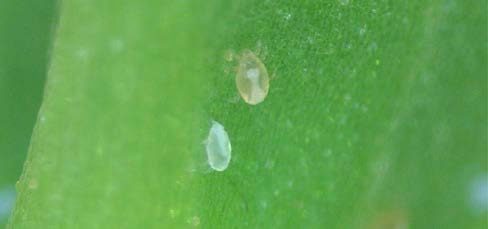
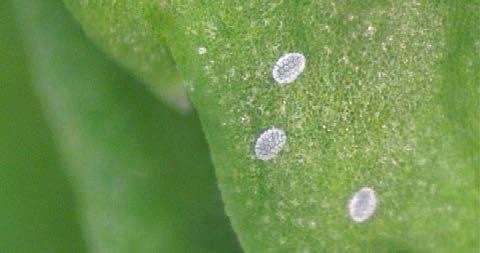
The eggs with have a light green to white elliptical shape that are laid in clusters.
These can also be seen in homes during the fall to overwinter.
Management
- Trap cropping with sunflowers, sorghum or buckwheat can be effective deterrents from tomato plantings.
- Assassin bugs, predatory stink bugs, and parasitic wasps (e.g., Trissolcus japonicus, the samurai wasp). Parasitized eggs are dark with irregular emergence holes.
- Conventional Spray Products: Insecticides (ex. bifenthrin, cyhalothrin, cyfluthrin, permethrin) targeting young nymphs, which are more susceptible. Avoid permethrin on tomatoes with fruit less than 1 inch in diameter. Consult New England Vegetable Management Guide for specific crop insect management section.
- Organic Spray Products: Insecticidal soap, neem oil, or pyrethrin-based sprays (e.g., azadirachtin and pyrethrins), though these are less effective against adults.
References
Clemson University, Home & Garden Information Center. (2020). Brown marmorated stink bug in structures. Retrieved July 2, 2025, from https://hgic.clemson.edu/factsheet/brown-marmorated-stink-bug-in-structures/
Penn State Extension. (2023). Brown marmorated stink bug. Retrieved July 2, 2025, from https://extension.psu.edu/brown-marmorated-stink-bug
University of California, Statewide IPM Program. (2020). Brown marmorated stink bug management guidelines. Retrieved July 2, 2025, from https://ipm.ucanr.edu/PMG/PESTNOTES/pn74169.html?src=302-www&fr=4388
University of Florida, Institute of Food and Agricultural Sciences. (n.d.). Brown marmorated stink bug. Retrieved July 2, 2025, from https://entnemdept.ufl.edu/creatures/veg/bean/brown_marmorated_stink_bug.htm
University of Maryland Extension. (2023). Brown marmorated stink bug. Retrieved July 2, 2025, from https://extension.umd.edu/resource/brown-marmorated-stink-bug/
Washington State University, Hortsense. (2023). Common insects and mites: Brown marmorated stink bug. Retrieved July 2, 2025, from https://hortsense.cahnrs.wsu.edu/fact-sheet/common-insects-and-mites-brown-marmorated-stink-bug/
Consult and follow pesticide labels for registered uses. To avoid potential phytotoxicity problems, spot test before widespread use. No discrimination is intended for any products not listed.
The information in this document is for educational purposes only. The recommendations contained are based on the best available knowledge at the time of publication. Any reference to commercial products, trade or brand names is for information only, and no endorsement or approval is intended. UConn Extension does not guarantee or warrant the standard of any product referenced or imply approval of the product to the exclusion of others which also may be available. The University of Connecticut, UConn Extension, College of Agriculture, Health and Natural Resources is an equal opportunity program provider and employer.