Tomato Broad Mites
Author: Matthew DeBacco
Reviewed by: Shuresh Ghimire, Ph.D.
Associate Extension Educator
Extension Vegetable Specialist
Date of Publication: June 29, 2026
Introduction
Broad mites (Polyphagotarsonemus latus), like most mites, are very small (less than 0.2mm) pests that tend to be more common in protective structures such as high tunnels and greenhouses. The warm and humid conditions can contribute to the speed of the life cycle in 5 to 13 days. The small size and ability to rapidly reproduce is what contributes to these mites becoming a widespread problem quickly as they feed on plant tissue. Some growers may also misdiagnose the actual mite damage since the damage can resemble a viral infection or nutrient deficiency was the toxic saliva is injected into the plant tissue.
Symptoms
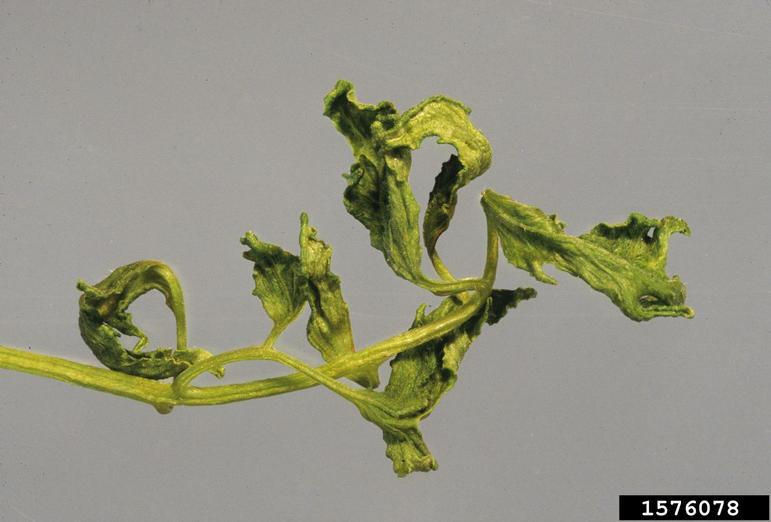
Young (newer growth) leaves will become distorted by twisting or curling down that typically have a browning discoloration. The veins of the leaf can remain green, causing a visual contrast. This can also impact the overall growth of the plant causing initial stunting and odd morphology to the growing tips which can progress to dieback and ultimately plant death.
The fruit can exhibit scarred patches and cracking at the spot of deformation which can reduce yield and lead to less marketable fruit.
Host Crops: Primarily of concern for Solanaceous crops (tomatoes, peppers, eggplants and potatoes). Beans and cucumbers can also be impacted especially if they are grown in protective structures.
Identification of Insects
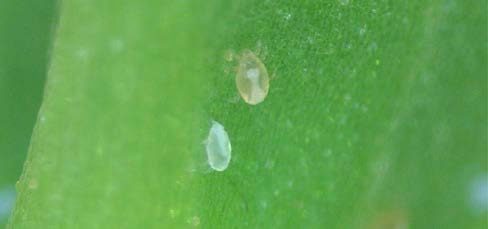
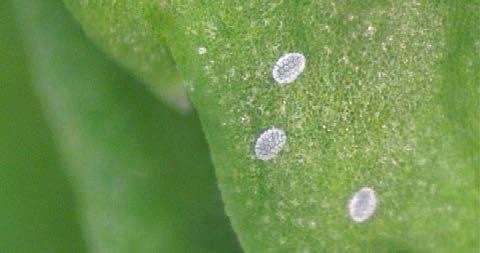
While it may seem obvious to look for the actual mites, remember these are very small (0.2mm) long so careful scouting of the undersides of young leaves, typically with the aid of a loupe or hand lens is strongly encouraged. Adult females are oval, yellow-green, with a white median stripe. Males lack the stripe, and are more mobile. Immature broad mites are white and slow-moving. The eggs are distinctive, clear, elliptical share with white raised bumps and will often be the key to confirming the presence of Broad Mites on a plant.
Management
Cultural
Inspect and quarantine new plants to reduce the chance of introducing them to a growing area.
Plant crops away from weed lines when possible as these can act as a reservoir for the mites.
Biological
Introduce predatory mites like Amblyseius swirskii, Neoseiulus californicus, or Neoseiulus cucumeris early in the crop cycle, especially in greenhouses. These predators are effective when released preventively or at low pest levels
Conventional Spray Products
The key is to be sure miticides (not just insecticides) classification of products is being used.
Examples include Avid, Akari, Judo, Pylon, SanMite, or sulfur-based products.
Miticides only labeled for spider mites may be ineffective since they are a different species.
Consult New England Vegetable Management Guide for specific crop insect management section.
Organic Spray Products
Organic options include neem oil, horticultural oil, or insecticidal soap, applied repeatedly for effective control.
References
Koppert US. (n.d.). Broad mite - Biocontrol, damage and life cycle. Retrieved July 2, 2025, from https://www.koppertus.com/plant-pests/spider-mites-and-other-mites/broad-mite/?utm_term=redirect
Schuster, D. J., & Smith, H. A. (2022). Broad and cyclamen mites. EDIS, 2022(3). https://edis.ifas.ufl.edu/publication/IN340
University of Florida, Institute of Food and Agricultural Sciences. (n.d.). Broad mite. Integrated Pest Management. Retrieved July 2, 2025, from https://ipm.ifas.ufl.edu/resources/success_stories/t&pguide/pdfs/Chapter4/Broad_Mite.pdf
University of Maryland Extension. (2019, August 9). Broad mites on high tunnel tomatoes. Retrieved July 2, 2025, from https://extension.umd.edu/resource/broad-mites-high-tunnel-tomatoes/
Virginia Cooperative Extension. (2024). Broad mite. Virginia Tech. https://www.pubs.ext.vt.edu/content/dam/pubs_ext_vt_edu/ENTO/ento-587/ENTO-587.pdf
Consult and follow pesticide labels for registered uses. To avoid potential phytotoxicity problems, spot test before widespread use. No discrimination is intended for any products not listed.
The information in this document is for educational purposes only. The recommendations contained are based on the best available knowledge at the time of publication. Any reference to commercial products, trade or brand names is for information only, and no endorsement or approval is intended. UConn Extension does not guarantee or warrant the standard of any product referenced or imply approval of the product to the exclusion of others which also may be available. The University of Connecticut, UConn Extension, College of Agriculture, Health and Natural Resources is an equal opportunity program provider and employer.