Botrytis blight is one of the most common diseases in the greenhouse. A wide range of plants including herbaceous ornamentals and ornamental bedding plants are susceptible. Here are some tips to prevent Botrytis blight during cool, cloudy weather periods during late spring greenhouse production when plants are in flower and greenhouses are full. The target audience of this fact sheet is commercial greenhouse growers.
- Keep plants in retail areas clean. Remove dead and injured plants and spent flowers a couple times a day. Spent flowers are a food source for Botrytis blight!
- Place debris in a COVERED garbage can with a tightly closed lid.
- Give white flowered varieties plenty of space and place in less humid areas. White flowered varieties always seem to be more prone to Botrytis blight.
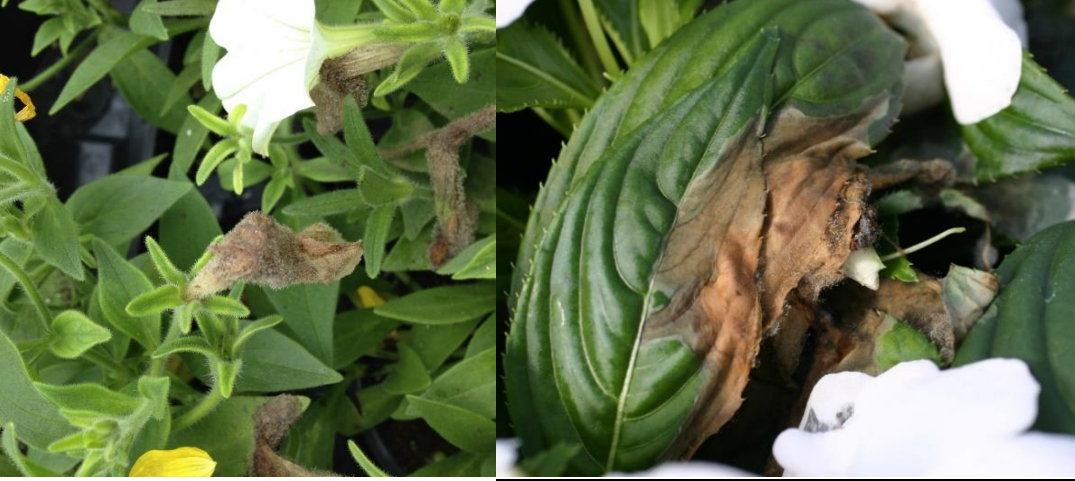
- Keep plants on the dry side. If you absolutely need to water, just spot water areas as needed to prevent over-watering.
- Water early in the day to make sure foliage is dry during the night. Avoid watering when the water will sit on leaf surfaces for long periods.
- Heat and vent to reduce humidity levels and fungal sporulation.
If you start to see fungal sporulation from Botrytis and physically clean the plants, as you handle the plants, you will just spread the fungal spores.
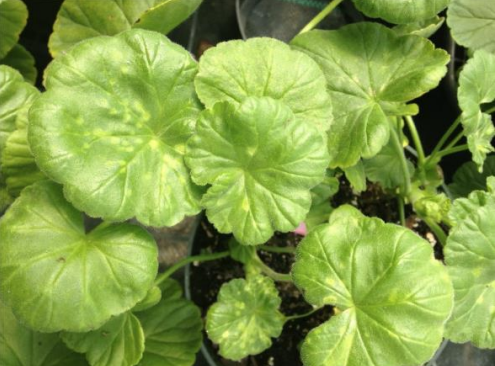
Sometimes, you will see “ghost spots” which are indicative of Botrytis lesions whose development has been arrested.
As you can see, these young zonal geranium plants were cleaned, which helped spread the spores to the tender young growth.
Tips to reduce humidity levels and condensation in the greenhouse
- Warm air holds more moisture than cool air. During warm days, the greenhouse air is more humid. As the air cools in the evening, the moisture-holding capacity drops until the dew point is reached. Water then begins to condense on surfaces.
- Reduce humidity by exhausting the moist air and replacing it with cooler, outside air that is drier.
The method and time to heat and vent depends upon the heating and ventilation system in your greenhouses.
- In greenhouses with vents, turn the heat on and crack the vents open about one inch. The moist, humid air escapes from the vents.
- In greenhouses with fans, activate the exhaust fans for a few minutes and then heat the greenhouse to raise the air temperature. Then, shut off the fans.
- A clock can be set to activate the fans. The cooler, outside air will lower the humidity levels as it is warmed in the greenhouse.
- A relay may be needed to lock out the furnace or boiler until the fan shuts off so that flue gases are not drawn back into the greenhouse. (This will also help to prevent air pollution damage (ethylene or sulfur dioxide) to sensitive plants.)
- Heat and vent two or three times per hour in the evening after the sun goes down and early in the morning at sunrise.
- Heating and venting can be effective even if it is cool and raining outside.
When you do not see the active fungal sporulation because of heating and venting to manage the greenhouse environment, you could then consider fungicide applications. If you spray when you see the Botrytis sporulation, you will just spread the spores around.
When ornamental crops are in flower, extra care is needed when selecting fungicides to avoid products that may leave unsightly residues on plants or damage sensitive flowers. Always read all labels carefully before applications!
- Read labels carefully for all plant safety information. Pesticide labels usually mention sensitive plant species and cultivars. However, due to the continued introduction of new species and cultivars, these listings are not complete. Before using a pesticide that is new to you or that you may have used before but not on the specific plant or cultivar you are interested in treating, test it first on a few plants. Treat similar age, cultivar and planting date and hold for at least 7 to 10 days to see if any phytotoxicity symptoms develop before widespread use. Leave a few plants of the same crop untreated, as a control.
See the latest edition of New York and New England Management Guidelines for Greenhouse Floriculture and Herbaceous Ornamentals for more information.
Disclaimer for Fact Sheets: The information in this document is for educational purposes only. The recommendations
contained are based on the best available knowledge at the time of publication. Any reference to commercial products, trade or brand names is for information only, and no endorsement or approval is intended. UConn Extension does not guarantee or warrant the standard of any product referenced or imply approval of the product to the exclusion of others which also may be available. The University of Connecticut, UConn Extension, College of Agriculture, Health and Natural Resources is an equal opportunity program provider and employer.