What are Entomopathogenic Fungi?
Entomopathogenic (insect-killing) fungi infect and parasitize insect and mite pests. Microbial insecticides contain a living fungus that is pathogenic to insects and other arthropod pests.
How do entomopathogenic fungi work?
When fungal spores contact and attach to the insect’s cuticle or outer covering, they produce enzymes that help break down the cuticle. The fungus then germinates and grows on the insect cuticle. It then produces a specialized structure known as an “appressorium” from which a germ tube emerges that enters the body of the insect so the fungus can penetrate the insect host, consuming the internal tissues and killing it. Some strains of Beauveria and Isaria may also release metabolites that weaken the insect’s immune system.
Insects may produce antimicrobial compounds the inhibit fungal attachment or shed the cuticle when molting. Molting reduces the time that the entomopathogenic fungus can infect the target insect pest. As insects groom themselves, they may also remove fungal spores.
Some entomopathogenic fungi that are commercially available
Specific fungal strains have been commercially developed that have been selected for their virulence and can be mass produced including Beauveria bassiana, and Isaria fumosoroseus.
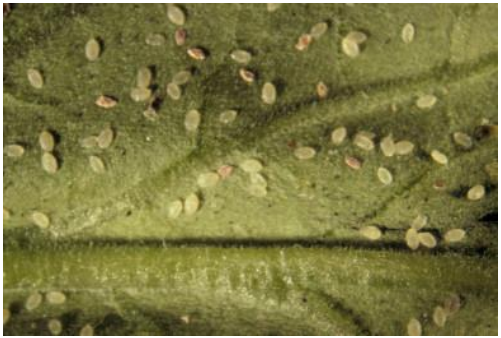
Beauveria bassiana is a fungus which causes the disease known as white muscadine disease. Beauveria is a naturally occurring fungus found in soil. Some of the target pests include whiteflies, aphids, and thrips. During conditions of high humidity, external sporulation produces conidia, which is how the fungus would complete its life cycle in nature. But, in the greenhouse, the fungi do not establish on their own, so repeated spray applications are needed. You will not see the fungi emerging from the body of the insect and producing a white cottony mass, but the target insect is still killed. To evaluate results, look for discoloration of the insect or lack of movement or reduction in numbers. The fungi infect the insect by contact, so the spores do not need to be consumed to cause infection.
Fungal spores are alive and can be harmed by storage at high temperatures or contact with water for more than 24 hours. Generally, wait 4 to 5 days before or after a fungicide application to apply Beauveria. However, some fungicides can be tank mixed. Contact the company technical representative for more information.
Isaria fumosoroseus was formerly known as Paecilomyces fumosoroseus. It has a world-wide distribution and wide host range. Isaria is one of the most common pathogens attacking Bemisia whiteflies and greenhouse whiteflies (Trialeurodes vaporariorum) in tropical and subtropical regions of the world. It has shown good residual activity against Bemisia whitefly nymphs but low activity against adults. Multiple applications are needed.
Isaria fumosoroseus Apopka 97 strain is reported to be generally compatible with biological control agents such as Encarsia formosa, Phytoseiulus persimilis, Orius, Eretmocerus, Delphastus and Dicyphus. According to the company literature, Isaria fumosoroseus FE990, is compatible with Encarsia formosa, Orius, and Amblyseius swirskii.
For more information consult the side effects databases from Koppert, Biobest, and Bioline Agrosciences.
Some of the benefits of entomopathogenic fungi
- Increasing market demand for biologically based products.
- Lower Re-entry Intervals (REI) and Pre-Harvest Intervals (PHI) intervals then many conventional insecticides.
- Complex modes of action may reduce selection pressure from conventional insecticide applications.
- Favorable plant safety.
- May be more compatible with biological control agents, but there are exceptions such as Beauveria is not compatible with ladybird beetles or or minute pirate bugs (Orius).
- Labeled for certain edible crops.
Some of the benefits of entomopathogenic fungi
- Work by contact, so thorough coverage is needed.
- As living spores, they have specific storage requirements.
- Have a short shelf life compared to conventional insecticides.
- Repeated applications are needed.
- Most do best with refrigerated storage.
Tips when using entomopathogenic fungi
- Use preventively and do not expect quick knockdown.
- Look for dead & discolored pests, and reduction in pests after 2 to 3 applications.
- Spray to glisten, not to runoff.
- Spray end of day, or a rainy day (to increase fungal sporulation).
- Fungal spores are very sensitive to ultraviolet rays, so apply in late afternoon or evening or on cloudy or rainy days.
- Check the date of manufacture on the container before using. Dead spores cannot infect insect pests.
- Follow storage guidelines.
Some Selected Entomopathogenic Fungi Used in Greenhouse Production
If any information is inconsistent with the label, then follow the label.
| Trade Name | Active Ingredient | Target Pests | Favorable Conditions | Storage & Shelf Life |
| Ancora 4 hr. REI OMRI |
Isaria fumosoroseus Apopka Strain 97 | Aphids, adult leafminers, mealybugs, plant bugs, spider mites, thrips, whiteflies |
Most effective RH > 80% for 8-10 hours. See OHP website for specific use directions. |
Keep refrigerated (39F) and dry. Use within 30 days of opening. |
| Bioceres WP 4 hr. REI OMRI |
Beauveria bassiana ANT-O3 |
Aphids, beetles, plant bugs, thrips, weevils, whiteflies |
RH > 60%, 65- 85 F | 18 months at 39F |
| BotaniGard ES, 22 WP 4 hr. REI Mycotrol WPO, ESO 4 hr. REI OMRI |
Beauveria bassiana GHA |
Aphids, mealybugs, plant bugs, thrips, weevils, mealybugs, whiteflies |
RH > 60%, 68- 80 F. WP: compatible with N. cucumeris and A. swirskii. Incompatible with Orius. Labeled as a cutting dip |
Store between 40-85F. WP: 12 months ES: 18 months |
| No Fly WP 12 hr. REI OMRI |
Isaria fumosoroseus FE 9901 |
Aphids, beetles, mites, leafhoppers, mealybugs, plant bugs, fungus gnats, thrips, weevils, whiteflies |
Most effective RH > 50%, 72 – 84 F. Most active on eggs and immatures. |
Store between 34-72 F. Viable at room temperature for up to 6 months. Refrigeration extends shelf life to 12 months. |
| Velifer (G) 12 hr. REI | Beauveria bassiana PPRI 5339 |
Aphids, mealybugs, mites, thrips, whiteflies |
RH > 60%, 71-82 F. | Store under refrigerated conditions. At 40 F lasts 24 months. Is an oil dispersion spore concentrate |
REI: Re-entry interval
OMRI – Organic Materials Review Institute https://www.omri.org/
G= Greenhouse Use only
Entomopathogenic fungi can be a useful tool against certain greenhouse pests if they are used preventively and applied during the favorable conditions and the products are stored properly.
Disclaimer for Fact Sheets: The information in this document is for educational purposes only. The recommendations contained are based on the best available knowledge at the time of publication. Any reference commercial products, trade or brand names is for information only, and no endorsement or approval is intended. UConn Extension does not guarantee or warrant the standard of any product referenced or imply approval of the product to the exclusion of others which also may be available. The University of Connecticut, UConn Extension, College of Agriculture, Health and Natural Resources is an equal opportunity program provider and employer.