Introduction
The tarnished plant bug (TPB), Lygus lineolaris, has a wide host range, attacking many different annual and perennial flowers, especially composites and legumes. It also feeds upon fruits, causing cat facing on strawberries.
Feeding Damage
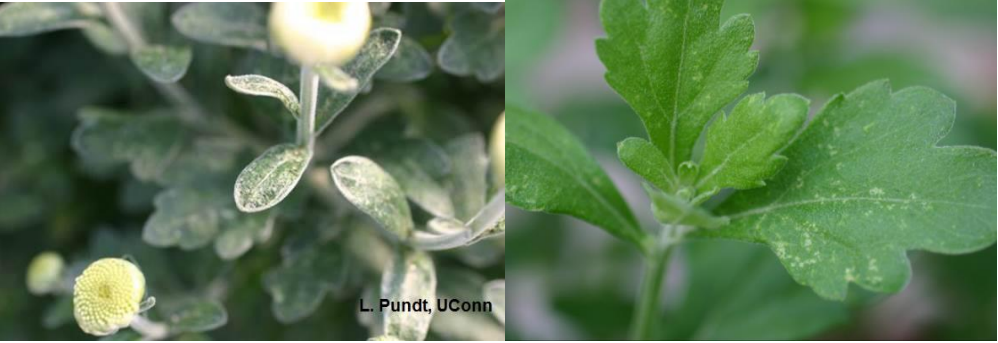
Both adults and nymphs use their piercing-sucking mouthparts (stylets) to feed on plant fluids while injecting toxic saliva that kills plant cells surrounding their feeding site. Flowers fail to develop on one side or flower buds abort. Leaves may look ragged with small brown spots. Terminal shoots and flowers may be killed.
Biology and Life Cycle
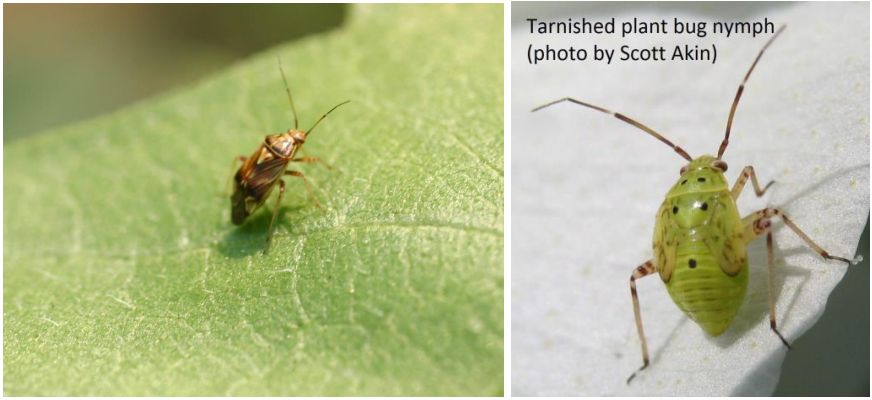
The adult is about ¼ inch long, flattened, oval and generally brown with yellow and black markings. Adults are winged and very active, especially when disturbed. Females insert eggs into flower petals, plant stems, leaf petioles, or along leaf midribs.
Tarnished plant bugs overwinter as adults under weeds or debris. Eggs hatch in 7 to 10 days. Newly emerged nymphs are wingless, about 1/10-inch-long and bright green, with long legs. Nymphs resemble immature aphids, but they are faster moving than aphids. As they get larger, they look like adults but have wing pads. Their life cycle may be completed in 3 to 4 weeks with two to three generations per season. As weeds desiccate in the summer months, tarnished plant bugs may migrate to hosts that are more succulent.
Scouting
Gently tap foliage over a sheet of white paper to look for nymphs and adults. White sticky traps can be used to monitor for adults. Check cards about once a week. Adults fly when disturbed or hide under leaves so they are hard to find on plants because they are so mobile.
Biological Controls
Natural enemies include an introduced braconid parasitic wasp (Peristenus digoneutis) that was first released in alfalfa crops in New Jersey. It has since spread throughout the Northeast to CT, PA, MA, NH, VT, and NY. However, only 50% mortality occurs, and it is very difficult to rear so commercial availability is unlikely. Ladybird beetles, spined soldier bugs and insidious flower bugs also prey on nymphs. However, currently, natural enemies do not provide adequate control.
Cultural Controls
Remove weeds and plant debris within and around the greenhouse perimeter to remove potential overwintering sites. Mow grasses and weeds surrounding the growing area.
Chemical Controls
Tarnished plant bugs are difficult to control due to their mobility. Contact insecticides may be used to kill adults or nymphs. Before using a pesticide on a new crop or cultivar, treat a few plants and check for phytotoxicity (plant damage) especially to flowers, before treating the entire crop. Insecticide labels may list lygus bug instead of tarnished plant bug.
Disclaimer for Fact Sheets: The information in this document is for educational purposes only. The recommendations contained are based on the best available knowledge at the time of publication. Any reference commercial products, trade or brand names is for information only, and no endorsement or approval is intended. UConn Extension does not guarantee or warrant the standard of any product referenced or imply approval of the product to the exclusion of others which also may be available. The University of Connecticut, UConn Extension, College of Agriculture, Health and Natural Resources is an equal opportunity program provider and employer.