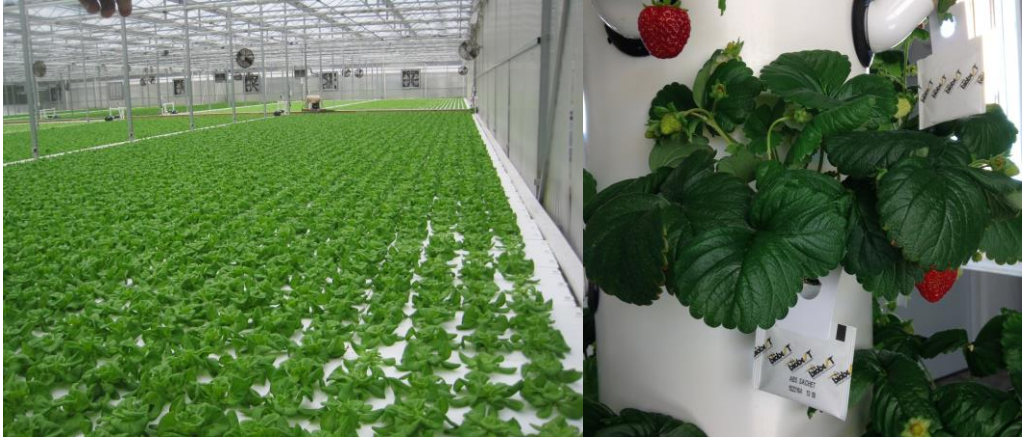
Hydroponics comes from the Greek word “hydro” for water and “ponos” for labor, so is a production method where the plants are grown in water that is enriched with all essential plant nutrients and oxygen. Because of the higher initial investment and technical skills needed, it is advisable to research this method extensively before starting an operation. Talk to other growers, suppliers and researchers to learn as much as possible. Below are some online resources to assist you.
Websites
Cornell Controlled Environment Agriculture Website
Includes grower handbooks on hydroponic lettuce, spinach, and strawberry runner
propagation. http://blogs.cornell.edu/cornellcea/
Controlled Environment Berry Production Information: presented by the Kubota Lab at Ohio State University includes information on planting materials, production, environment, lighting, fertigation, IPM, and production costs with online training schools, videos and webinars. https://u.osu.edu/indoorberry/
eGro (Electronic Grower Resources Online-Edible Alerts A colloraborative effort of greenhouse specialists to create a clearing house for alerts about disease, insect, environmental, physiological and nutritional disorders. http://www.egro.org/alerts.php#EDIBLE
University of Arizona: Controlled Environment Agriculture Center (CEAC)
http://ceac.arizona.edu/
UConn Greenhouse Research and Extension
https://greenhouse.uconn.edu/
Nutrient Programs for Hydroponic Crops Webinar by Rosa Raudales
https://greenhouse.uconn.edu/hydroponics/
The Greenhouse Channel on You tube includes videos on greenhouse tomatoes and
leafy greens & IPM https://www.youtube.com/@UConnGreenhouse/videos
Factsheets, Newsletter Articles
Currey, C. 2017. An Introduction to Pests in Hydroponic Systems.
http://www.producegrower.com/article/an-introduction-to-pests-in-hydroponicproduction/
Mattson, N. and C. Peters. 2014. A Recipe for Hydroponic Success – Guide to Fertilization
http://hort.cornell.edu/greenhouse/crops/factsheets/hydroponic-recipes.pdf
Williams, K. A, O. Francescangeli and J. Nelson. 2013. Using Organic Fertilizers in Hydroponics and Recirculating Culture. Kansas State University Research.
http://www.gpnmag.com/wpcontent/uploads/06_KSU%20Research_GPN0913%20FINAL.pdf
Vallotton, A., L. Strawn, J. Latimer. 2017. Guide to Identifying Food Safety Hazards in Greenhouse Systems. Virginia Cooperative Extension.
https://vtechworks.lib.vt.edu/handle/10919/80715
Nemali, K. and P. Langenhoven. 2017. How to determine if Supplemental Lighting is Economical for Hydroponic Lettuce Production in winter?
https://www.purdue.edu/hla/sites/cea/article/how-do-i-know-if-supplemental-lighting-iseconomical-for-hydroponic-lettuce-in-winter/
Trade Magazines and Newsletters
Produce Grower: http://www.producegrower.com/
Search for hydroponics http://www.producegrower.com/news/category/hydroponics/
Greenhouse Vegetable News from GrowerTalks Magazine Inside Grower – Controlled Environment Agriculture
https://www.growertalks.com/Newsletters/
Some selected reference books
Growing Greenhouse Vegetables in Ontario. Publicaton 0836E Ontario Ministry of Agriculture, Food and Rural Affairs. https://www.publications.gov.on.ca/browse-catalogues/livestock/horticultural-crops/greenhouse-crops-general/growing-greenhousevegetables-in-ontario
Hydroponic Food Production: A Definitive Guidebook for the Advance Home Gardener and Commercial Hydroponic Grower, 8th edition by Howard M. Resh. A Definative Guidebook for the Advanced Home Gardener and Commercial Hydroponic Grower.
Disclaimer for Fact Sheets: The information in this document is for educational purposes only. The recommendations
contained are based on the best available knowledge at the time of publication. Any reference to commercial products, trade or brand names is for information only, and no endorsement or approval is intended. UConn Extension does not guarantee or warrant the standard of any product referenced or imply approval of the product to the exclusion of others which also may be available. The University of Connecticut, UConn Extension, College of Agriculture, Health and Natural Resources is an equal opportunity program provider and employer.