Introduction
Sawflies in the order Hymenoptera are close relatives of bees and wasps yet may feed upon plants. There are two main families of sawflies, conifer sawflies which feed upon conifers and common sawflies, which can feed upon a wide range of broadleaved plants. Growers may encounter various species of sawflies feeding upon herbaceous perennials. The target audience of this fact sheet is commercial greenhouse growers and retailers.
Identification, Biology and Life Cycle
Although sawfly larvae may be confused with caterpillars which are Lepidopteran larvae, it is important to distinguish between the two, because management strategies against these two types of larvae differ. Both sawflies and caterpillars have prolegs which are stumpy legs that help them crawl on their abdomen.
Caterpillars generally have two to five pairs of fleshy, stubby prolegs on their abdomen. Their prolegs also have hooks or spines at the tip, which help them attach to plants.
Sawfly larvae have six to eight pairs of prolegs without the hooks or spines at their tip.
Sawfly adults are heavy bodied, thick-waisted wasps that do not sting. They insert their eggs into plant foliage with their saw-like ovipositor.
Feeding Damage
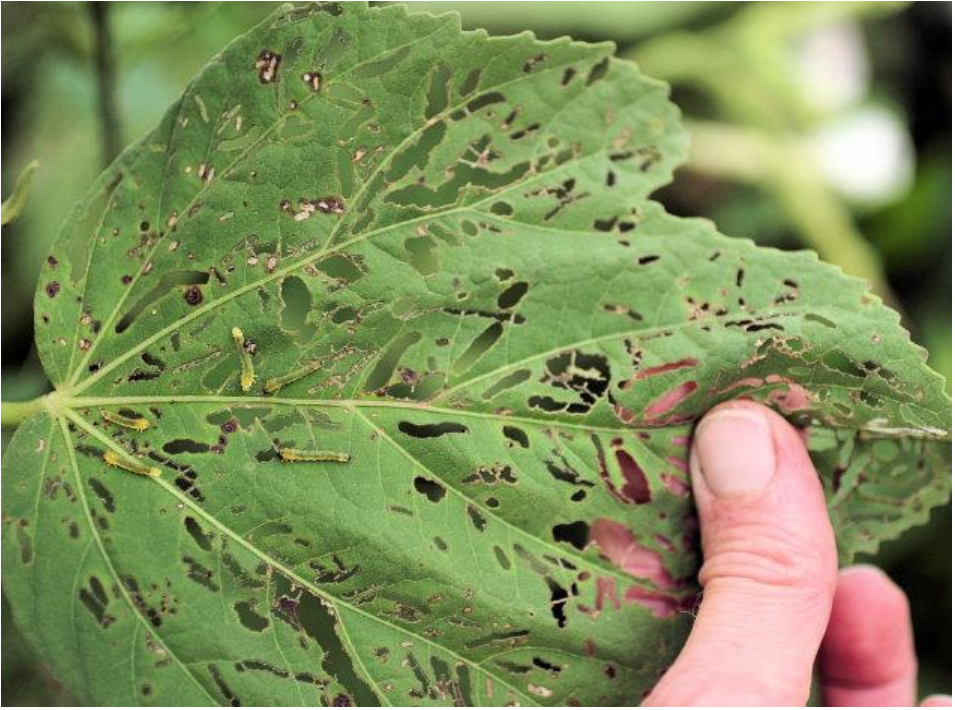
Sawfly larvae feed together in groups and can cause extensive damage to herbaceous perennials. All sawfly larvae feed in groups on leaf tissue but not veins, skeletonizing leaves, giving leaves a lacy appearance.
For example, the pale green columbine sawfly larvae (Pristophora aquiligae) can rapidly defoliate columbine in the spring. Generally, there is only one generation per year.
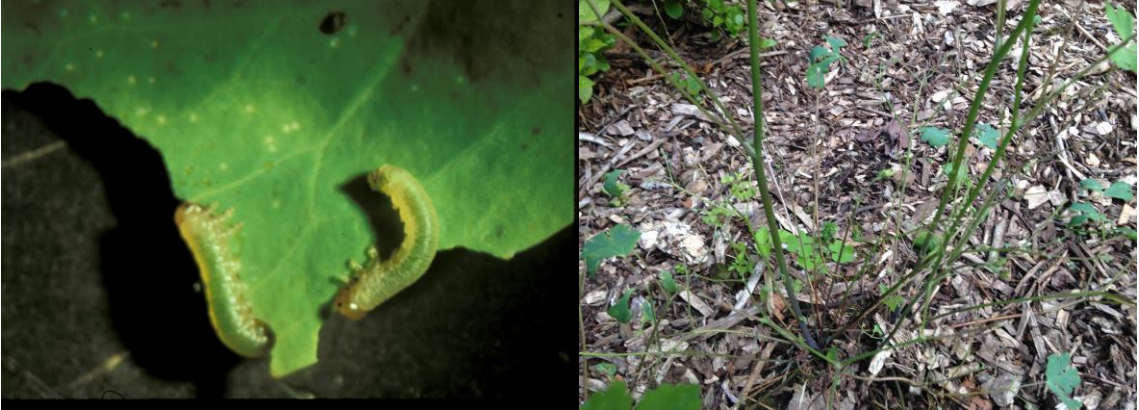
The light green Hollyhock sawfly larvae (Neoptilia malvacearum) feeds on hollyhock causing skeletonization of their leaves.
Hibiscus sawfly (Atomacera decepta) can be very damaging to susceptible Hibiscus moscheutos or rose mallow varieties. Hibiscus cultivars such as Luna, Belle, Lord and Lady Baltimore are very susceptible. The hibiscus sawfly can also feed upon hollyhock and other mallows but not Hibiscus syriacus or Rose of Sharon and Hibiscus rosasinensis.
Scouting
Look for the thick-waisted adults in the early morning, resting on plant leaves. The young sawfly larvae first feed on the underside of the leaves.
Chemical Controls
Bacillus thuringiensis subsp. kurstaki, or Btk, is specific to caterpillars and is not effective against sawflies. Spinosad or a pyrethroid-based insecticide may be effective against sawflies.
Disclaimer for Fact Sheets: The information in this document is for educational purposes only. The recommendations contained are based on the best available knowledge at the time of publication. Any reference commercial products, trade or brand names is for information only, and no endorsement or approval is intended. UConn Extension does not guarantee or warrant the standard of any product referenced or imply approval of the product to the exclusion of others which also may be available. The University of Connecticut, UConn Extension, College of Agriculture, Health and Natural Resources is an equal opportunity program provider and employer.