Introduction
Rust diseases are easily recognized, but once they become established, they can be difficult to control. The common name “rust” refers to the characteristic reddish to orange blister-like swellings (known as “pustules”) produced on the infected leaves and stems of host plants. The fungi that cause rust diseases are obligate parasites that need living plants to survive. Host plants are rarely killed, but their overall plant health and appearance is adversely impacted. With severe infections, leaf blighting and premature drops occur. The target audience of this fact sheet is commercial greenhouse and nursery growers.
Unlike most fungi that produce only one or two types of spores on a single host, rust fungi have a more complicated life cycle. For some rusts, only one host is needed. For others, two different types of hosts are needed for the pathogen to complete its life cycle. Conifers and grasses may be alternative hosts.
Favorable Conditions
Mild, moist conditions favor the development of rust diseases. Windblown spores from infected plants to healthy plants spread rusts. Spores are also easily spread by splashing water. They need wet leaf surfaces to germinate and cause infection.
Symptoms
Symptoms of rust diseases vary with the host plant and often begin as chlorosis or yellowing on the upper surface of leaves. These develop into blister-like swellings or pustules on the leaf undersides that produce powdery masses of spores. Pustules may also occur on the upper leaf surface. Rust diseases can be inadvertently be spread when apparently healthy, but already infected, plants are shipped.
Rust diseases can affect a wide range of ornamental host plants. Greenhouse crops such as chrysanthemum, fuchsia, salvia, and snapdragon may become infected. Herbaceous perennials such as Aconitum, Adenophora, Alcea, Anemone, Aster, Calamagrostis, Campanula, Clematis, Delphinium, Hemerocallis, Heuchera, Iris, Liatris, Miscanthus, Monarda, Lupinus, Panicum, Pennisetum, Solidago Veronica, and Viola may become infected,
Here is an overview of some of these rust diseases.
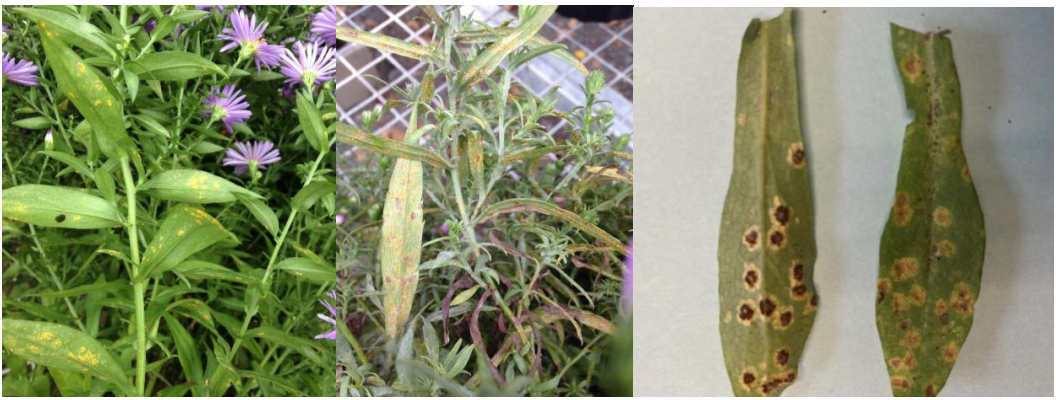
Aster Rust
Several rust diseases affect aster. Orange-red pustules develop on the leaf undersides; heavy infections can cause leaf yellowing. Coleosporium campanulae requires pine as an alternate host, while Puccinia species have various sedges and grasses as alternate hosts. The removal of alternate hosts is helpful.
Chrysanthemum Brown Rust
Caused by the fungus Puccinia tanaceti causes yellow spots on the upper leaf surface. As this disease progresses, chocolate-brown rust pustules develop on the underside of the leaves.
Chrysanthemum White Rust (CWR)
Is caused by Puccinia horiana and its common name refers to the diagnostic pustules that develop on the underside of the leaves, which are first white, and then turn pinkish or buff-colored as they age. Symptoms first begin as yellow to tan spots on the upper leaf surfaces. Infected plants may not show any symptoms during hot, dry conditions, but only when the weather turns cool and wet. Cool weather (40-73 ˚F), high humidity and wet foliage for at least 5 hours promote the
development of CWR. For more see: Chrysanthemum White Rust Bulletin Program Summary for Prevention (Syngenta Flowers, Inc. 2011).
Fuchsia Rust
Is caused by the fungus Pucciniastrum epilobii. Affected leaves may be deformed and defoliation often occurs. Bright orange pustules develop on the underside of the leaves. This disease can be especially severe during propagation, so may be spread on infected cuttings. Fireweed (Epilobium), can serve as a reservoir of inoculum (a pathogen or its parts that can cause disease). To complete its cycle, Fuchsia rust must rotate from fireweed and fuchsia to its alternate host, true fir (Abies).
Geranium Rust
Is caused by the fungus Puccinia pelargoni-zonalis. It affects only zonal or bedding geraniums. This fungus completes its life cycle on only one host. Initial symptoms appear as chlorotic specks on the upper leaf surface. Pustules containing rust-colored spores erupt in concentric rings that form a distinct "target" spot on the underside of the leaves. Purchase certified culture indexed cuttings because this rust disease can be spread on infected cuttings. Discard unwanted geraniums at the end of the growing season. Carried over stock plants may be a source of infection. Rust resistance has been found in the Regal, scented and ivy leaf geraniums.
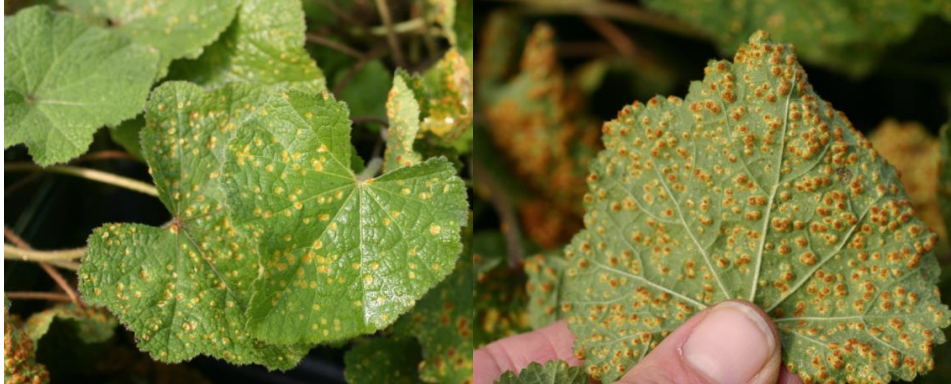
Hollyhock Rust
Is caused by the fungus Puccinia malvaracearum. Symptoms include yellow spots on the upper leaf surface. More noticeable are the orangish-brown pustules found on the underside of the leaves and on plant stems. Heavily infected
plants become unattractive and are not marketable. Hollyhock rust also occurs on mallow, a common weed, which can serve as a disease reservoir of hollyhock rust.
Veronica Rust
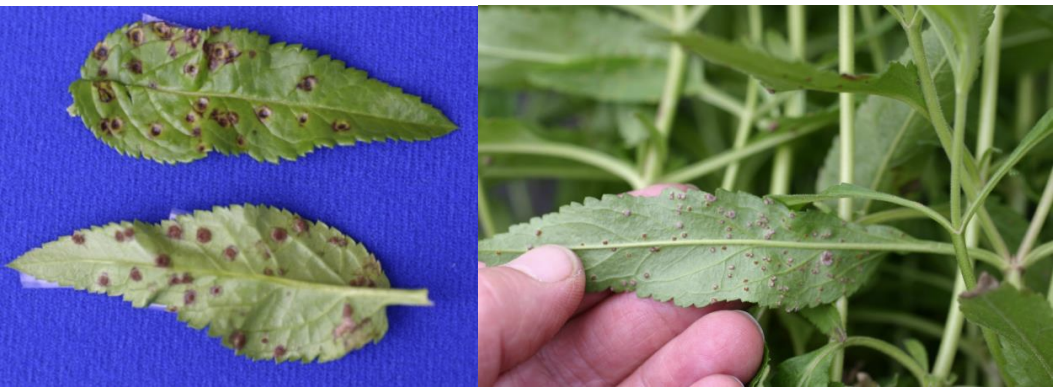
Is caused by the fungus Puccinia veronicae-longifloliae and has been observed on Veronica longifolia "Eveline" and Veronica spicata. Symptoms include reddish-brown necrotic sunken spots with a faint yellow margin on the upper leaf
surface. Reddish-brown to tan pustules also develop on the underside of the leaves. Heavy infections can result in defoliation.
Switchgrass Rust
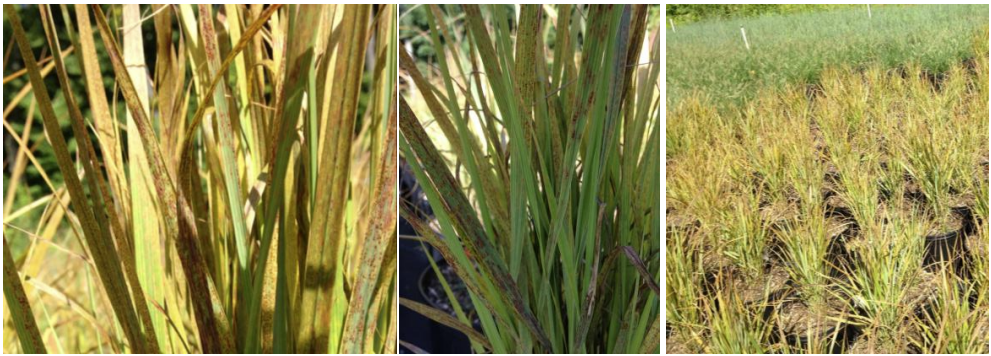
Is caused by the fungus Puccinia emaculata and is especially severe on susceptible cultivars of Panicum sp. (switchgrass) such as Dallas Blues, Dewey Blues, Cloud Nine and Northwind during favorable environmental conditions. Elongate,
narrow, rust colored pustules form on the leaves, which are followed by browning and drying of infected leaves.
Management
- Carefully inspect all incoming plants for symptoms, especially those that occur at the beginning of the production cycle. Keep in mind that plants may be purchased that are already infected, but not yet showing any symptoms.
- Setting aside new plants, especially those with which you have recurring problems, in a quarantine area for up to three weeks to allow rust diseases to develop (if present) helps reduce their potential spread.
- Scout regularly for rust diseases on susceptible plants or cultivars. Look on the upper leaf surface for chlorotic or yellow specks and on the underside of the leaves for the characteristic pustules that develop on that host plant. Watch carefully for the beginnings of rust outbreaks, so treatments can be effective.
- Once detected, remove all rust-infected leaves and heavily infected plants by carefully placing them in a plastic bag before removing them from the greenhouse. Rust spores are easily spread in air currents! Destroy infected plant material by burning, rapid-composting, or burying.
- Reducing leaf wetness helps to reduce favorable conditions for rust development. Keep foliage dry by proper watering practices and environmental controls in the greenhouse. Space plants properly to provide for good air circulation between plants.
- Select less susceptible cultivars, if available.
- At the end of the growing season, carefully clean up and destroy all infected crop debris.
- Use a commercially available disinfectant to clean up the growing area.
There are several different fungicides effective against rust diseases. If you have a history of a problem with a rust disease on certain plants or cultivars, preventative applications are helpful. Rotate applications between chemical classes or FRAC codes to help prevent fungicide resistance from developing. Use contact fungicides in rotation with systemic fungicides. See the latest edition of New England Floricultural Recommendations: A Management Guide for Insects, Diseases, Weeds and Growth Regulators available from Northeast Greenhouse Conference and Expo for more
information.
Disclaimer for Fact Sheets: The information in this document is for educational purposes only. The recommendations
contained are based on the best available knowledge at the time of publication. Any reference to commercial products, trade or brand names is for information only, and no endorsement or approval is intended. UConn Extension does not guarantee or warrant the standard of any product referenced or imply approval of the product to the exclusion of others which also may be available. The University of Connecticut, UConn Extension, College of Agriculture, Health and Natural Resources is an equal opportunity program provider and employer.