Introduction
Whiteflies are sucking insects that feed on plant sap. Adults are small, white insects with four white wings. Both the adults and immature stages are found on the underside of the leaves. If heavy populations develop, plants become weakened with less vigor. The presence of low numbers of whiteflies can reduce the marketability of many greenhouse ornamental crops. The target audience of this fact sheet is commercial greenhouse growers.
Identification
The primary whitefly species in greenhouses include the greenhouse whitefly (Trialeurodes vaporariorum) and sweetpotato whitefly (Bemisia tabaci). Occasionally, the Bandedwinged whitefly (Trialeurodes abutilonea) may enter greenhouses from outdoors in the fall, but it not a serious pest and control is rarely needed. Adults may occasionally be seen on yellow sticky cards.
The powdery white (1/16th inch long) greenhouse whitefly adults have wings that tend to lie flat over their body.
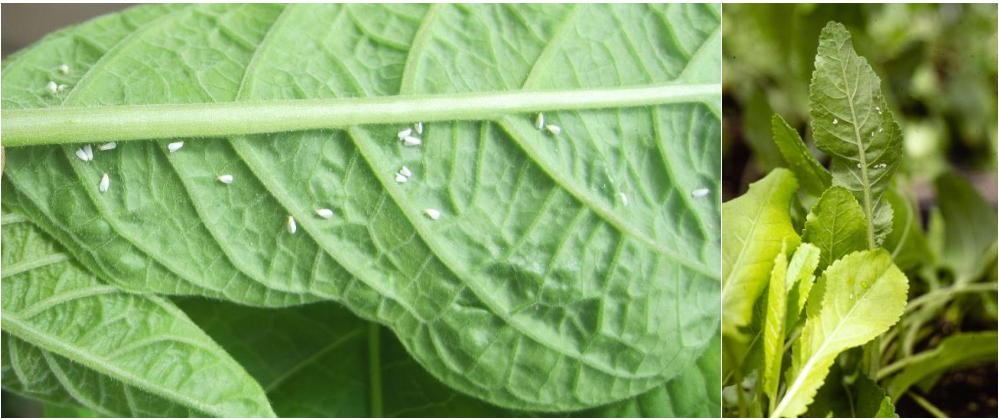
The yellowish, sweetpotato whitefly adults are slightly smaller than the greenhouse whitefly adults. Sweetpotato whitefly adults also tend to hold their wings at a 45-degree angle close to their body.
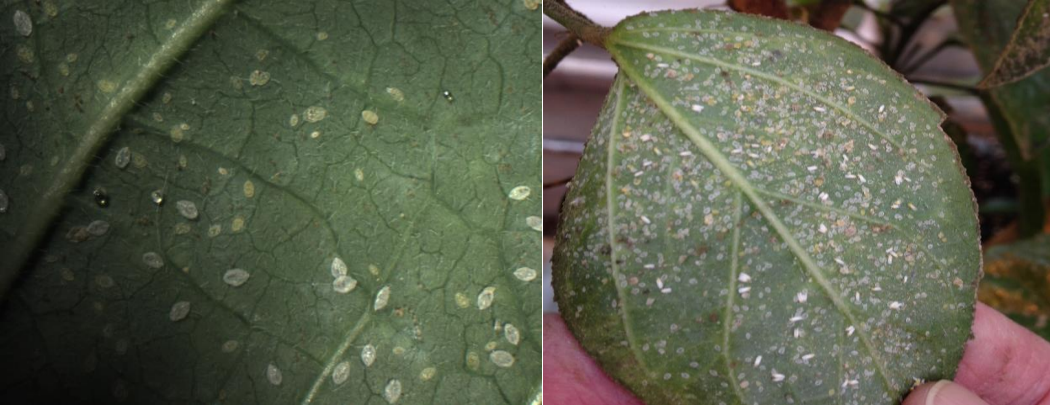
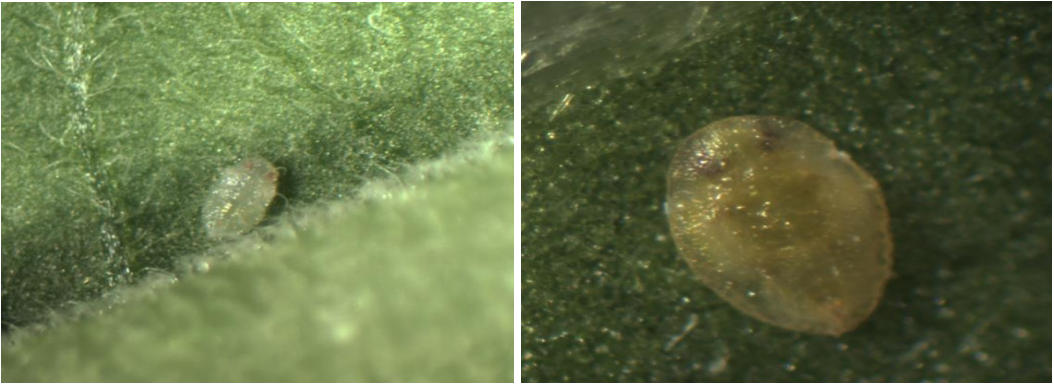
A more reliable method to identify the different species is to examine the immature pupal stage. Red eyes indicate adults are ready to emerge.
- Greenhouse whitefly pupae are white with straight, elevated sides and a fringe of wax filaments around the edge of the pupal case.
- Sweetpotato whitefly pupae are yellowish with a more rounded edge. In general, sweetpotato pupae have fewer waxy filaments than the greenhouse whitefly pupae.
Feeding Damage
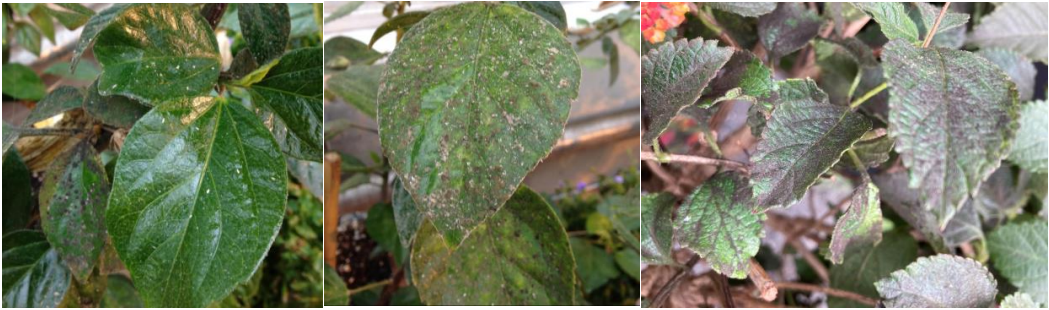
Whitefly nymphs and adults have piercing sucking mouthparts that are used to feed on plant fluids. While low populations may not cause serious plant injury, the presence of only one or two whiteflies at the time of sale may be objectionable to customers. At higher population levels, whiteflies can cause the plant's foliage to become yellowed
and mottled. Nymphs may secrete large amounts of honeydew, a sweet sugary sap, onto the plant's foliage. Honeydew serves as a growing media for the black sooty mold fungus that is unsightly and can interfere with photosynthesis.
Whitefly Development at 70oF
| Developmental Stage | Greenhouse Whitefly | Sweet potato Whitefly |
| Egg | 9 days | 12 days |
| 1st instar | 4 days | 6 days |
| 2nd/3rd instar | 7 days | 10 days |
| Pupal (4th instar) | 11 days | 10 days |
| Adult
Egg laying period of adult female |
5-40 days
6 days |
5-30 days
22 days |
| Egg to Adult | 32 days | 39 days |
Biology and Life Cycle
Whiteflies life cycle progresses from the first, second, third and fourth nymphal stages to the pupal stage (end of the 4th instar) to adults. Adult whiteflies may live for one to two months. Development takes from 14 to 40 days depending upon temperature, host plant and whitefly species. Females lay their eggs on the underside of upper leaves. The eggs hatch into first instar nymphs that move a short distance and then settle down to feed. The nymphal stages (2nd, 3rd, and 4th) are stationary and do not move. During the late fourth instar, you may see the red eyes of the developing adult. After the adults emerge from the pupal case, you can see a T-shaped emergence hole. (Do not confuse this with the round emergence hole as parasitic wasps emerge).
Prevention
- Start the season with a clean, weed-free greenhouse.
- A fallow period of 2 to 4 weeks, when all plants and weeds are eliminated, will help to minimize potential whitefly problems.
- Avoid over-fertilizing crops as this increase their attractiveness to adult whiteflies.
- Inspect incoming plants and cuttings for both adult and immature whiteflies.
Scouting
A weekly, regular monitoring program is needed for the early detection of whiteflies and to evaluate the effectiveness of your management program. Use yellow sticky cards, random foliar plant inspections and pest-infested indicator plants to monitor whitefly populations.
- Yellow sticky cards can be placed in the greenhouse at the rate of approximately one per 1000 sq. ft. Place additional cards near doors and vents. Change cards weekly and keep track of population trends to determine if populations are increasing or decreasing.
- Randomly inspect plants in production areas and near whitefly emigration areas. Weekly inspections will help you determine which life stage (egg, crawler, pupae, or adult) is present. Often, only one to two life stages may be present. By knowing the predominant life stage one can better time pesticide applications to the most susceptible life stage. For example, you may want to target foliar sprays against the adult and immature whitefly nymphs. Eggs and pupae are tolerant to many insecticides.
- When a pest-infested plant is detected, it can be tagged to be used as an indicator plant to track whitefly development.
Biological Controls
Several different host specific parasitic wasps, as well as predatory mites and beetles are commercially available. See Biological Control of Whiteflies factsheet on the UConn Greenhouse IPM webpage for more information.
Chemical Controls
Systemic, contact, and translaminar insecticides and insect growth regulators may be used against whiteflies See New York and New England Management Guidelines for Greenhouse Floriculture and Herbaceous Ornamentals for more information.
An integrated program focusing on sanitation, cultural practices, biological controls, and chemical controls is needed to manage whiteflies.
Disclaimer for Fact Sheets: The information in this document is for educational purposes only. The recommendations contained are based on the best available knowledge at the time of publication. Any reference commercial products, trade or brand names is for information only, and no endorsement or approval is intended. UConn Extension does not guarantee or warrant the standard of any product referenced or imply approval of the product to the exclusion of others which also may be available. The University of Connecticut, UConn Extension, College of Agriculture, Health and Natural Resources is an equal opportunity program provider and employer.