Small, fringed winged thrips may occur on vegetable transplants. Western flower thrips (WFT), Frankliniella occidentalis small size (1/16 inch) and tendency to remain hidden in young buds makes it difficult to detect the thrips before severe feeding damage is evident. WFT broad host range, high reproductive capacity, rapid life cycle, and resistance to insecticides also makes them difficult to control. More growers are using preventive releases of biological control agents to manage thrips.
Thrips feeding Damage
Thrips feed by piercing plant cells with their mouthparts and feeding on the exuded plant juices. This collapse of plant cells results in deformed leaves and shoots. Silvery-flecked scars and small black "fecal" spots may be seen on the expanded leaves. Scar formation and distorted growth can occur. Thrips have a broad host range, feeding upon include many vegetable transplants such as Cole crops, leafy greens, and eggplant, peppers, and tomato transplants.
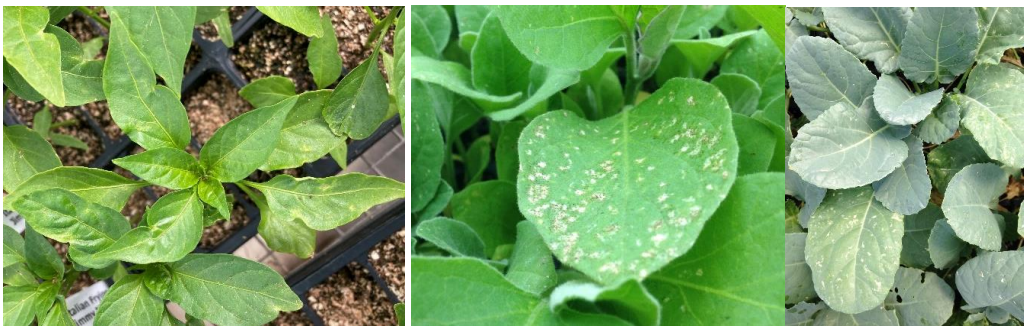
In addition to direct feeding injury, WFT may vector (spread) two closely related tospoviruses; impatiens necrotic spot virus (INSV) and tomato spotted wilt virus (TSWV), to uninfected plants. Onion thrips (T. tabaci) may also vector TSWV.
Biology and Life Cycle
Thrips life cycle consists of eggs, two larval stages, prepupal and pupal stages and adults. Adult females may live for approximately 30 to 45 days. Female thrips insert their saw-like ovipositors into plant leaves to lay eggs. During their lifetime, female thrips lay from 150 to 300 eggs that hatch in about one week. The first two larval stages remain protected in the tender young growth. Larvae resemble adults but are wingless. After the second instar larvae stops feeding, it drops to the growing media to pupate. Adults emerge in about 6 days, depending upon temperature. Adults are weak flyers but are spread throughout the greenhouse on air currents. The thrips life cycle is dependent upon temperature with development occurring between 50° F and 90˚ F. Their life cycle varies from seven to 14 days at fluctuating temperatures between 68 to 98˚ F that may be more common in greenhouses.
Cultural Controls
- Keep vegetable transplants separate from flowering spring bedding plants and annuals. (Thrips reproduction increases 3fold when there is a source of pollen. Spring bedding plants and annuals are often a source of thrips).
- Keep greenhouse free of weeds, unsold “pet plants”, and growing media debris.
- Keep a weed free barrier of at least 10 feet outside the greenhouse.
- Have a fallow period of 3 to 4 weeks where the greenhouse is completely free of all plant material including weeds.
- Dispose of plant debris in tightly sealed containers. Do not allow open garbage bins in the greenhouse, as thrips may disperse from the plant material unto the crop.
Biological Controls
Predatory mites, entomopathogenic nematodes and entomopathogenic fungi can all be used in your biological control program.
Predatory mites
Neoseiulus (Amblyseius) cucumeris
Neoseilus (Amblyseius) cucumeris is a small, generalist predatory mite that feeds upon young 1 st instar thrips larvae. Because N. cucumeris only preys on the young thrips larvae, it is important to start releases preventively, at planting, before thrips are detected. N. cucumeris also eats pollen, and prey upon spider mites, broad mites, and cyclamen mites. Adult predatory mites live for about 3 weeks. Their development from egg to adult takes 8 days at 77 ˚F and 11 days at 68 ˚F.
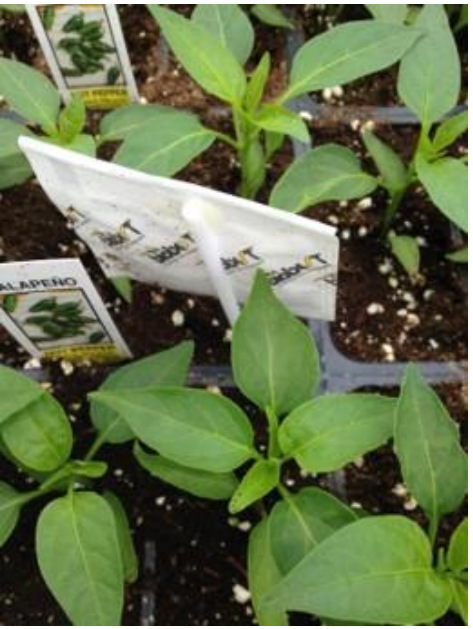
N. cucumeris is available in slow release minisachets that consist of bran, whitish storage mites (that feed upon the bran), and N. cucumeris which prey upon the storage mites. Predatory mites should emerge from the sachets for 4 to 6 weeks unto the crop. Place 1 to 4 mini-sachets per shuttle tray.
Research has shown that these mini-sachets are best placed in the plant canopy where they are protected from bright sunlight. If the mini-sachets are placed in bright sunlight, high temperatures and low relative humidity in the sachets adversely affects the reproduction and egg hatch of the predatory mites. (Eggs will shrivel and die at low relative
humidity). If mini-sachets are placed within the plant canopy, the temperature peaks less, with higher relative humidity needed for the reproduction of these predatory mites.
Stratiolaelaps scimitus
Stratiolaelaps scimitus is a soil-dwelling predatory mite that feed upon pupal stages of thrips in the soil as well as fungus gnat larvae. A single preventive release to the media at planting is generally recommended to supplement control with N. cucumeris.
Lacewings
The predatory larvae (also known as “aphid lions”) prefer to feed upon aphids, but will also feed upon thrips, whiteflies, spider mites and caterpillar eggs. Green lacewings are sold as eggs on cards, or as larvae shipped with a food source in an inert material in a small container. Larvae may survive better than eggs and are quicker acting.
Use of selective insecticides
Selective insecticides and microbial insecticides may be the first line of defense. Chemical options for aphids and other pests on Vegetable transplants, are listed in the Vegetable Transplant section of the New England Vegetable Management Guide that is available online at: https://nevegetable.org/vegetable-transplant-production and see Insecticides Labeled for
Insects and Mites on Vegetable Transplants: https://nevegetable.org/table-20-insecticideslabeled-insects-and-mites-vegetable-transplants
Disclaimer for Fact Sheets: The information in this document is for educational purposes only. The recommendations contained are based on the best available knowledge at the time of publication. Any reference to commercial products, trade or brand names is for information only, and no endorsement or approval is intended. UConn Extension does not guarantee or warrant the standard of any product referenced or imply approval of the product to the exclusion of others which also may be available. The University of Connecticut, UConn Extension, College of Agriculture, Health and Natural Resources is an equal opportunity program provider and employer.