Introduction
Slugs, although a minor pest, occasionally can be troublesome to greenhouse growers and retailers. The moist, humid greenhouse environment, with its abundance of plant material, often makes greenhouses a favorable habitat for slugs.
Soft-bodied slugs are close relatives of clams, mussels, and other mollusks. They move with a muscular foot covering the underside of their body that secretes mucus. Slime trails on plants are an important indicator of their presence. This coating of slime also helps protect slugs from desiccation.
Description
Slugs are from ½ inch up to 1.5 inches in length. They are often gray or brown and may have darker spots. Slugs also have two sets of “feelers’ or tentacles on their head. Slug eyes are on the tips of the upper tentacles. The lower tentacles are for tasting and smelling. Slugs also have a fold of skin, known as a mantle, on their back, with a breathing pore at the edge of this mantle. The size, color, location of the mantle, and color of the mucous are used to identify the different species. Some species of slugs secrete a clear slime, others a milky slime. The Terrestrial Mollusca Tool website is a helpful tool to identify slugs to species.
Feeding Damage
Slugs have a tooth-covered radula that works like a rasp to grate plant tissue. Slugs chew holes in the leaves by rasping away the surface of the plant tissue, often leaving larger veins behind. The nocturnal slugs feed upon a wide range of plants including annuals, perennials, orchids, and vegetables. They can destroy tender young seedlings. Slime trails also reduce the marketability of plants.
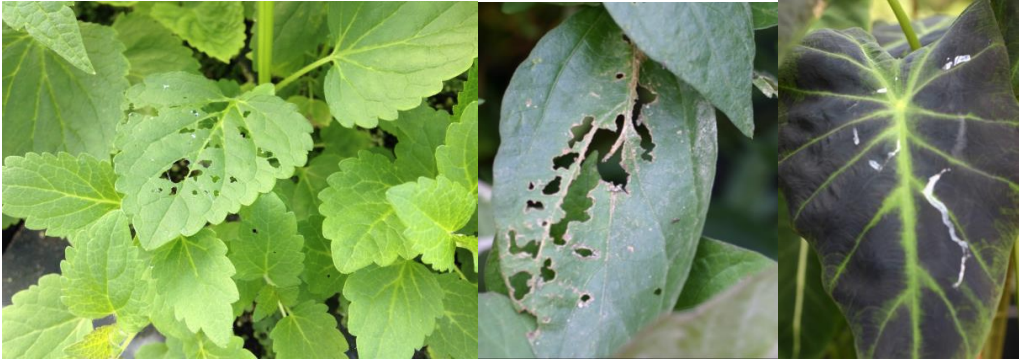
Slugs may also eat fungi, dead worms, and dead insects in addition to plants. During the day, they hide under debris, pots, flats, boards, etc.
Biology and Life Cycle
Slugs contain both male and female organs so may alternate between sexes at different times during their adulthood. Self-fertilization is also possible. Slugs lay clusters of about 20 to 100 pearl-shaped eggs in moist locations under containers or debris. Eggs hatch in less than 10 days at 50°F. Newly hatched slugs are smaller and lighter than the adults. Slugs mature in about 3 months to a year (depending upon the species). In greenhouses, slugs feed and reproduce year-round. Adults may live for a year or more.
Monitoring
- Check damp, moist areas for slugs and their egg clusters that are covered with a gelatinous shell giving them a somewhat milky appearance.
- Slug feeding damage may be confused with caterpillar feeding damage. However, caterpillars typically feed on all but the largest veins, may be more active during the day, and leave fecal droppings.
- To distinguish slug feeding from caterpillar feeding, look for slug slime trails on plants or on the ground. These may be more evident when slugs are most active in the evening or early morning hours, or after irrigation. Slugs may also be active during cool, cloudy, overcast days.
- Check for slugs under pots, containers, flats, boards, stones, and dense foliage.
- A shingle, with the top covered with aluminum foil reflecting light to keep the board cool, provides a daytime hiding place and monitoring tool.
Management Options
A combination of proper sanitation, barriers, and baits may be used to help manage slugs. Overuse of poison baits may result in the development of slugs that ignore or are resistant to the baits.
Proper Sanitation
Proper sanitation practices combined with cultural controls are the first line of defense to control slugs.
- Remove weeds in and around the greenhouse. Weeds provide a good hiding place and alternative food source for slugs.
- Slugs hitchhike into the greenhouse on equipment, containers and flats that have been stored outdoors, or on unsterilized growing media (soil and sand).
- Clean equipment and supplies before introducing into the greenhouse.
- Carefully inspect incoming plants and containers for their presence.
- Eliminate favorite hiding places; remove debris, clutter, boards, empty containers on greenhouse floors.
- Keep areas under the greenhouse benches clean and dry.
- If possible, grow plants on expanded metal benches, not on wooden benches which are difficult to sanitize and as they rot, provide a good hiding place for slugs.
- Water early in the day, so foliage dries before nightfall, to help discourage slug activity.
- In small areas, it may be possible to handpick and destroy the slugs. Handpicking is best done in the evening, about two hours after sunset.
Barriers
- Slugs avoid crossing copper barriers. They receive an electric shock when their moist bodies contact the copper.
- Copper tape, flashing or strips are available from many different suppliers. Wrap copper tape on bench legs, or surround raised beds with flashing to help exclude slugs.
- If areas are already infested, kill the slugs first, and then install the copper strips.
- Slugs also avoid crossing abrasive materials if these materials remain dry. They may be less likely to crawl across dry gravel, or diatomaceous earth, if it remains dry.
Biological Control
Although there are parasites, predators, and pathogens of slugs, few have been investigated for commercial biological control in greenhouses. A nematode parasite of slugs, Phasmarbabditis hermaphrodita is commercially available in Europe, but this non-native nematode is not yet commercially available in the U.S.
Outdoors, toads, several species of lightning bug larvae, garter snakes, ground beetles, and marsh flies may help provide some level of natural control.
Chemical Management
Baits containing iron phosphate and metaldehyde are commercially available. Poison baits are formulated in bran and must be eaten by the slugs to work. Apply baits in the evening when slugs are active. Irrigating before placement also helps promote slug activity and their contact with the bait.
Baits containing iron phosphate are stomach poisons. Slugs consume the iron, a toxic heavy metal, and immediately stop feeding. They crawl away to die, usually within 3 to 6 days. Baits containing iron phosphate can be used around pets and wildlife. There are also combination productions containing iron phosphate and spinosad.
Baits containing metaldehyde do not directly kill slugs but stimulate water loss in slugs through excessive mucus secretion. Slugs stop feeding; produce large amounts of mucous, dehydrate and die. Metaldehyde baits may be more effective if applied when days are warm and dry, so slugs desiccate and die. During cool, wet days, slugs may recover from their exposure to metaldehyde. Re-applications may then be needed. Metaldehyde can be harmful to children and is fatal to domestic animals when ingested. See New York and New England Management Guidelines for Greenhouse Floriculture and Herbaceous Ornamentals for more information.
Disclaimer for Fact Sheets: The information in this document is for educational purposes only. The recommendations contained are based on the best available knowledge at the time of publication. Any reference commercial products, trade or brand names is for information only, and no endorsement or approval is intended. UConn Extension does not guarantee or warrant the standard of any product referenced or imply approval of the product to the exclusion of others which also may be available. The University of Connecticut, UConn Extension, College of Agriculture, Health and Natural Resources is an equal opportunity program provider and employer.