Shore fly adults (Scatella stagnalis) are a nuisance pest in the greenhouse that do not feed directly on plants. However, the presence of adults and their droppings (known as frass) on plant leaves may be objectionable to customers. Shore fly adults may be confused with the dark winged fungus gnats that are also common in the moist greenhouse environment, especially propagation houses. It is important to correctly identify whether you have fungus gnats or shore flies present because management strategies differ between these pests.
Identification
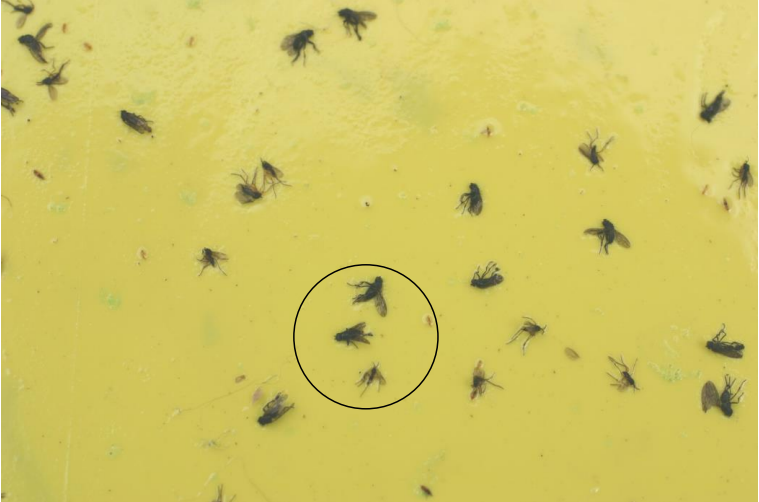
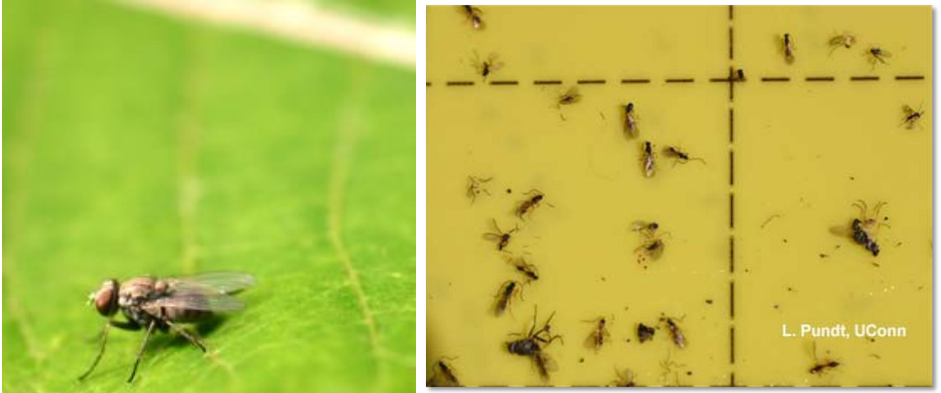
Shore fly adults (Scatella spp.) are about 1/8 of an inch long with a robust body like a house fly, short legs, and antennae. Each shore fly wing has about five or six distinctive white or light-colored spots. Fungus gnats are long-legged delicate
flies.
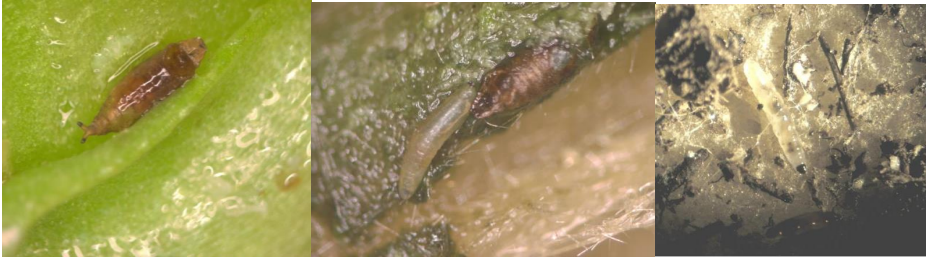
Shore fly larvae are yellowish-brown in color, lack the black head capsule characteristic of fungus gnat larvae and have forked spiracles, or breathing tubes, at their rear end. Shore fly pupae are dark-brown, and spindle shaped with forked spiracles at their end.
Biology and Life Cycle
Adult shore flies lay up to 300 white, oblong eggs in algae or in very wet areas. Adult females need three days to mate and mature before they can begin to lay eggs. Eggs hatch into first stage larvae (maggots) with two forked breathing tubes at their rear. The pupae (protected with a thick skin) are found near algal mats. Shore flies develop from egg to adult in as little as 8 days at 78F to 14 days at 68F. Adults can build-up to nuisance levels very quickly, especially under warm conditions and live for two to three weeks.
Damage
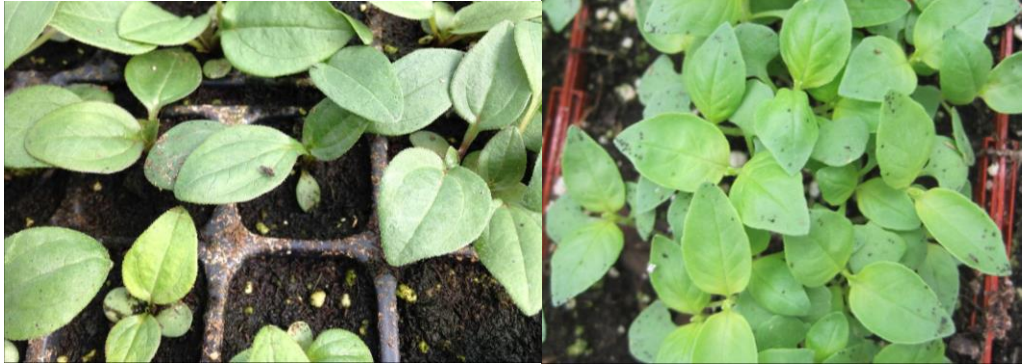
Shore fly larvae feed upon algae and do not directly feed upon plant roots. However, their frass (droppings) on plants are unsightly. In addition, their presence may be objectionable to customers and can be a nuisance to workers. Shore fly larvae have been reported to help spread soil borne pathogens such as Thielaviopsis basicola (black root rot) and Pythium sp. via their droppings but it is unclear how important this is under greenhouse conditions.
Scouting
Use yellow sticky cards to monitor for the adults. Adults are often seen resting on plant leaves. Shore flies are stronger fliers than fungus gnats and may fly upwards when disturbed.
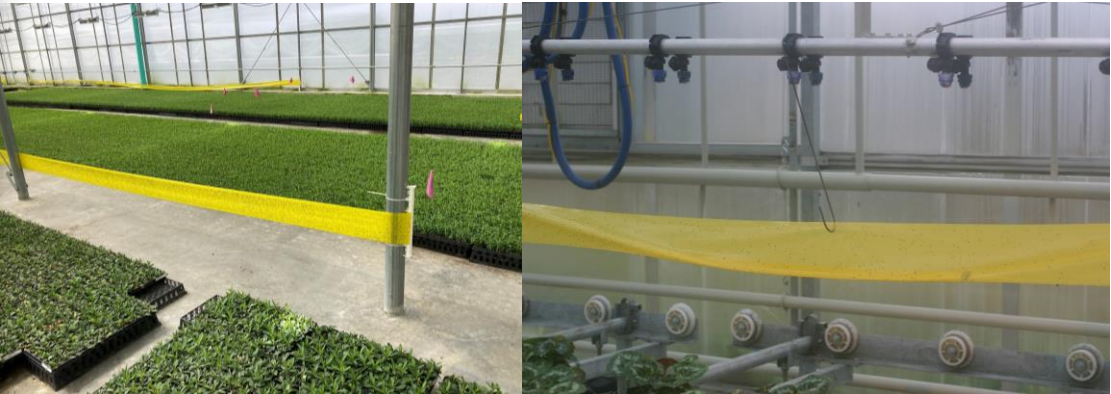
Sticky tape may be used in propagation houses to help capture shore fly adults.
Cultural Controls
Shore flies are best prevented through proper cultural management. All life stages of shore flies can be found on or near algae, their food source.
- Proper sanitation and environmental modification are crucial to managing algae growth.
- Reduce the moisture and puddling water on greenhouse floors, benches, and greenhouse surfaces.
- The greenhouse floor should be level and drain properly to prevent the pooling of water.
- Avoid over watering crops, especially early in the production cycle, to allow the upper media surface to dry out between watering’s.
- Select growing media that drains well and avoid compacting the media.
- Use disinfectants as part of a pre-crop cleanup program for control of algae on greenhouse surfaces and walkways.
Biological Controls
Biological controls are best used preventively in conjunction with proper cultural practices.
Rove beetles (Dalotia coriaria) are generalist predators that feed upon shore flies, fungus gnats and thrips pupae in the growing media. They feed upon the eggs and larvae of shore flies. Adults are best released in the evening. Consult with your supplier for information on release rates.
Beneficial nematodes (Steinernema spp.) infect shore fly larvae but do not provide sufficient levels of control. They are not well adapted to the semi-aquatic environment where shore flies are breeding. Some growers are using repeated sprenches with Steinernema carpocapsae (Millenium) at high rates against shore flies.
The beneficial hunter flies (Coenosia attenuata) have been observed in Connecticut greenhouses. They are not commercially available from biological control suppliers but have been transported from greenhouse to greenhouse on plant material. Hunter flies prey on shore flies as well as fungus gnats.
Hunter flies have shiny, clear wings without any spots and are about twice as large as shore flies. This aerial predator is often found perching on leaves, waiting to ambush its prey.
The parasitoid wasp Hexacloa neoscatella may also be present in unsprayed greenhouses and help to regulate shore fly populations.
Insecticides
Repeated applications of insect growth regulators can be used to suppress shore fly larvae. Some insecticides can be used to reduce adult populations, but adult females can begin laying eggs as soon as 3 days after emerging so this is not a long-term solution. See New York and New England Management Guidelines for Greenhouse Floriculture and Herbaceous Ornamentals for more information.
Disclaimer for Fact Sheets: The information in this document is for educational purposes only. The recommendations contained are based on the best available knowledge at the time of publication. Any reference commercial products, trade or brand names is for information only, and no endorsement or approval is intended. UConn Extension does not guarantee or warrant the standard of any product referenced or imply approval of the product to the exclusion of others which also may be available. The University of Connecticut, UConn Extension, College of Agriculture, Health and Natural Resources is an equal opportunity program provider and employer.