Introduction
Scale insects are more common on woody ornamental trees and shrubs than herbaceous plants. Woody tropical plants and other long-term crops tend to be more susceptible to scale insects. There are two major types of scale insects found on
ornamental plants: soft scales (Coccidae) and armored scales (Diaspididae). Some species are host specific, but some feed on many different plants. The target audience of this fact sheet is commercial greenhouse growers.
Feeding Damage
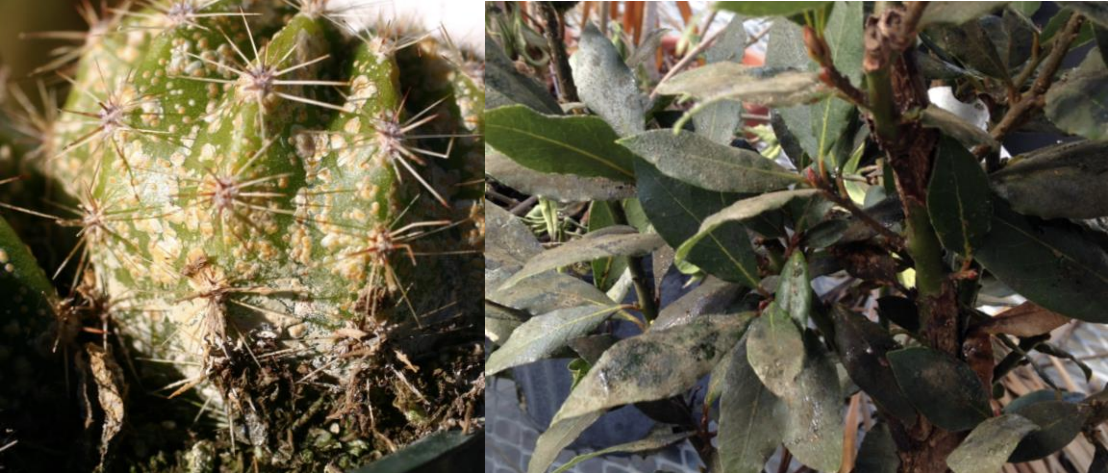
Scales damage plants by using their piercing-sucking mouthparts to withdraw plant fluids. As they feed, they also inject toxic saliva, with resultant yellowing of the foliage, dieback, and leaf drop.
Armored scale insects
Are protected by a hard-waxy covering known as a shield or “test”, which is made of the wax they secrete and cast skins. They do not produce honeydew.
Soft scale insects
Whose body is just covered by wax do secrete honeydew. Black sooty mold may grow on the honeydew
Biology and Life Cycle
The wingless adult females are usually legless insects. Their life cycle consists of eggs, nymphs, and adults. Only the first instar nymphs (“crawlers”) that emerge from eggs are mobile as they look for a suitable place to feed. Later nymphal stages and females are not mobile. The short-lived, rarely seen males are mobile. Males do not feed, and their primary purpose is to fertilize females.
Soft scales usually have one generation a year and females can lay more than 1000 eggs over several months. Eggs are laid in cottony sacs at the end of the female body. Males may be winged or wingless. Soft scales often feed on a wide range of woody and herbaceous plants.
Armored scales
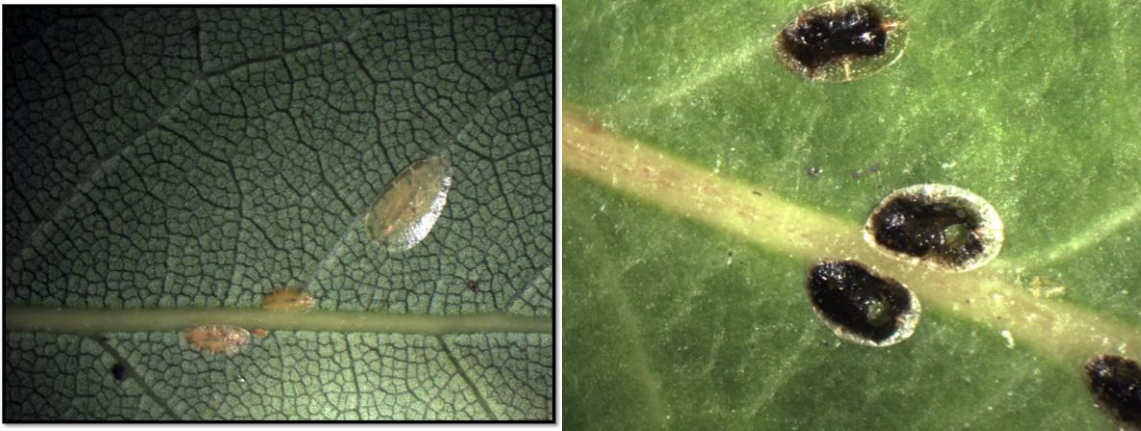
Uusually have two or more generations a year and lay less than 100 eggs during their lifetime. The biology and life cycle varies among armored scale species. Some females lay eggs whereas others give birth to live young.
The scale you see is a covering known as a “test” which consists of wax and molted skins from earlier instars. This covering may be circular, elliptical, oyster-shell like with varying colors. Armored scales may be more common on woody ornamentals and may only feed on one or two host plants.
Scouting
The fungus gnat's life cycle from egg to adult may be completed in 21 to 28 days depending on temperature. Eggs are laid in cracks and crevices in the media surface and hatch in four to six days. Fungus gnat larvae feed and develop for about two weeks at 72o F. Pupation occurs in the soil. After four to five days, adults emerge. Overlapping and continuous generations make control difficult.
Scouting
Inspect incoming plants with a 20-30x hand lens. Look on the upper and lower leaf surfaces, leaf axils, buds, and stems.
For soft scales, look for honeydew, and black sooty mold fungus. Ants and wasps may also be attracted to the sticky honeydew. Soft scales appear convex in shape resembling a helmet.
Hard scales are harder to detect because they do not produce honeydew. They produce a waxy covering called a test, which protects eggs and crawlers and adult females from natural enemies. Armored scales are circular or rounded in shape.
- It is important to know if the scale insect is alive or dead.
- Use a small needle or sharp fingernail to see if you can “pop off” the scale cover.
- Look for a pink or orange-bodied scale insect.
- If the scale is dead, the body will be dry and shriveled or absent.
- If when you probe the insect, and you see a colored liquid, they are alive.
- When you crush them, if there is no liquid, they are dead.
Cultural Controls
- Inspect incoming plants for scale insects.
- Remove heavily infested plants and do not overwinter pet plants infested with scale insects.
- Prune out heavily infested branches.
- Avoid over-fertilizing especially with nitrogen, as this encourages the development and reproduction of scales.
Biological Controls
Rhyzobius (=Lindorus) lophanthae is a ladybird beetle that feeds upon California red, purple, and other armored scales. Release this beetle in the evening when greenhouse vents are closed. This ladybird beetle lays its eggs under the scale insect in small groups of 1 to 5 eggs. Mated females can live about 2 months. Optimum conditions are 77° F and 65% relative humidity, but 46° F is the minimum threshold for development. Consult your biological control supplier for information on release rates and availability.
Chemical Controls
Foliar sprays to target the most susceptible crawler stage are often applied. Repeated applications are needed because not all the eggs hatch at once and there are overlapping generations. Systemic insecticides may kill soft scales more effectively than armored scales. Horticultural oils can also smother the scale insects. For more see New York and New England Management Guidelines for Greenhouse Floriculture and Herbaceous Ornamentals.
Disclaimer for Fact Sheets: The information in this document is for educational purposes only. The recommendations contained are based on the best available knowledge at the time of publication. Any reference to commercial products, trade or brand names is for information only, and no endorsement or approval is intended. UConn Extension does not guarantee or warrant the standard of any product referenced or imply approval of the product to the exclusion of others which also may be available. The University of Connecticut, UConn Extension, College of Agriculture, Health and Natural Resources is an equal opportunity program provider and employer.