Producing a high-quality transplant is important for both field production and for retail plant sales. Compact, uniform transplants can be easily handled for planting in the field or garden.
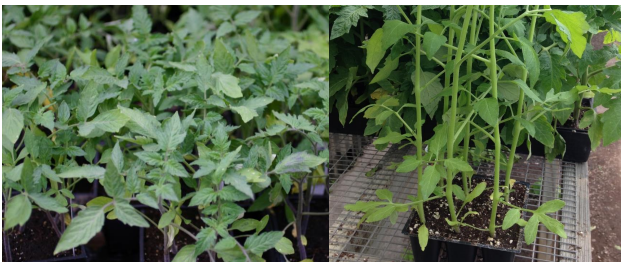
Leggy transplants may develop with low light levels, overwatering, over fertilizing or when plants are held for longer than anticipated in the greenhouse due to unseasonable weather conditions. Problems with crop scheduling and starting seeds too soon, results in overgrown transplants of poor quality.
Since very few growth regulators are registered for vegetable bedding plants, plant height is often managed by increasing light levels, using mechanical stresses such as “brushing” and adjusting temperature, water, and fertilizer levels.
Maximizing Light Levels
Maximizing the amount of light plants receive helps reduce plant stretch. Giving plants adequate space, cleaning glass, and replacing plastic coverings as needed, helps prevent reduction in light levels. Eliminate shading from overhead hanging baskets.
Adjusting Temperature (DIF)
Each vegetable species will have an optimum day temperature and minimum night temperature for optimum growth. Prevent premature bolting of Cole crops by avoiding exposure to temperature below 50° F. Eggplants are susceptible to chilling injury and should not be grown below 40° F. Exposing tomato transplants to temperatures below 60° F results in deformed fruit (“cat facing”) on the first few fruit clusters.
Most greenhouses will be warmer during the day than at night. However, one way to manage plant growth is the expose plants to different day and night temperatures. DIF is the difference between day temperature (DT) and night temperature (NT).
- Positive DIF is when the day temperature (DT) is higher than the night temperature (NT).
- Zero DIF is when the day temperature (DT) and night temperature (NT) are the same.
- Negative DIF is when the day temperature (DT) is lower than the night temperature (NT).
DIF has the greatest effect on height during the period of most rapid stem elongation. Plants exposed to a positive DIF promotes plant growth, increasing plant stretch. Plants exposed to a negative DIF reduces plant growth, so plants are more compact.
A cool morning “pulse” has the same effect as using a negative DIF and is accomplished by lowering the morning temperatures for 5 to 10° F at dawn and then returning to daytime temperatures of 60 – 70 F. Plant response to DIF varies depending upon species and cultivar. For example, tomatoes, Basil, Cole crops, eggplant and melons are very responsive to DIF; however, squash and watermelon are much less responsive. Using negative DIF does not adversely affect the field establishment of transplants or their yield.
Growers should determine the effect of DIF treatments on the average daily temperature, which affects the rate of crop development. DIF treatments that lower the average daily temperature would slow crop development, whereas DIF treatments that increase the average daily temperature would increase crop development times.
Adjusting Fertilizer
Low Phosphorus
Withholding nutrients can also be used to prevent plant stretch. Low phosphorus fertilization is especially effective for tomatoes. If carefully managed, a mild to moderate phosphorus (P) deficiency may result in a desirable reduction in growth with no foliar symptoms of P deficiency. If this method is used, use a starter fertilizer when planting in the field.
Water Stress
After transplants have reached sufficient size, using cycles of water stress can be used to manage height. Maintaining plants on the dry side limits cell expansion and plant growth. This method requires close monitoring to avoid leaf scorch or plant death.
Irrigate the growing mix thoroughly and then allow it to dry to the point where plants wilt before watering again. Plant growth is restricted during the period when the growing medium is very dry. Once watered, the plants rapidly resume growth. If wilting progresses too far, plants are at risk of dying, so experienced growers should very carefully use this technique.
Mechanical Stress or Brushing
Mechanical stress reduces stem elongation and improves stem strength. Wind, shaking, or brushing are all types of mechanical stress. However, brushing is more effective than using wind or shaking the transplants. Growers have successfully used a wand made of plastic plumbing pipe or a flat piece of polystyrene foam. Larger growers have attached a sheet of plastic to an irrigation boom to “brush” their plants. Plants should be of uniform height which may be difficult with plants of different ages, vigor, and type in the same greenhouse.
Mechanical conditioning can reduce plant height by 20-50% that is similar to the type of response expected from plant growth regulators. Research has shown brushing to be effective on tomatoes, eggplant, cucumber, celery and some cultivars of broccoli and cabbage. However, brushing may damage tender plant species such as peppers. Cultivar differences have also been reported. Transplants are generally darker green in color with shorter stems and are more uniform. Brushing can improve establishment of transplants in the field. Transplants resume their normal growth about 3 days after the brushing stops. There is also little or no effect on yield.
Brush when the foliage is dry to reduce the potential for disease spread. Cornell researchers recommended 10 to 40 strokes per day for tomato. Start brushing tomatoes when they are about 2.5 inches tall. Brushing smaller plants increases the chance of damaging young seedlings. However, larger tomato plants that have larger leaves are also more easily damaged because their leaves tear more easily. Start brushing cucumbers as soon as the cotelyons open and continue brushing for about 5 days. If you see plant damage, reduce the number of times you are brushing the plants. This technique is not widely used by growers because it needs to be an automated process to reduce labor costs.
Plant Growth Regulators (PGR)
Most of the plant growth regulators labeled for ornamental bedding plants are not registered for vegetable transplants.
Sumagic (uniconazole) is the only plant growth regulator labeled for use as a foliar spray on a limited group of vegetable transplants including tomato, pepper, eggplant, tomatillo, ground cherry, and pepino. Sumagic is a gibberellin biosynthesis inhibitor suppressing plant height by inhibiting internode elongation. It is a particularly active PGR, so very small concentrations are needed. Accurate calibration, measurement and spraying by experienced growers is needed.
Some advantages of using plant growth regulators include increased shelf life, with reduced water use on the more compact transplants. However, only a limited number of tomato varieties have been tested, so growers are encouraged to do their own in-house trials on a small number of plants with a low rate before full-scale implementation. Based upon research trials at Michigan State, University of Kentucky and University of Florida, researchers suggested a starting rate of 1.0 – 2.5 ppm. In one study, applications of uniconazole reduced the number of fruit produced by pepper and egg plants. In another study, the higher labeled rates caused extreme stunting of peppers. Delay in flowering, fruit size, or reduced sugar accumulation are additional concerns.
The label states to apply Sumagic only as a foliar spray at a rate of 2 to 10 ppm. Make the first application when transplants have two to four leaves. The maximum cumulative amount of Sumagic applied must not exceed 10 ppm with coverage of 2 quarts per 100 sq. feet. The total amount of plant growth regulator used in sequential applications can only add up to 10 ppm spray. For example, four applications at 2.5 ppm. The last spray must be no later than two weeks after the two to four leaf stage of development. Research trials indicate that sequential applications produce the best results and that the earlier that the plants receive the Sumagic spray, the greater effect it will have on the final height of the transplants.
Hardening off transplants by exposing young plants to outdoor conditions will also help produce a stockier transplant. Larger growers may be using roll out benches, but smaller growers can use wagons to move transplants into and out of the greenhouse as needed.
Maximize light levels, use cool morning pulse, or negative DIF or experiment with brushing or the plant growth regulator Sumagic to manage plant height.
Disclaimer for Fact Sheets: The information in this document is for educational purposes only. The recommendations
contained are based on the best available knowledge at the time of publication. Any reference to commercial products, trade or brand names is for information only, and no endorsement or approval is intended. UConn Extension does not guarantee or warrant the standard of any product referenced or imply approval of the product to the exclusion of others which also may be available. The University of Connecticut, UConn Extension, College of Agriculture, Health and Natural Resources is an equal opportunity program provider and employer.