Introduction
Caterpillars are the immature or larval stage of moths and butterflies (Lepidoptera). Most caterpillars overwinter outdoors and may migrate into greenhouses during the summer and fall. Night flying moths may be attracted to lights near greenhouses and female moths enter the greenhouse to lay their eggs on susceptible crops. The target audience of this factsheet is commercial greenhouse growers.
Feeding Damage
The damaging larval stages (caterpillars) use their chewing mouthparts to feed on plant leaves and flowers. Some caterpillars roll plant leaves together in a silken web (leafrollers), others tunnel into stems and buds (borers), and some are active at night cutting off plants at their base (cutworms). Caterpillars are voracious feeders and can severely damage plants, leaving fecal deposits or insect frass on the damaged plant leaves.
Biology and life Cycle
Their life cycle consists of an egg, larva, pupa, and adult. Adult females emit pheromones that attract males, and after mating, the females lay eggs that hatch into rapidly growing caterpillars. They may molt up to 3 to 5 times before entering a resting stage. Day flying butterflies, such as the imported cabbageworm, develop into a chrysalis as a resting stage and night flying moths develop into a pupal cocoon.
In outdoor production fields, ornamental cabbage and kale are especially susceptible to damage from the imported cabbageworm, cabbage looper, diamondback moth and cross-striped cabbageworm. Garden mums and herbaceous perennials are also susceptible to caterpillar feeding damage.
Some Selected Caterpillars that feed upon Ornamental Cabbage and Kale
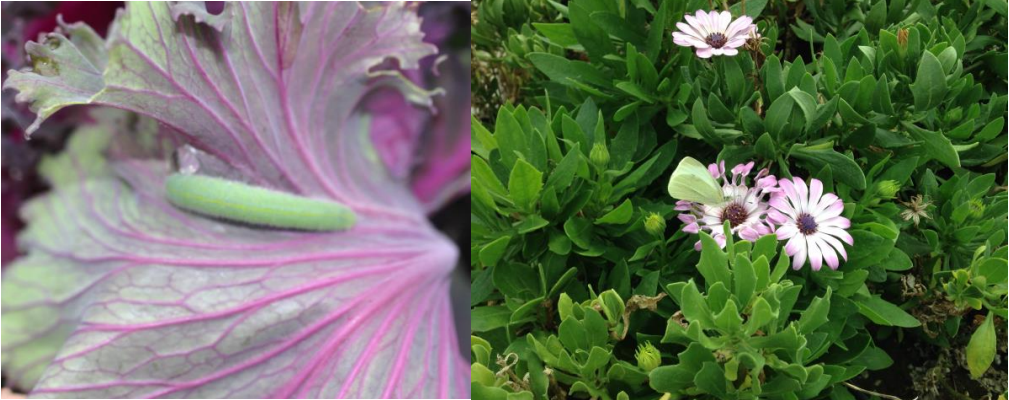
The imported cabbageworm (Pieris rapae) is native to Europe. This familiar white butterfly has wings that are tinged with yellow on their undersides. Females have two black spots on their wings, whereas males have only one. Females lay up to 200 bullet shaped eggs singly on the underside of leaves.
This slow moving velvety-green caterpillar feeds on the underside of the leaves. When fully grown it is about 1 ¼ inch long with a thin yellow line running down the center of its body. After about two to three weeks, a resting stage (chrysalis) is formed on the underside of leaves. Multiple generations (3 to 5) occur in Connecticut.
Cabbage looper
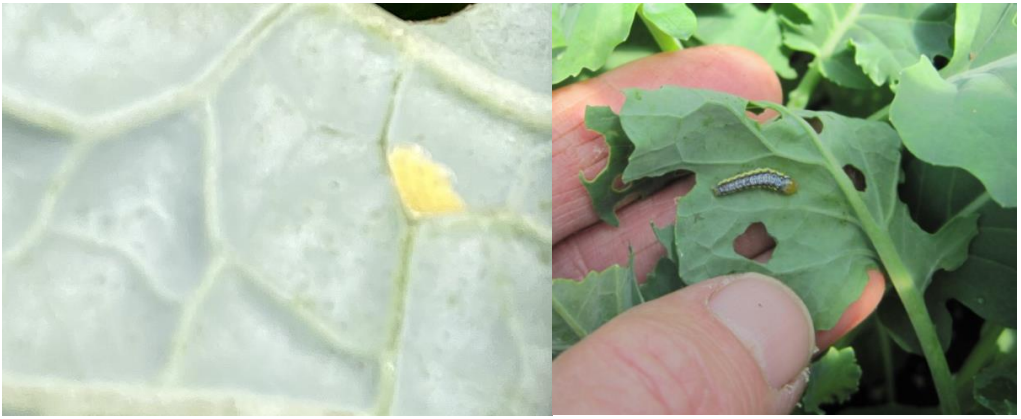
(Trichoplusia ni) adults are mottled brown and gray moths that migrate from the southern states each year. These nocturnal moths lay from 200 to 300 white, spherical eggs that hatch into light-green caterpillars. They move in an inchworm-like motion (because they have no legs in the middle portion of their bodies) so are known as “loopers”. Multiple generations (1 to 3) may occur in Connecticut.
The diamondback moth (Plutella xylostella) adult is a very small moth with diamond shaped spots that are visible when their wings are held at rest. The small larvae (less than ½ of an inch long) feed on the underside of leaves, resulting in a “windowpane” appearance to leaves. The pale-green larvae have a hind pair of prolegs that are visible at their rear so that the caterpillar appears pointed at both ends. Diamondback larvae are very active and will wiggle vigorously when touched. They may be resistant to many commonly used insecticides.
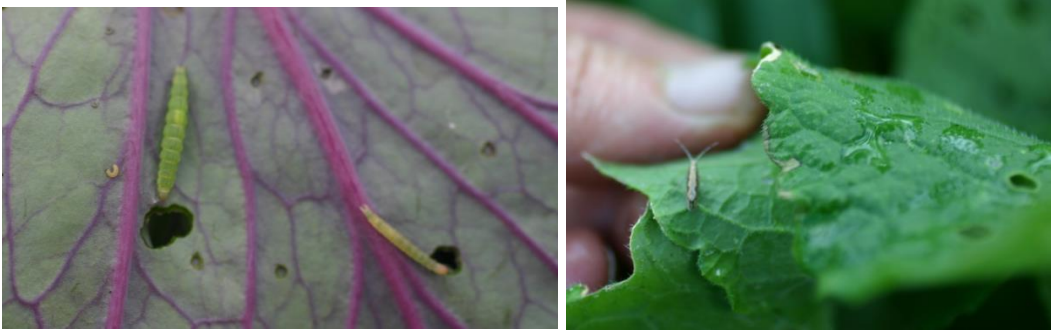
The cross-striped cabbageworm (Evergestis rimosalis) adult moth is brown with dark eyes and blotched markings on its wings. Eggs are laid in masses of 20 to 30 eggs on the underside of the leaves. These eggs hatch into small caterpillars with black and white stripes on their back and yellow lines on their sides. Mature caterpillars are only 6/10 of an inch long. Larvae produce small holes in the leaves until leaves are completely skeletonized.
Caterpillars on Garden Mums
Saltmarsh caterpillars
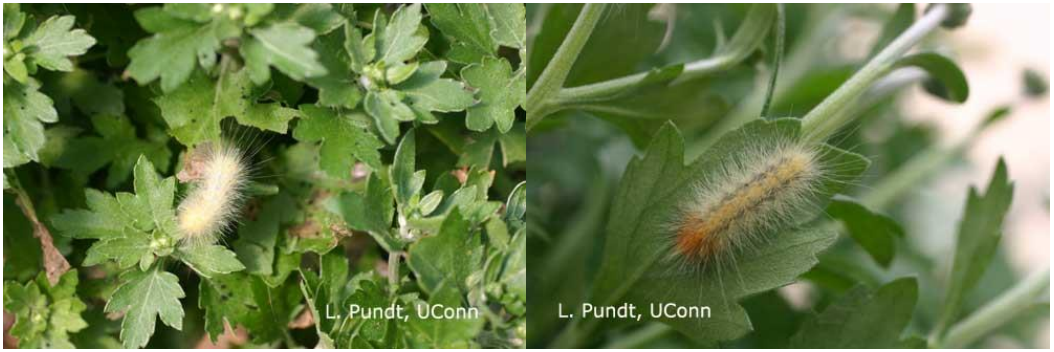
(Estigmene acrea) were first described feeding on salt grass hay in the Boston area; however, they have a wide host range. Saltmarsh caterpillars may feed upon garden mums, herbaceous perennials, and broad leaf weeds (especially pigweed).
The young, hairy larvae are yellowish-white becoming reddish-brown as they mature. Caterpillars may be found on the edges of outdoor garden mum fields near weedy areas. They are active dispersers and can move into greenhouses. Young larvae skeletonize the foliage but as they grow, you may see large holes in the mum leaves plus the presence of caterpillar droppings (frass). Adults are large white moths (up to one and ¾ of an inch long) with many small black spots and are known as acrea moths.
European pepper moth
(Duponchelia fovealis) (EPM) is a moisture-loving caterpillar that is often found where the plant foliage is in contact with the growing media. Look for caterpillars boring into the base of stems and for webbing close to the media surface. The caterpillars create feeding tunnels from leaves spun together with webbing and will leave behind frass, feeding damage, leaf wilting and stem collapse (from larval tunneling). Mature larvae are up to 1¼ of an inch long. When scouting, look for light webbing at the base of the plant. Plants wilt, so damage may be confused with damage from root rot diseases.
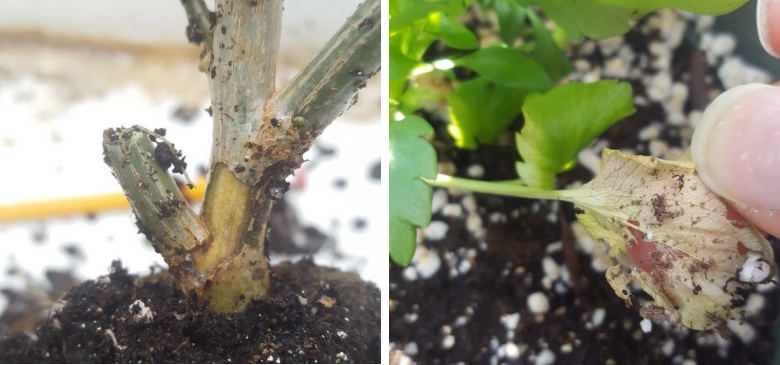
European pepper moth can cause significant damage when their populations rise in the late summer, affecting ornamental peppers, poinsettias, garden mums, perennials, herbs, vegetables, and woody ornamentals.
Scouting for Caterpillars
Visually inspect plants when adults are active. In greenhouses, pay close attention to plants near doors, vents, and other openings, especially near weedy areas or vegetable fields. In outdoor fields, pay close attention to plants near weedy areas.
Cultural Controls
- Eliminate weeds that may serve as alternate hosts.
- Clean up plant debris that may harbor overwintering pupae.
- Install insect screening to prevent entry of adults into the greenhouses.
Biological Controls
The commercially available egg parasitoid, Trichogramma spp. lay their lay their eggs into the eggs of the diamondback moth, cabbage looper and imported cabbageworm. These mini-wasps have a rapid life cycle of about 7 to 10 days from egg to adult, so populations can increase rapidly. Timing is critical as these very small wasps only work against the egg stage and not the larval stage. Trichogramma turns the eggs of some caterpillars black. When releasing these mini-wasps, protect them from ants.
Microbial Controls
Bacillus thuringiensis spp. kurstaki, applied to the foliage as a spray, is most effective against the young actively feeding larvae. The caterpillars must consume this bacterium in order to be effective, so thorough spray coverage to the foliage is needed. Repeated applications are also needed, because the bacterium is susceptible to ultraviolet light degradation and may be washed off the leaves. When spraying plants with waxy leaves, add a spreader sticker (if the label permits this use). See New York and New England Management Guidelines for Greenhouse Floriculture and Herbaceous Ornamentals for more information.
Disclaimer for Fact Sheets: The information in this document is for educational purposes only. The recommendations contained are based on the best available knowledge at the time of publication. Any reference to commercial products, trade or brand names is for information only, and no endorsement or approval is intended. UConn Extension does not guarantee or warrant the standard of any product referenced or imply approval of the product to the exclusion of others which also may be available. The University of Connecticut, UConn Extension, College of Agriculture, Health and Natural Resources is an equal opportunity program provider and employer.