Introduction
Aphids can be serious and persistent pests in the greenhouse. They are difficult to control due to their high reproductive capability.
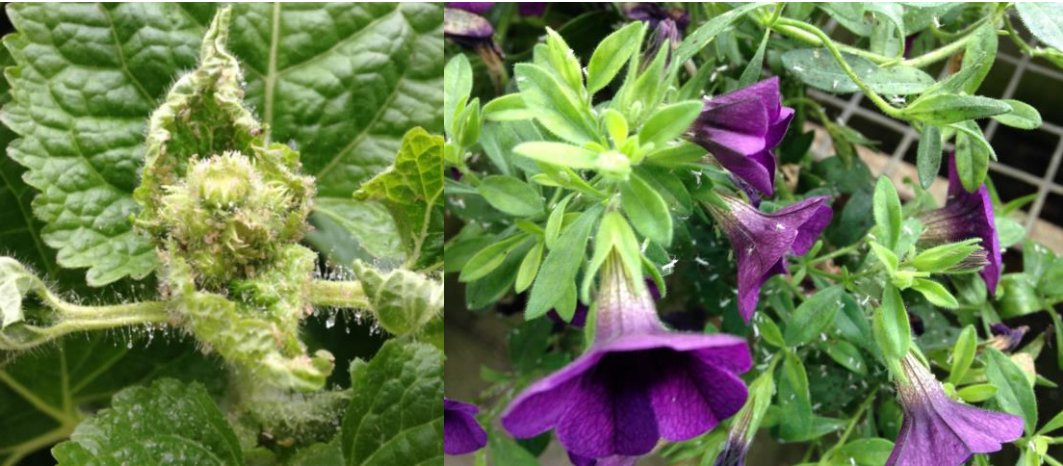
Aphids are sucking insects that can cause curling and distortion of tender young growth. The presence of aphids, their white shed skins and honeydew reduces the aesthetic quality of a wide range of greenhouse crops. The target audience of this factsheet is commercial greenhouse growers.

Feeding Damage
Aphids feed by inserting their stylet-like, sucking mouthparts directly into the phloem and removing plant sap. When high aphid populations develop, plants become stunted with curling and twisting of the young leaves. As aphids feed, a sugary plant sap, known as “honeydew,” is excreted that promotes the growth of black sooty mold fungi. As aphids molt, whitish cast skins are left behind.
Identification
Aphids are small (less than 1/8 of an inch long), soft-bodied, pear-shaped insects with long legs and antennae. Look for cornicles, or “tail pipe like” protrusions at the rear of their abdomen.
Proper identification is important to choose the most effective management option. Aphids vary in color depending upon the plants they are feeding on, so do not rely upon color to identify species.
Three of the most common species found in greenhouses include the green peach aphid (Myzus persicae), the melon or cotton aphid (Aphis gossypii) and the foxglove aphid (Aulacorthum solani).
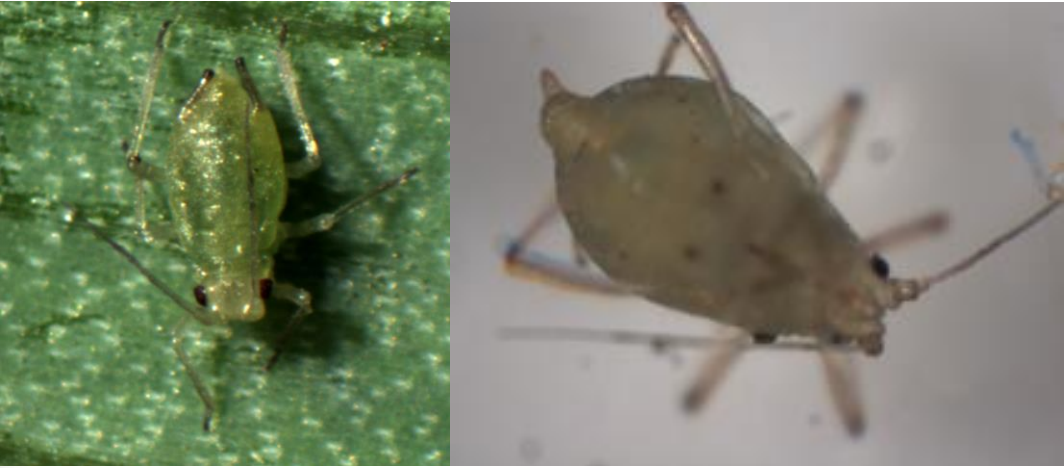
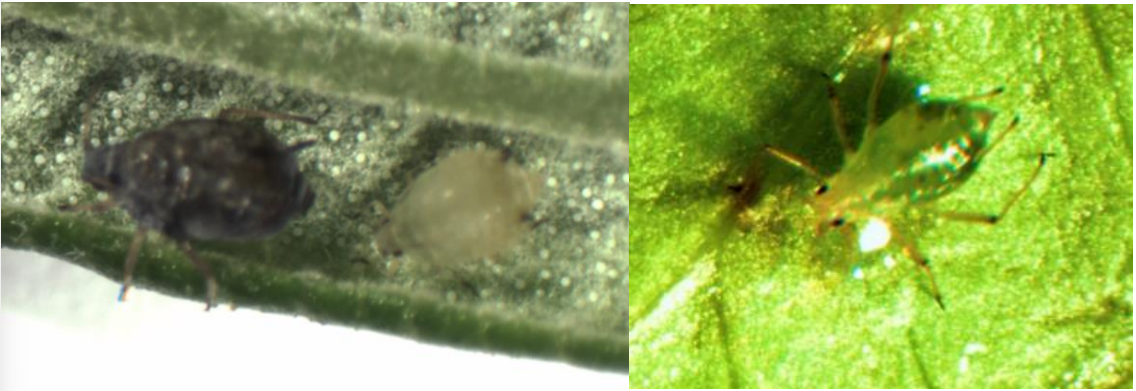
Comparison of green peach aphid, melon/cotton aphid, and foxglove aphid
| Green Peach Aphid | Melon/ Cotton Aphid | Foxglove Aphid | |
| Color | Light green; occasionally pink to orange |
Variable from dark green to light green to yellow |
Pale green |
| Cornicles (tailpipes) | Light green; slightly darker than the body, with black tips |
Black | Green spot at base |
| Head (use hand lens to see profile of top of head) |
Indentation
|
No indentation
|
Indentation
|

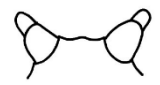
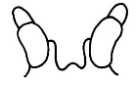
Table reproduced with permission from Integrated Pest Management for Bedding Plants: A Scouting and Pest Management Guide,
Copyright 1999, New York State Integrated Pest Management Program, Cornell University.
Life Cycle of Aphids
Most of the aphids found in greenhouses do not mate. All the aphids present are females that can give birth to live nymphs. There is no egg stage (except for the cannabis aphid). An adult female may live for up to one month. During this time, she may give birth to 60 to 100 live nymphs. Migratory winged aphids may appear when the colony becomes overcrowded or when the food supply is depleted. Outdoors, aphids overwinter in the egg stage.
Cultural Controls
- Inspect incoming plant material for signs of aphids. Many aphid outbreaks occur when herbaceous perennials are introduced into the greenhouse from overwintering cold frames. Aphids may also be carried inside on worker’s clothing or blown into the greenhouse through doors or vents.
- Aphid-infested weeds under the benches are frequently a source of recurring aphid problems. Inspect and remove weeds promptly. Use a weed mat barrier to prevent weed growth under the benches.
- The use of excessive nitrogen promotes lush growth that is favorable to aphid development.
Monitoring
Regular, weekly scouting is needed to detect aphids early before populations explode.
Focus on random plant inspections to detect wingless aphid nymphs. Look for whitishcast skins and honeydew.
- Green peach aphids tend to be spread more evenly throughout the crop whereas melon/cotton aphids tend to be found in isolated hot spots.
- Melon/cotton aphids are also less likely to form winged adults and usually stay on the lower leaves and along the plant stem.
- Foxglove aphids inject toxic saliva as they feed leading to curled and distorted leaves, and early leaf drop. Foxglove aphids also tend to drop off the leaves so may be hard to find. Because foxglove aphids reproduce faster at 50˚ to 60˚ F than at 77˚F, they are more of a problem when spring crops are grown cool.
Look on the leaf undersides and buds of aphid-susceptible crops.
Some key bedding plants prone to aphids include ageratum, alyssum, basil, begonia, calibrachoa, Cole crops, celosia, chrysanthemum, dahlia, dianthus, eggplant, Easter geraniums (ivy and zonal), gerbera daisy, herbs (many), fuchsia, garden impatiens, Ipomoea, leafy greens, marigolds, nasturtium, pansy, pepper, portulaca, primula, salvia, snapdragon, tomato, verbena, zinnia, etc.
Many herbaceous perennials including Acanthus, Achillea, Alcea, Asclepias, Aster, Bellis, Dianthus, Digitalis, Heuchera, Helianthus, Helleborus, Hibiscus, Monarda, Papaver, Oleander, Phlox, Primula, Rudbeckia, Salvia, Sedum, Sempervivum, Veronica, and Viola may also be affected.
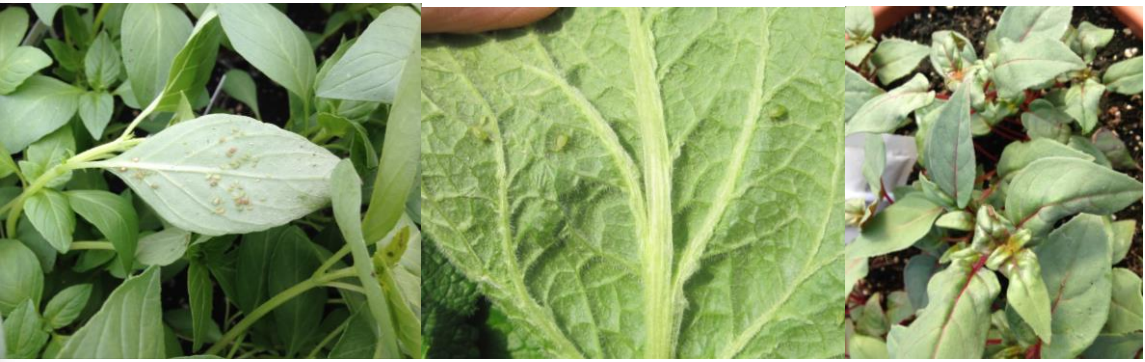
Yellow sticky cards will only attract winged aphids that have entered the greenhouse from outdoors, especially during the spring and early summer. They may also indicate an aphid infestation within the greenhouse that resulted in winged aphids.
Biological Controls
In outdoor production, natural enemies, including ladybird beetles, lacewings, syrphid or hover flies, host specific parasitic wasps and fungal diseases, may provide a degree of control. Outdoor environmental conditions, such as wind, rain, and freezing temperatures, can also reduce aphid populations.
Commercially available biological control agents include predators, host specific parasitoids and pathogens. Repeated releases are needed to keep pace with the aphids' high reproductive rate in the greenhouse. For more see Biological Control of Aphids on the UConn Greenhouse IPM webpage under publications and then biological controls.
Chemical Controls
Aphids are difficult to control with insecticides for several reasons. Control failures may be due to poor spray techniques, inadequate coverage, or high pH in the spray tank. If aphids are present on flowers, systemic insecticides will not be able to move into the flowers. Aphids may be difficult to reach if they are on the underside of the lowest leaves. Thorough coverage of the underside of leaves is needed for contact materials. Two applications of contact sprays may be more effective than one treatment.
Systemic materials may be more effective because aphids tend to ingest large quantities of plant sap, especially if applied before plants are in flower. Among green peach aphid populations, resistance to organophosphates, carbamates and pyrethroid insecticides has been reported. Limited options for aphid materials that are compatible with predatory mites released for thrips and spider mites make effective aphid rotations challenging for growers. See New York and New England Management Guidelines for Greenhouse Floriculture and Herbaceous Ornamentals for more specifics.
Disclaimer for Fact Sheets: The information in this document is for educational purposes only. The recommendations contained are based on the best available knowledge at the time of publication. Any reference to commercial products, trade or brand names is for information only, and no endorsement or approval is intended. UConn Extension does not guarantee or warrant the standard of any product referenced or imply approval of the product to the exclusion of others which also may be available. The University of Connecticut, UConn Extension, College of Agriculture, Health and Natural Resources is an equal opportunity program provider and employer.