Introduction
Algae are primitive, simple plants lacking true roots, leaves and stems that contain chlorophyll. The greenhouse provides an ideal environment for their growth and spread. In order for algae to grow, they need water, light, and mineral nutrients. Algae reproduce vegetatively by single cell division or fragmentation of colonies. The warm temperatures, high humidity and fertigation that are ideal for your crops contribute to the growth of algae. The target audience of this fact sheet is commercial greenhouse growers.
The spores and cells of blue green or green algae are ubiquitous. How to manage algae depends upon where it is growing. Treating your water source, treating walkways or structures, or treating media surfaces may all be needed. Many algaecides are not labeled for direct plant treatments because they can be phytotoxic (damaging to plants). Even in the absence of phytotoxicity, some of the products suppress plant growth.
Growth of algae on the growing media The growth of algae on the growing media may be especially troublesome in propagation, either with slow- growing plugs or during cutting production. Algae compete with desirable plants for nutrients. Eventually, algae form an impermeable layer or “crust” on the growing media surface that can interfere with water penetration, reducing plant growth.
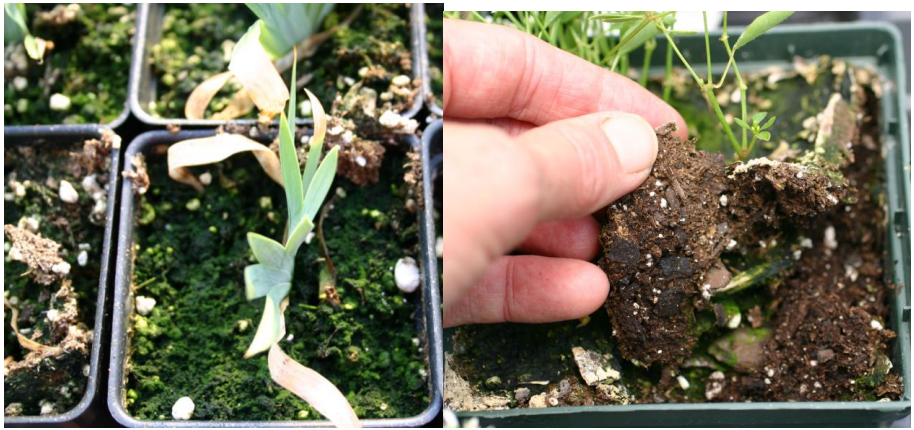
Growth of Algae on Walkways, Greenhouse Coverings If severe, excessive algae growth on walkways is a safety hazard to workers. The growth of algae on greenhouse coverings can also reduce light levels in the greenhouse, adversely affecting plant growth.
Prevention of algae growth is the grower’s first line of defense. Algae can be difficult to control and a combination of methods including sanitation, environmental modification, and the frequent, careful use of disinfectants are all needed.
Greenhouse Sanitation
- Keep propagation houses as clean as possible. Check for algae in areas with standing water.
- Clean and sanitize pots and trays before their re-use.
- All surfaces should be kept free of plant debris and weeds that can be a nutrient source for algae growth.
- Regularly clean and disinfect empty greenhouses between crop cycles.
Environmental Modification to Help Suppress Growth of Algae
- Reduce excessive moisture from improper irrigation or misting practices.
- Proper ventilation helps reduce the amount of moisture in the greenhouse.
- Horizontal airflow fans help regulate greenhouse temperatures and reduce excess condensation.
- Retractable roof or open roof greenhouses provide superior ventilation benefits.
- Avoid excessive fertilization, runoff and puddling water on floors, benches, and greenhouse surfaces to discourage algae growth.
- The use of porous concrete floors limits the development of excessive moisture in the greenhouse.
- The greenhouse floor should be level and drain properly to prevent the pooling of water.
- Water only as needed to prevent excess puddling on the greenhouse floor.
Proper Cultural Practices
- Train employees on proper watering practices.
- Overwatering crops frequently leads to algae buildup on the surface of the growing media.
- Avoid overwatering crops, especially early in the crop cycle, to allow the upper surface of the media to dry out between watering’s.
- Select a growing media with the appropriate drainage for your crops.
- Do not apply excessive fertilizer to your crops.
- Use controlled release fertilizer incorporated into growing media for cuttings during propagation.
Disinfectants for Controlling Existing Algae
Quaternary Ammonium Compounds
Quaternary ammonium compounds include Physan 20® and KleenGrow. They can be applied to floors, walls, benches, tools, pots, and flats as disinfectants in greenhouses where ornamental crops are grown. Before using these quaternary ammonium compounds, pre-clean all surfaces. Contact with any type of organic matter inactivates these compounds. Surfaces should remain thoroughly wet for at least 10 minutes. A fresh solution should be applied daily or when the solution becomes visibly dirty.
A fourth-generation quaternary ammonium product (KleenGrow™) can be applied to hard surfaces and to greenhouse ornamental crops as a fungicide and bactericide. KleenGrow is an advanced Q salt and is more tolerant of organic matter, pH and temperatures changes and hard water.
Hydrogen Peroxide & Peroxyacetic Acid
Hydrogen peroxide and peroxyacetic acid (XeroTol) is labeled as a disinfectant for use on greenhouse surfaces, equipment, benches, pots, and trays and for use in chemigation. All surfaces should be thoroughly wetted before treatment. Several precautions are noted on the label. It is a strong oxidizing agent and should not be mixed with any other pesticides or fertilizers. When applied directly to plants, especially if applied above labeled rates or if plants are under stress, phytotoxicity may be of concern.
Hydrogen Peroxide, Peroxyacetic Acid & Octanoic Acid
Hydrogen peroxide & peroxyacetic acid & octanoic acid (X™ 3) is a strong oxidizing agent. It may be used as an algaecide on greenhouse structures, floors etc. For best results, use with water with a neutral pH and low levels of organic materials. Do not use at higher than recommended rates or leaf burn may result. It is advisable to test X™ 3 on a few plants before treating large numbers
Sodium carbonate peroxyhydrate
Sodium carbonate peroxyhydrate (GreenClean Pro) is a strong oxidizing agent that is water activated. Upon contact with water, it breaks down into sodium carbonate and hydrogen peroxide.
Disinfectants and Algicides for Greenhouse Sanitation
A number of disinfectants and algaecide are registered for algae control in the greenhouse (See Table 1). When the greenhouse is empty between crops, is an ideal time to thoroughly clean and use disinfectants.
Table 1. Algicides labeled for use in a greenhouse
| Common Name | Trade Name | Target Applications | Comments |
| Hydrogen peroxide & peroxyacetic acid | XeroTol 2.0 | Use on greenhouse structures, benches, walkways and in watering systems. | Strong oxidizing agent. Organic product. |
| Hydrogen peroxide & hydrogen dioxide | PERPose Plus | Use on greenhouse structures, benches, walkways and in mist systems. | Strong oxidizing agent. Organic product. |
| Hydrogen peroxide & peroxyacetic acid | SaniDate 12.0 | Use on greenhouse surfaces and equipment and in greenhouse irrigation systems |
Strong oxidizing agent. Organic product. |
| Hydrogen peroxide & peroxyacetic acid & octanoic acid | X3 | Use on greenhouse structures and walkways and in watering systems. |
Strong oxidizing agent. Not for use in greenhouses where food crops are grown. |
| Quaternary ammonium | KleenGrow | Use on greenhouse surfaces and walkways. | Pre-clean all surfaces. Saturate for 10 minutes. Re-apply every 14 days to keep algae from returning. Do not use in greenhouses where food crops are grown. |
| Quaternary Ammonium | Physan 20 | Use on greenhouse and benches. | Pre-clean all surfaces. Thoroughly wet all surfaces for at least 10 minutes. Not for use in greenhouses where food crops are grown. |
| Sodium carbonate peroxyhydrate | PerCarb | Use on greenhouse walkways, and under benches. | Strong oxidizing agent. Treat when algal growth first appears. Non-target plants suffer contact burn if granules are accidently spilled on them.
Organic product. |
Mention of particular materials is for educational purposes only and is not to be interpreted as an endorsement, nor is criticism implied of any materials not mentioned. Consult and follow pesticide labels for registered uses. The label is the law!
Disclaimer for Fact Sheets: The information in this document is for educational purposes only. The recommendations
contained are based on the best available knowledge at the time of publication. Any reference to commercial products, trade or brand names is for information only, and no endorsement or approval is intended. UConn Extension does not guarantee or warrant the standard of any product referenced or imply approval of the product to the exclusion of others which also may be available. The University of Connecticut, UConn Extension, College of Agriculture, Health and Natural Resources is an equal opportunity program provider and employer.