Introduction
Leafminer larvae damage crops by mining between the upper and lower leaf surfaces. Leafminers can create either winding or serpentine leaf mines or blotch type leaf mines.
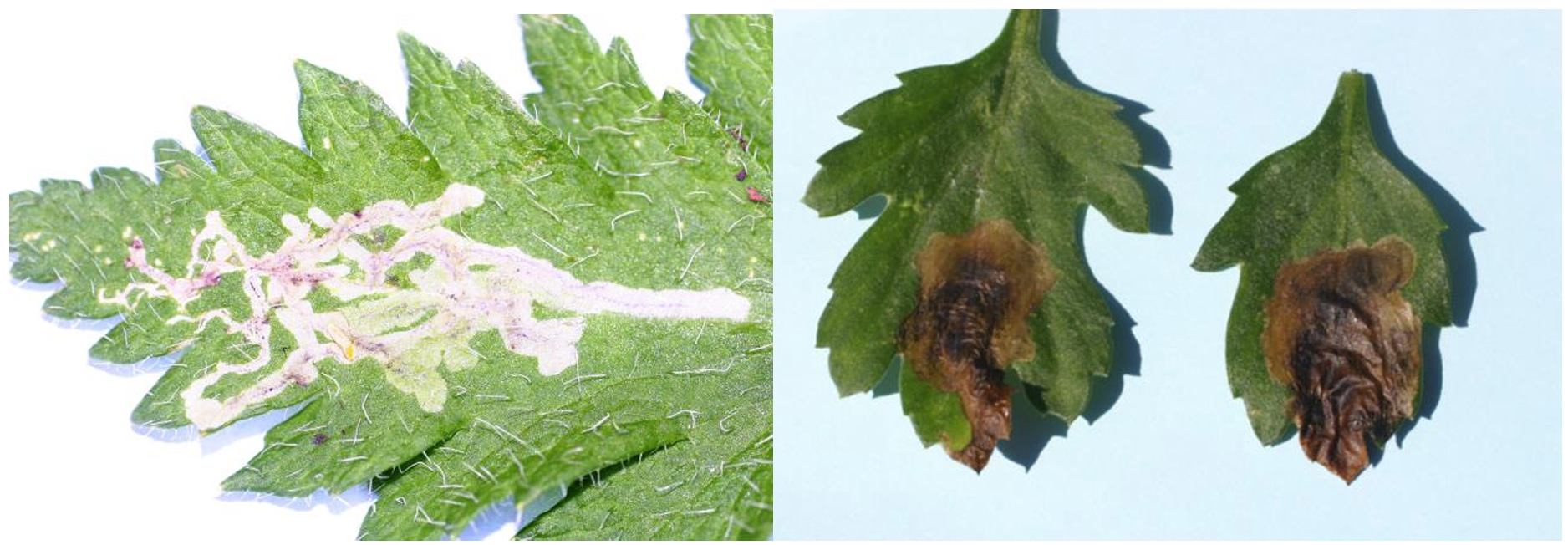
Small flies in the family Agromyzidae are common insect pests of greenhouse crops and herbaceous perennials. The American serpentine leafminer (Liriomyza trifolii), caused serious problems in the greenhouse cut floral mum industry in the 1980’s. The overuse of certain insecticides led to widespread resistance, control failures and unsaleable plants.
Leafminer species are often host specific. (Some other leafminer species reported include the serpentine leafminer (Liriomyza brassicae), pea leafminer (Liriomyza huidobrensis) and the vegetable leafminer (Liromyza sativae).
Leafminer feeding damage is generally aesthetic, and plants are rarely killed. Damage may be more severe on seedlings and young plugs. If severe, leafminer damage affects the salability of plants. The target audience of this fact sheet is commercial greenhouse growers.
Identification, Biology and Life Cycle
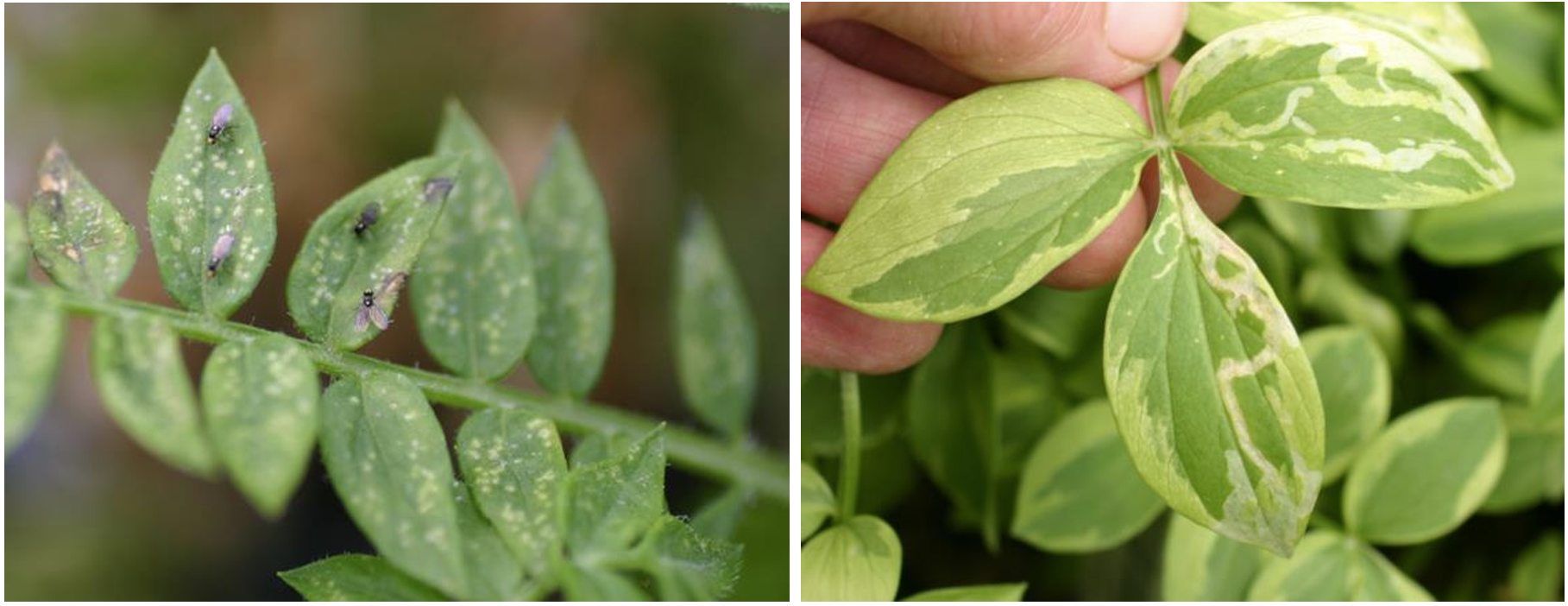
American serpentine leafminer adults resemble small houseflies and are 1/4-inch-long with shiny, black bodies with yellow markings on their abdomen. (This helps distinguish leafminer adults from shore fly adults.)
Adult females pierce young leaves with their ovipositor (egg-laying structure), and feed on the liquid that exudes from the wounded leaf tissue. Females insert their eggs into leaves. The small larvae are typically bright yellow to brown. As larvae feed within the leaf tissues, they create serpentine or winding mines.
In general, leafminer females lay approximately 100 eggs during their 2 to 3-week lifespan. Eggs hatch in 5 to 6 days, and larvae feed beneath the leaf cuticle for about two weeks. The final larval instar creates an opening in the leaf and then falls to the ground. Larvae burrow into the growing medium or soil under the benches to pupate. Leafminers need complete darkness to pupate. Pupae are brown, and adults emerge within a two-week period. The length of the life cycle depends on the leafminer species, host plant and temperature. At 86° F, their life cycle from egg to adult can be completed in as little as 14 days. So, there can be multiple, overlapping generations with multiple leaf stages present making management challenging.
Scouting
- Inspect incoming plants for signs of leafminer activity. When visually inspecting plants, look for any egg-laying punctures, which appear as white spots on the tops of leaves.
- Use yellow sticky cards to monitor for adult leafminers, especially in susceptible crops such as chrysanthemum, Gerbera daisy, asters, and other members of the composite family.
- Adults may be observed walking on plant leaves and flowers. Yellow markings on their bodies are helpful to distinguish certain species of leafminer adults from shore fly adults.
Cultural Controls
- Avoid over-fertilizing plants, particularly with nitrogen.
- Over-fertilized plants are more attractive to adult females for egg-laying.
- Remove weeds, plant debris and infested leaves or highly infested plants before leafminers pupate.
- Hopper tape may be used to mass trap adults, especially if winged biological control agents are not being used.
Biological Control
Commercially available biological control agents include the parasitic wasps, Diglyphus isaea and Dacnusa sibirica for suppression of serpentine and related leafminers.
Diglyphus isaea is a small (1/25 to 1/11 inch or 1.0 to 2.3 mm long) black wasp with short antennae. It is an ectoparasitoid; females paralyze the host before laying one or more eggs next to the leafminer larvae. Adult females attack second instar leafminer larvae within the leaf mines. D. isaea also feeds on host fluids of the larvae. This small parasitic wasp works best at high temperatures (above 68° F) and when pest populations are high.
When scouting, look for short mines with the dead leafminer larvae inside the mines. Look for signs of parasitism: round holes in the leaf mine where the parasitic wasp adults have emerged
Dacnusa sibirica is a small (1/11 to 1/9-inch (2.5 to 3.0 mm long) braconid wasp with long, extended antennae. It is an endoparasitoid; females lay eggs directly into leafminer larvae. This wasp uses odors emitted from leafminer droppings (frass) to locate larvae within damaged plant tissue. Dacnusa is better adapted to lower temperatures (60° F), short days, and lower light levels than Diglyphus.
Tips for Using Parasitic Wasps
Both wasps are best used preventively and have been used in long term crops such as cut flowers
- Release the adult parasitic wasps in the morning or evening. Apply weekly. Consult with your supplier for release rates.
- Remove yellow sticky cards or tape before making releases.
- Replace the cards 3 to 4 days after making releases.
- Diglyphus isaea has been used in greenhouse-grown chrysanthemums and gerbera daisy.
Chemical Controls
Using insecticides to control leafminer populations may be difficult because several species have developed resistance to certain insecticides. Applications of pyrethroidbased insecticides may be required every 3–4 days to kill adults as they emerge from pupae in the growing medium. Apply insecticides in the morning, when females are actively laying eggs, for the wet sprays may disrupt their ability to deposit eggs in leaf tissue. Several pyrethroid-based insecticides have repellent properties that may deter adult females from laying eggs, minimizing damage to plant leaves. Insecticides with translaminar properties, including several insect growth regulators, may also be effective in killing the larvae within leaf mines. For more, see the New York and New England Management Guidelines for Greenhouse Floriculture and Herbaceous Ornamentals.
See the New England Vegetable Management Guide for information on spinach and beet leafminers on chard, beet and spinach transplants.
Disclaimer for Fact Sheets: The information in this document is for educational purposes only. The recommendations contained are based on the best available knowledge at the time of publication. Any reference to commercial products, trade or brand names is for information only, and no endorsement or approval is intended. UConn Extension does not guarantee or warrant the standard of any product referenced or imply approval of the product to the exclusion of others which also may be available. The University of Connecticut, UConn Extension, College of Agriculture, Health and Natural Resources is an equal opportunity program provider and employer.