Introduction
Leafhoppers are not common pests in greenhouses, but can occasionally enter greenhouses from outdoor crops, (especially herbaceous perennials) and be seen on yellow sticky cards. On outdoor growing crops of herbaceous perennials, woody ornamentals and cut flowers, leafhoppers can be difficult to control pests. Of the over 2500 species of leafhoppers found in North America; the potato leafhopper, the aster leafhopper, sage and Ligurian leafhopper will be reviewed. The target audience of this fact sheet is commercial greenhouse growers.
Feeding Damage
Leafhoppers with their sucking mouthparts, feed on plant sap. Some species only feed on the upper layers of plant cells causing white flecking on plant leaves.
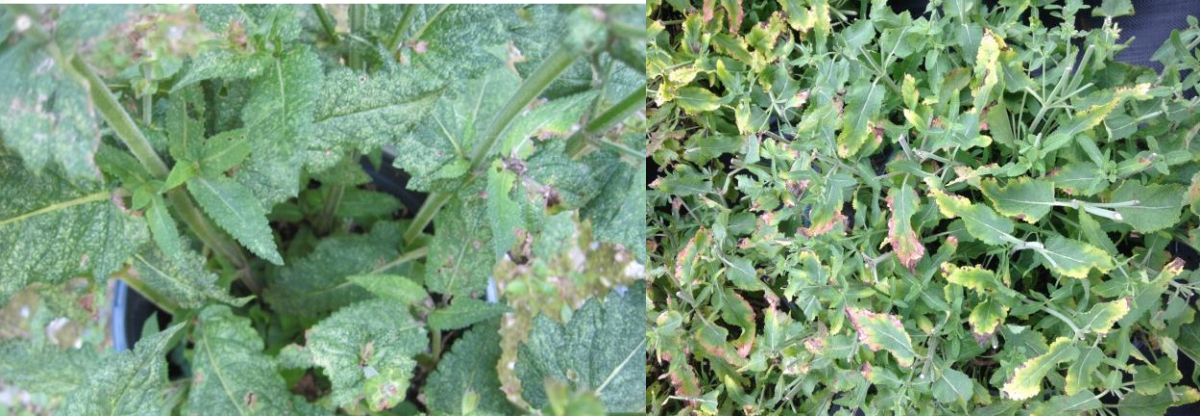
Other species, such as potato leafhopper, injure the plant’s vascular system, resulting in a “hopperburn” type of damage beginning at the leaf tip with distortion, yellowing, stunting and loss of plant vigor.
Life Cycle and Biology
Leafhoppers are small, (about 1/8 to 3/16 of an inch in length) with slender wedgeshaped bodies that taper at their end. Eggs are inserted into plant leaves, often near the leaf veins, and hatch into active nymphs found on the underside of the leaves. Adults hold their wings roof-like over their body.

Potato leafhopper
Potato leafhopper is found primarily in eastern North America. Feeding causes leaves to develop yellow and brown margins; growth may become stunted known as ‘hopperburn,’ and is sometimes mistaken for fertilizer (or high soluble salts) injury, drought, or herbicide damage. Look for the pale green nymphs with their characteristic crab-like walk on Alcea, Astilbe, Baptisia, Dahlia, Gaura, Hibiscus, Lupinus, and Nepeta.
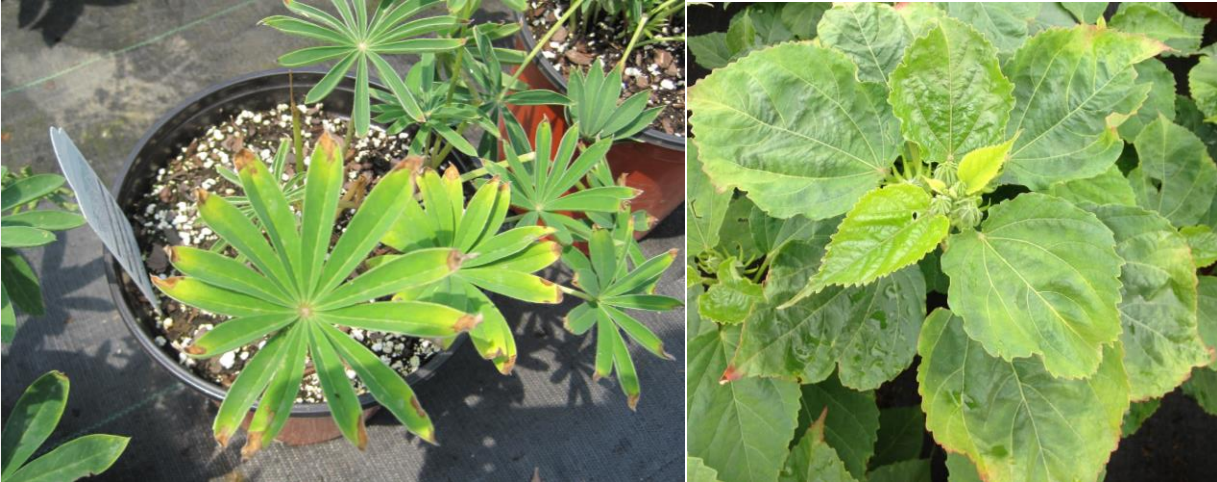
The very active leafhoppers dart around and fly up from foliage when disturbed so yellow sticky cards are helpful. Using yellow sticky cards also makes it easier to determine which species of leafhopper is present. Potato leafhopper adults are
approximately 1/8-inch long, light-green with characteristic white spots just behind their head that are visible under high magnification. This species overwinters in the warmer parts of the southeastern US. Each year, it migrates northward. Generally, two to three generations occur in Connecticut each year.
Aster Leafhopper
The adult aster leafhoppers are about 1/8-inch-long and yellow-green with black spots just behind the head. Use sticky cards to trap adults in order to see the distinguishing spots behind the head.
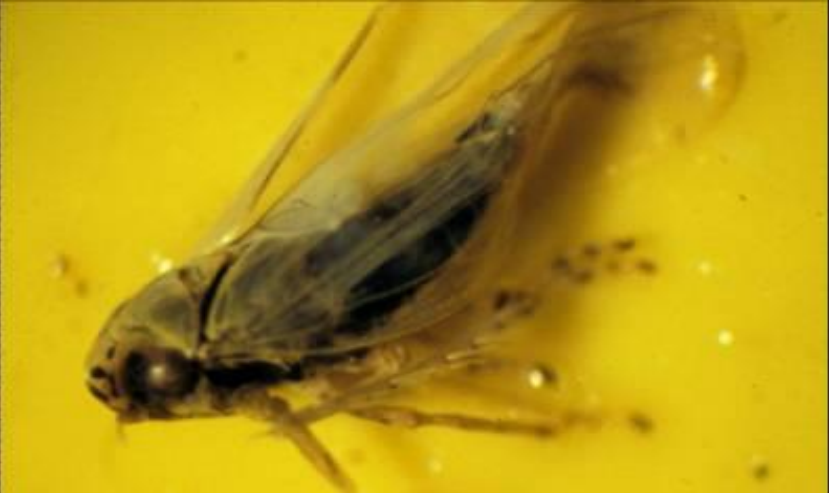
Aster leafhoppers overwinter as eggs on various grasses and herbaceous perennials. In New England, there can be up to five generations during the growing season. Aster leafhoppers transmit the pathogen that causes aster yellows disease, especially leafhoppers migrating in from southern states.
Aster yellows may be found on herbaceous perennials, annuals, cut flowers, vegetables, and weeds. Members of the aster family (Aster, Coreopsis and Echinacea) are more commonly affected. When plants are infected early in the season, they
become stunted, with shortened internodes and deformed yellowish-green flower heads. Severely infected plants develop a bushy mass of leaves (known as a “witches’ broom”) with no normal flower production. Infected plants infected cannot be cured. Manage weeds in and around production areas to prevent infection of alternative hosts and overwintering of aster yellows.
Scouting
Look for the fast moving adults and nymphs on the underside of leaves. Their feeding causes a stippling of the foliage (resembling spider mite feeding), stunting, and distortion of new growth. Potato leafhopper also injects a toxin as it feeds, so that leaves develop a v-shaped, brown edge burn at the tip known as “hopperburn” that may be mistaken for leaf scorch due to drought stress. One may also see their shed, white skins.
Biological Controls
There are limited natural enemies commercially available for the management of the fast moving leafhoppers.
Chemical controls
Control of leafhoppers with contact insecticides is difficult because they are very mobile, and new leafhoppers enter treated areas after sprays have dried. Systemic insecticides may be applied to ornamental perennial plants to prevent feeding damage when leafhoppers first appear. See New York and New England Management Guidelines for Greenhouse Floriculture and Herbaceous Ornamentals for more information.
Leafhoppers on Herbs
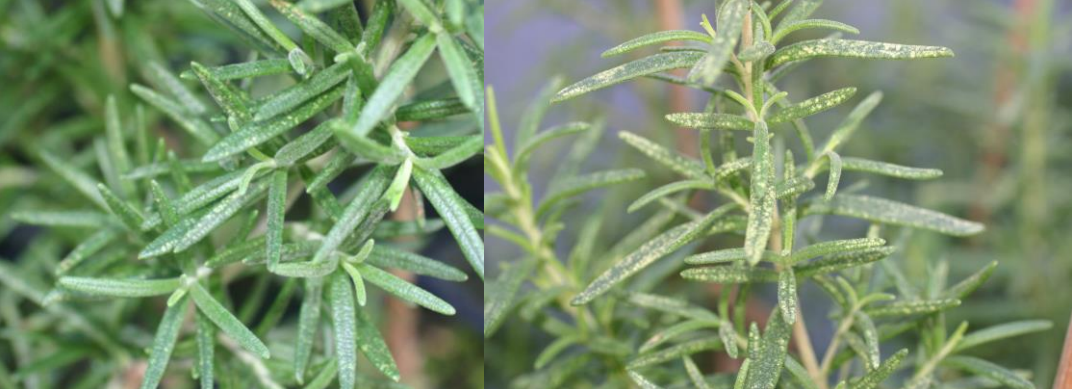
Sage (also known as mint) leafhopper (Eupteryx melissae) prefers herbs in the mint family such as rosemary, sage, catnip, and mint., Native to Europe, this insect is now established in the US and has been a pest both outdoors and in greenhouses. Adults are small (slightly larger than 1/8”) and pale with distinctive brownish oval markings. Feeding damage may be confused with leaf injury caused by thrips, or spider mites. Young leaves may become distorted. It overwinters as eggs in plant stems and petioles.
The Ligurian leafhopper (Eupteryx decemnotata) closely resembles the sage leafhopper. It can be distinguished by 5 pairs of spots on its head. See Tasi & Lucky (2020) for photos to distinguish Ligurian leafhopper from sage leafhopper. Hosts include rosemary, sage, lemon balm, basil, marjoram, oregano, and thyme. Damage resembles thrips or spider mite feeding damage.
Because eggs are laid in plant stems, these eggs can escape the effects of the short residual, contact insecticides that are labeled for use on herbs. (There are no systemic insecticides labeled for leafhoppers for use on herbs). Adults are highly mobile, so can easily re-infest plants. In Europe, vacuums have been used to collect adults. Exclusion netting has been used in production areas. The fast-moving adults and nymphs also can escape possible predation by generalist natural enemies.
Disclaimer for Fact Sheets: The information in this document is for educational purposes only. The recommendations contained are based on the best available knowledge at the time of publication. Any reference commercial products, trade or brand names is for information only, and no endorsement or approval is intended. UConn Extension does not guarantee or warrant the standard of any product referenced or imply approval of the product to the exclusion of others which also may be available. The University of Connecticut, UConn Extension, College of Agriculture, Health and Natural Resources is an equal opportunity program provider and employer.