Biological controls against the western flower thrips, Franklinellia occidentalis, include predatory mites, predatory bugs, entomopathogenic nematodes and entomopathogenic fungi. An integrated approach is often needed with banker plants helping in their establishment. The target audience of this fact sheet is commercial greenhouse growers.
What are Banker Plants?
Banker plants are used to supply needed resources such as pollen, egg-laying sites, and a stable habitat to help in the establishment of biological control agents. They serve as in-house rearing units for natural enemies and can help establish populations of beneficials.
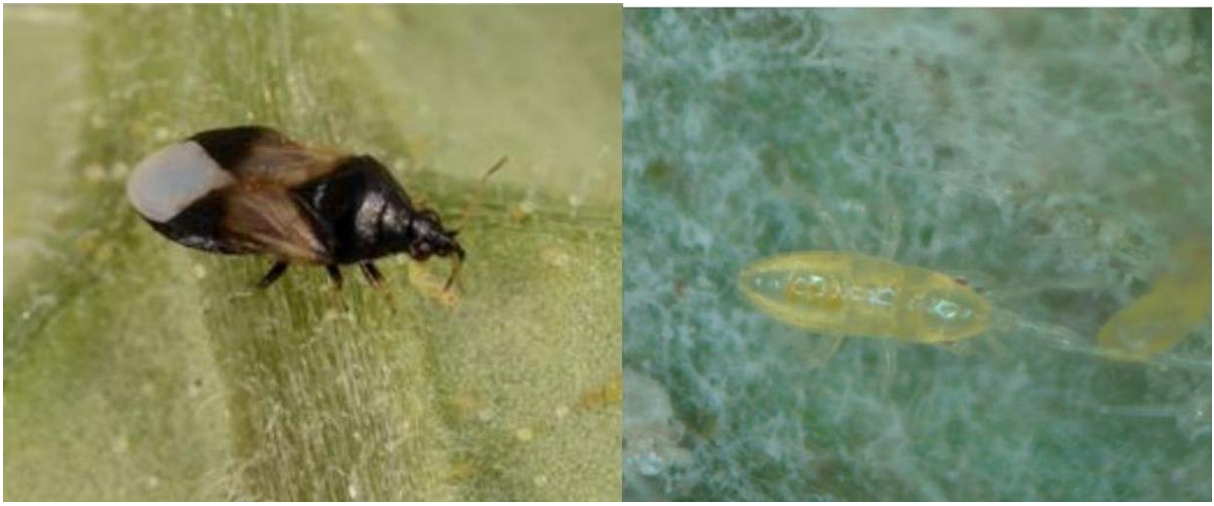
Life Cycle and Biology of Minute Pirate Bugs (Orius sp.)
While predatory mites are often a growers first line of defense, minute pirate bugs can also be released. An advantage to using minute pirate bugs (Orius sp.) compared to predatory mites (Neoseiulus cucumeris) is that Orius feeds upon immature and adult thrips, whereas Neoseiulus cucumeris only feeds upon the first instar thrips larvae.
Orius insidious feeds upon both larval and adult thrips as well as aphids, spider mites and other small arthropods. Both nymphs and adult minute pirate bugs are predacious. They can consume up to 20 thrips per day. Minute pirate bugs also feed upon pollen and plant sap when suitable prey is not present. But, Orius may take up to two months to get established in the greenhouse. Because Orius can also feed on pollen, the use of banker plants can help with its establishment in the greenhouse.
Orius has five nymphal stages and completes its life cycle from egg to adult in about 30 days at 65 °F. Minute pirate bugs usually lay their eggs in growing tips and buds. After an initial release, it takes eight to 10 weeks before the Orius population is high enough to have an impact on a thrips population in the greenhouse. Minute pirate bugs lay their eggs within the plant stems, so their eggs are removed from the greenhouse when the short-term spring crops are sold.
Orange to brown nymphs may be found on plant leaves and adult Orius in open flowers. All life stages move quickly. Adults are good flyers and can move throughout a greenhouse to locate their prey. Orius is most effective at temperatures between 68 and 85 ˚F.
How to Use Thrips Banker Plants
Start the slow growing ornamental pepper plants early (late October, early November). Some growers even start their ornamental plants as early as August. The larger the plants, the more flowers and pollen you will have for Orius to feed upon. Some growers are producing ornamental pepper banker plants for sale to other growers. Grow banker plants in hanging baskets or larger planters.
Biological control suppliers recommend 80 to 100 pots per acre containing three plugs of ornamental peppers per pot. The ornamental pepper cultivar ‘Purple Flash’ is a more effective banker plant than the cultivar ‘Black Pearl’ because it produces more pollen.
Some growers combine the Lobularia hybrid ‘Snow Princess’ with the pepper plants to attract Orius. Lobularia is also very attractive to hover or syrphid flies, whose larvae feed upon aphids.
Minute pirate bugs are released onto the banker plants that are in flower, using the pollen as a food source.
It may take up to two months to establish sufficient populations
Never spray your banker plants.
Remove pepper fruits about once a month to keep pepper plants flowering.

Descargo de responsabilidad para las hojas informativas: La información de este documento es solo para fines educativos. Las recomendaciones contenidas se basan en el mejor conocimiento disponible en el momento de la publicación. Cualquier referencia a productos comerciales, nombres comerciales o de marca es solo para información y no se pretende ningún respaldo o aprobación. La Extensión de UConn no garantiza el estándar de ningún producto al que se hace referencia ni implica la aprobación del producto con exclusión de otros que también puedan estar disponibles. La Universidad de Connecticut, Extensión de UConn, Facultad de Agricultura, Salud y Recursos Naturales es un empleador y proveedor de programas con igualdad de oportunidades.