Introduction
Echinothrips americanus is thrips species that is native to eastern North America. It has a wide host range and can feed on greenhouse ornamentals, vegetables, and weeds. Echinothrips has become an increasing problem in greenhouse ornamentals as it has spread throughout the industry on tropical foliage plants. Echinothrips was first reported on poinsettias in Georgia in 1984, so it may sometimes be referred to as the poinsettia thrips. (However, CT greenhouse growers have not noted its presence on poinsettia.)
Life Cycle and Biology
Unlike the dominant western flower thrips (WFT) Frankliniella occidentalis, whose pupal and pre-pupal stages are found in the growing media, all life stages from egg to adult of Echinothrips are found on plant leaves. .
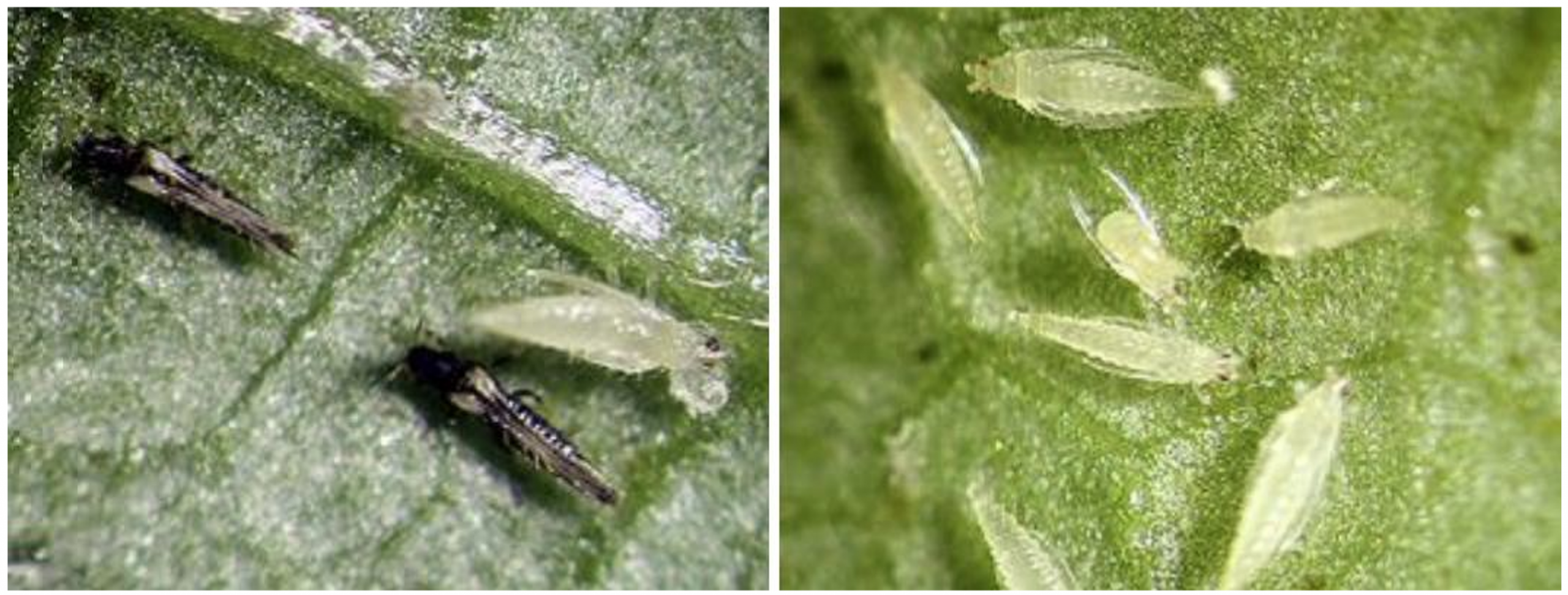
Eggs are inserted into plant tissue, with larvae and pupal thrips found on the upper and underside of leaves. Larvae, pre-pupae, and pupae are white to light-yellow in color. The dark brown to black adults are relatively large (females are 1.6 mm long) with distinctive orange pigmentation between their segments. Adults also have white patches at the base of their wings. Echinothrips life cycle development depends upon temperature, with development from egg laying to adult emergence over 34, 15, and 11 days at 68F, 77F and 86F. Below 32F, Echinothrips cannot survive for more than a few hours, so it does not overwinter outside in temperate climates.
Scouting
Adults are dark brown with red bands between their abdominal segments. Their dark wings also have distinctive white patches at their base which most thrips species do not have. The sedentary Echinothrips tend to stay along the leaf veins. Look on the leaves, especially along the midvein, for the distinctive adults and their black fecal spots. Adults are not strong fliers so may not be found on sticky cards. Green sticky cards are reported to be more effective than yellow or blue sticky cards.
Feeding Damage
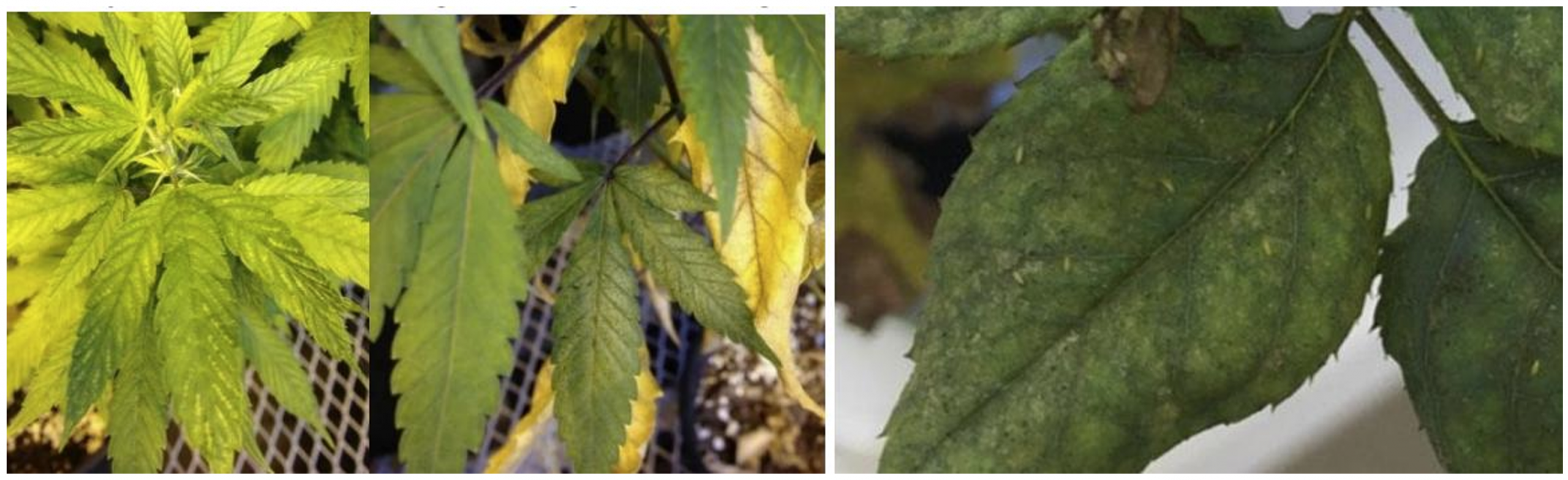
As they feed, Echinothrips pierce the plant cells, sucking out the cell contents resulting in silvergray patches on the leaves. The damage may look a little more like spider mite feeding damage than typical thrips feeding damage. Damage may be more prevalent on the lower leaves.
Biological Controls
Predatory mites are not as effective against Echinothrips compared to their use against western flower thrips. According to research at Wageningen University in the Netherlands, Amblyseius swirskii may be more effective than Neoseilus cucumeris which is the mainstay of the biological control programs against western flower thrips. Orius spp. also tends to be ineffective against Echinothrips in greenhouse ornamentals. Because Echinothrips pupate on the leaves, the entomopathogenic nematode, Steinernema feltiae, is also not effective against the pupal stage
Microbial insecticides containing Beauveria bassiana or Cordyceps (formerly Isaria) fumosoroseus, may be used and are also are reported to be compatible with A. swirskii
Limited research has been completed on chemical efficacy. In the latest research summary on thrips by the IR-4 project, only five thrips species were tested and Echinothrips was not included.
Descargo de responsabilidad para las hojas informativas: La información de este documento es solo para fines educativos. Las recomendaciones contenidas se basan en el mejor conocimiento disponible en el momento de la publicación. Cualquier referencia a productos comerciales, nombres comerciales o de marca es solo para información y no se pretende ningún respaldo o aprobación. La Extensión de UConn no garantiza el estándar de ningún producto al que se hace referencia ni implica la aprobación del producto con exclusión de otros que también puedan estar disponibles. La Universidad de Connecticut, Extensión de UConn, Facultad de Agricultura, Salud y Recursos Naturales es un empleador y proveedor de programas con igualdad de oportunidades.