Broad mites (Polyphagotarsonemus latus) can cause serious damage to a variety of greenhouse crops. These mites are extremely small which makes it difficult to detect the mites before severe feeding damage is evident. This tropical or subtropical species generally doesn’t survive outdoors in the Northeast, so it may be introduced on vegetatively propagated material. Damage may be more pronounced on certain plant species or on one or two cultivars. The target audience of this fact sheet is commercial greenhouse growers.
Description
Broad mites are colorless-to-pale brown mites with a white stripe down the center of their backs. Broad mite eggs are elliptical but are covered by small whitish bumps that look like rows of diamonds. After eggs hatch, the distinctive dots on the surface persist. Look on the underside of the leaf or stem surface for the broad mite eggs. With practice and good lighting, it is possible to detect the eggs with a 20x hand lens, but a microscope is preferred.

Feeding Damage
Broad mites have a wide host range and can feed on ageratum, begonia, chrysanthemum, cyclamen, dahlia, gerbera daisy, gloxinia, hibiscus, English ivy, jasmine, impatiens, New Guinea impatiens, lantana, marigold, snapdragon, verbena, and zinnia. Broad mites can also infest vegetable bedding plants, especially peppers.
They may be spread among a crop via air currents, plant-to-plant contact, by workers handling infested plants and then touching uninfested plants and hitching on whitefly adults.
- Broad mites inject a toxin from their saliva as they feed.
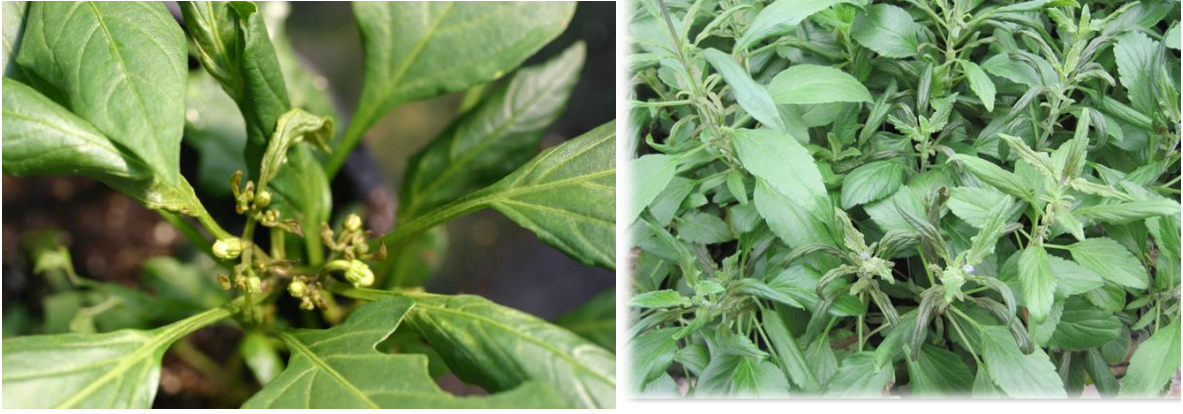
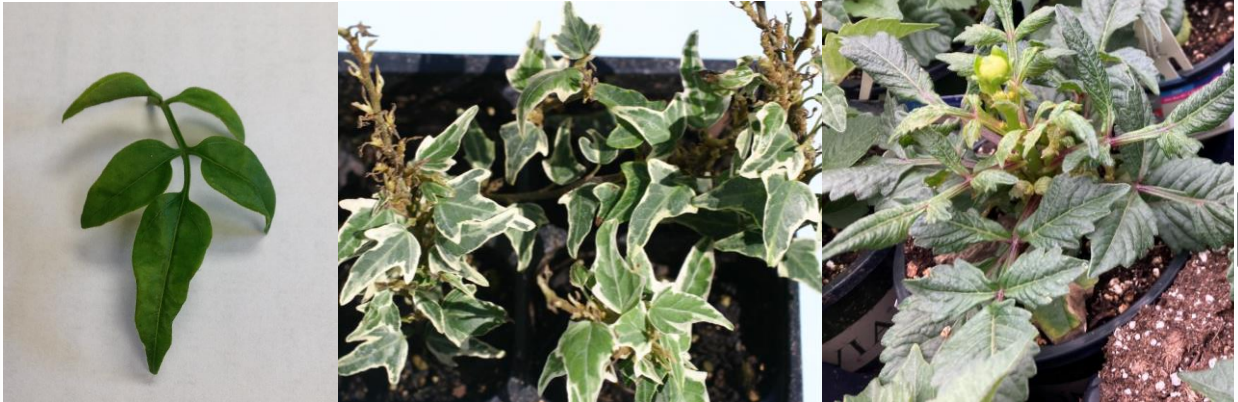
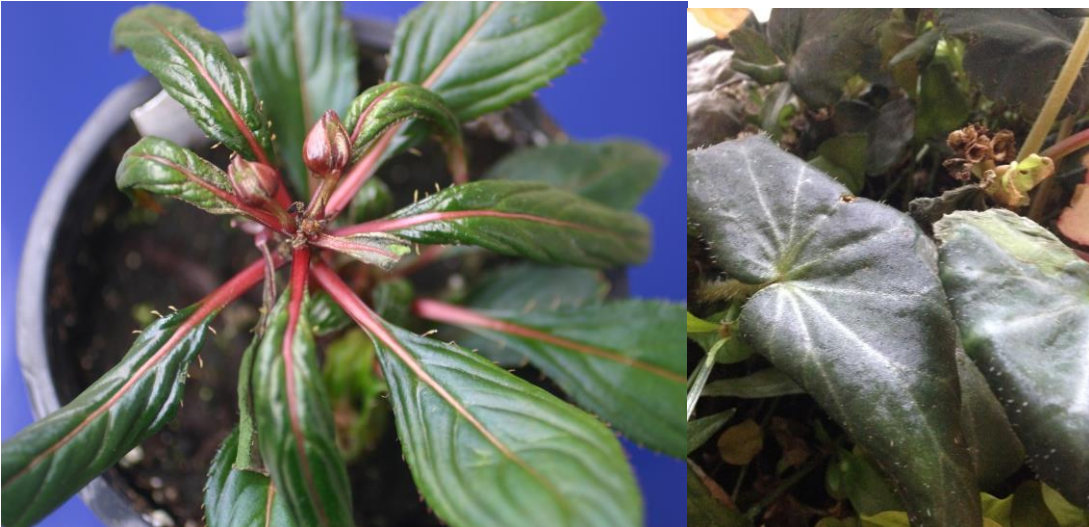
- Leaves become twisted, hardened, and distorted with bronzed lower leaf surfaces. Young terminal buds can be killed, especially if high broad mite populations are present. Broad mite feeding prevents normal leaf expansion and causes a downward puckering along the leaf edges.
- Broad mite injury may resemble herbicide injury, certain nutrient deficiencies (boron or calcium), cold temperature injury, or several physiological disorders. Broad mite injury often occurs suddenly and may be spotty in distribution. This damage may persist long after the mites are gone.
Life Cycle and Biology
High temperatures of 70o to 80o F and 80 to 90% relative humidity favor the development of broad mites. Female broad mites lay from 30 to 75 eggs on the leaf surface over an 8 to 13-day period. Larvae hatch in 2 to 3 days and begin feeding. Broad mites can complete their life cycle from egg to adult in as little as one week's time
Scouting
- Broad mites are very hard to see without the aid of a microscope.
- Regular inspection of crops for their feeding damage is the best way to detect infestations.
- Broad mites often feed on the underside of leaves.
- Leaves near the growing points or collected during humid conditions are more likely to have mites present.
- If characteristic symptoms are seen, inspect samples under a dissecting microscope. See the Video Identifying Broad Mites and Their Damage on the Greenhouse Channel on You tube for more tips on identification and scouting for broad mites.
Prevention
Rogue infected plants as soon as possible. If detected early, it may be feasible to discard a small number of infested plants. Broad mites can be easily spread to healthy plants by workers' hands or clothing. During scouting and other routine tasks, enter broad mite-infested areas last.
Biological Control
The commercially available predatory mites, Neoseiulus cucumeris, Neoseiulus californicus and Amblyseius swirskii, may be used preventatively against broad mites. These generalist predatory mites also feed upon pollen. However, these predatory mites must be released before populations are high and plant damage occurs. When growers are placing N. cucumeris sachets in thrips-prone crops they often also place these sachets in crops that are prone to broad mites. Consult with your biological control supplier for more information on release rates.
Chemical Control
Several different miticides are labeled for broad mites. If possible, select materials with translaminar properties that move through the leaf. High volume applications and repeat applications are frequently necessary to achieve adequate control. Not all miticides labeled for spider mites are labeled for broad mites. See New York and New England Management Guidelines for Greenhouse Floriculture and Herbaceous Ornamentals for more specific information.
Disclaimer for Fact Sheets: The information in this document is for educational purposes only. The recommendations contained are based on the best available knowledge at the time of publication. Any reference commercial products, trade or brand names is for information only, and no endorsement or approval is intended. UConn Extension does not guarantee or warrant the standard of any product referenced or imply approval of the product to the exclusion of others which also may be available. The University of Connecticut, UConn Extension, College of Agriculture, Health and Natural Resources is an equal opportunity program provider and employer.