Introduction
Downy mildew on basil was first reported in the US in 2007 in Florida and by 2008 and 2009, it was widespread in the Northeast. Downy mildew on basil is seed-borne, so infections can begin in the greenhouse. It is also readily spread by air-blown spores. The target audience of this factsheet is commercial greenhouse growers.
Symptoms
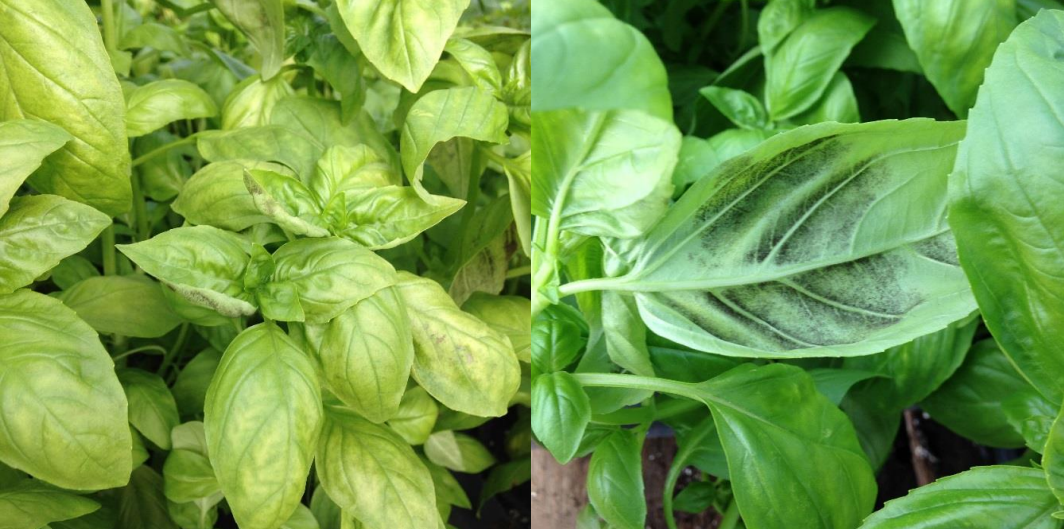
Symptoms may be confused with a nutritional deficiency when the upper leaves become yellowed and mottled. However, during conditions of high humidity, (greater than 85%), dark purplish-brown to gray fungal-like sporulation develops on the underside of the basil leaves giving them a “dirty appearance.”
Environmental Conditions Favoring Downy Mildew on Basil
Downy mildew on basil is especially severe when foliage stays wet for extended periods after inoculation (arrival of the pathogen on its host plant). The downy mildew pathogen needs at least 4 hours of leaf wetness for infection and more than 7.5 hours of high humidity levels (greater than 95%) at night for sporulation. When the relative humidity is at 100%, optimum temperature for basil downy mildew to develop is 68° F. It can develop at temperatures between 41 F to 86F with spores germinating within two hours and infecting plant tissue within four hours. After infection, it may take from 5 to 10 days for the symptoms to appear.
Causal Organism and Host Range
Basil downy mildew is caused by the host specific fungus-like organism Peronospora belbahrii. Like other downy mildews, it is an obligate parasite and needs a living host to live and reproduce.
Sweet basil (Ocimum basilicum) is the most susceptible basil type while citrus basil and spice basil types are the most resistant. Fortunately, breeding efforts have resulted in Genovese sweet basil varieties with intermediate to high levels of resistance. Disease resistance is rarely immunity, so some symptoms may occur.
Management
- Start with pathogen-free seed. Ask if your supplier is steam treating their basil seed. (Basil seed produces a gelatinous exudate, so it is difficult for the seed companies to use hot water seed treatments.) Purchase seed from a trusted source.
- Purchase basil downy mildew resistant varieties. Prospera is an organic basil seed that has performed very well in replicated field evaluations. The Rutgers Breeding program has released varieties such as Rutgers Obsession DMR,
Rutgers Devotion, Rutgers Passion DMR, or Rutgers DMR Thunderstruck which are resistant varieties. Proven Winners has developed the downy mildew resistant variety, Amazel, that is sold as cuttings for the seed is sterile. None of these varieties are fully resistant but will develop the disease more slowly than fully susceptible varieties. - Reduce humidity and leaf wetness duration to prevent spore germination. The pathogen needs humidity of at least 85% in the plant canopy in order to infect.
- In the greenhouse, use a combination of heating and venting to reduce humidity and condensation, especially at night. See Reduce Greenhouse Humidity factsheet for more tips.
- Use horizontal air flow fans to improve air flow.
- Increase plant spacing and use open wire benches to increase air flow around the plants.
- Reduce leaf wetness periods by watering when plants will dry quickly or use of drip irrigation.
- Promptly destroy any infected plants and carefully remove from the greenhouse by placing in plastic bags that are tightly closed.
- Thoroughly clean and sanitize the greenhouse after removal of diseased plants. Use of a contact spray with hydrogen peroxide and peroxyacetic acid such as XeroTol to help kill any spores that may have spread.
- Once plants become infected, the disease is inside the plant tissues and fungicides will not be effective in stopping the downy mildew within the infected basil plants.
- The following conventional fungicides are labeled for use against basil downy mildew in the greenhouse part of a preventive IPM program:
Azoxystrobin (Heritage) (FRAC 11),
Cyazofamid (Segway O), (FRAC 21),
Fluopicolide (Adorn) Group 43 (see resistance management guidelines on tank-mixing), o mandipropamid (Micora) (FRAC 40), for greenhouses with permanent flooring o mefenoxam (Subdue Maxx) (FRAC 4) foliar spray must be used in a tank mix with other fungicides
Oxathiapiprolin (Segovis) (FRAC U15) with supplemental label for retail
sale to residential consumers,
Potassium salts of phosphorous acid (K-phite 7LP) (FRAC 33)
Organic products work by contact and it is difficult to reach the underside of the basil leaves and have not performed well in numerous trials.
Researchers are investigating the use of night lighting to inhibit spore production. This method works best on young seedlings, for if basil leaves overlap, the spores develop. In Israel, where basil is grown in shade or net-houses, they found that nighttime use of fans suppressed downy mildew development. The fans helped keep the relative humidity levels at lower levels within the plant canopy suppressing sporulation.
Advice for Retailers Selling to Home Gardens
When you are selling basil plants to retail customers, encourage home gardeners to plant and harvest basil early! Basil downy mildew does not overwinter in Connecticut, but the windblown spores move in from the South and infections often begin around mid-July. Keep track of where the disease is being found via the basil downy mildew monitoring program.
Home gardeners can also plant basil in containers that can be brought inside when humidity outside is high (overnight and on rainy days) especially if they are growing susceptible Genovese varieties. The pathogen needs at least 85% humidity for sporulation to occur.
Disclaimer for Fact Sheets: The information in this document is for educational purposes only. The recommendations contained are based on the best available knowledge at the time of publication. Any reference to commercial products, trade or brand names is for information only, and no endorsement or approval is intended. UConn Extension does not guarantee or warrant the standard of any product referenced or imply approval of the product to the exclusion of others which also may be available. The University of Connecticut, UConn Extension, College of Agriculture, Health and Natural Resources is an equal opportunity program provider and employer.