Introduction
Bulb mites (Rhizoglyphus species) infest bulb crops such as amaryllis, crocus, freesia, gladiolus, hyacinth, lily, Dutch iris, narcissus, and tulip. These mites can also infect garlic and onion bulbs. The two most common species are Rhizoglyphus echinopus and R. robini. These mites can be easily shipped long distances on infested bulbs, corms, and tubers. The target audience of this factsheet is commercial greenhouse growers.
Feeding Damage
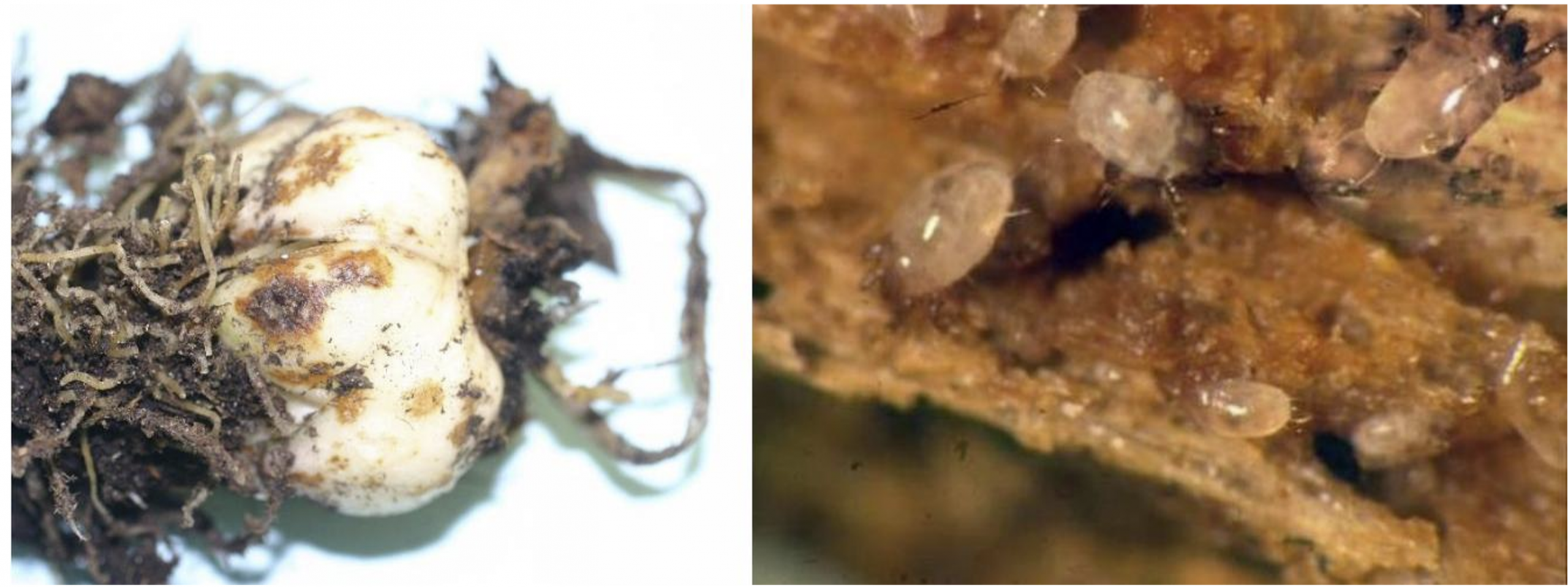
Visible signs of damage are typically not apparent until bulb mite populations are extensive. Infested bulbs may rot with new growth stunted and distorted.
Bulb mites are secondary pests commonly associated with bulbs already injured from fungus gnat larvae and/or root rot pathogens. They infest bulbs and corms by penetrating the basal plate or outer skin layers. Infested bulbs decay and turn rotten. Bulb mites may feed in Easter lily stems causing the stems to become brittle. Infested lilies are shorter with fewer stem roo
Symptoms of bulb mite infestations include stunting when there are low mite numbers to failure of bulbs to produce new growth with heavy mite infestations. Leaves will be stunted, distorted, and turn yellow. Flowers do not develop. Infested bulbs show reddish-brown discoloration and may rot after planting.
Feeding sites provide entry points for the root rot pathogens Rhizoctonia, Pythium, and Fusarium. Populations may increase faster on bulbs infested with Fusarium and other fungi. Signs of damage may not be evident until large populations develop.
Biology and Life Cycle
Bulb mites have a short life cycle and high reproductive potential. Their life cycle consists of an egg, larva, nymph, and adult. Bulb mites tend to occur in groups or colonies. There is also a non-feeding stage known as a “hypopi,” which can occur when there is overcrowding. This form can attach itself to other insects for dispersal.
Bulb mites are 1/50 to 1/25-inch-long with eight legs. They are shiny white to translucent with two brown spots on their body, with short reddish-orange legs. These extremely small, slowmoving mites are usually found in clusters underneath bulb scales or at the base of the bulb.
Each female bulb mite lays up to 100 eggs during her lifespan. The life cycle takes approximately 40 days to complete depending upon relative humidity, temperature, and host plant. For example, at 77ºF, the life cycle takes approximately 12 days. They do not undergo a resting stage or diapause.
Cultural Controls
Avoid rough handling of bulbs. Store bulbs at cool temperatures and low relative humidity to prevent disease problems, helping to prevent the build-up of bulb mites. Control fungus gnat larvae to avoid their feeding damage to bulbs. Plant only healthy, disease-free bulbs.
Biological Controls
The predatory mite, Hypoaspis aculeifer, may suppress bulb mites but it is not currently available. In one study, Stratiolaelaps scimitus (formerly known as Hypoaspis miles), died out without reducing bulb mites but H. aculeifer suppressed populations. It may also be difficult for the predatory mites to reach the bulb mites hidden in the inner folds of the bulbs. Bulb mite populations may be controlled by immersing infested plants in 110ºF water for 30 minutes. However, this may significantly damage some bulb crops.
Chemical Controls
Currently, there are no insecticides or miticides specifically labeled to control bulb mites.
Disclaimer for Fact Sheets: The information in this document is for educational purposes only. The recommendations contained are based on the best available knowledge at the time of publication. Any reference to commercial products, trade or brand names is for information only, and no endorsement or approval is intended. UConn Extension does not guarantee or warrant the standard of any product referenced or imply approval of the product to the exclusion of others which also may be available. The University of Connecticut, UConn Extension, College of Agriculture, Health and Natural Resources is an equal opportunity program provider and employer.