Introduction
The black vine weevil (Otiorhynchus sulcatus) may be found in herbaceous perennial production nurseries. It has a wide host range, feeding on over 200 plant species and may be spread by the transport of infected plant material. The target audience of this factsheet are commercial greenhouse and nursery growers.
Feeding Damage
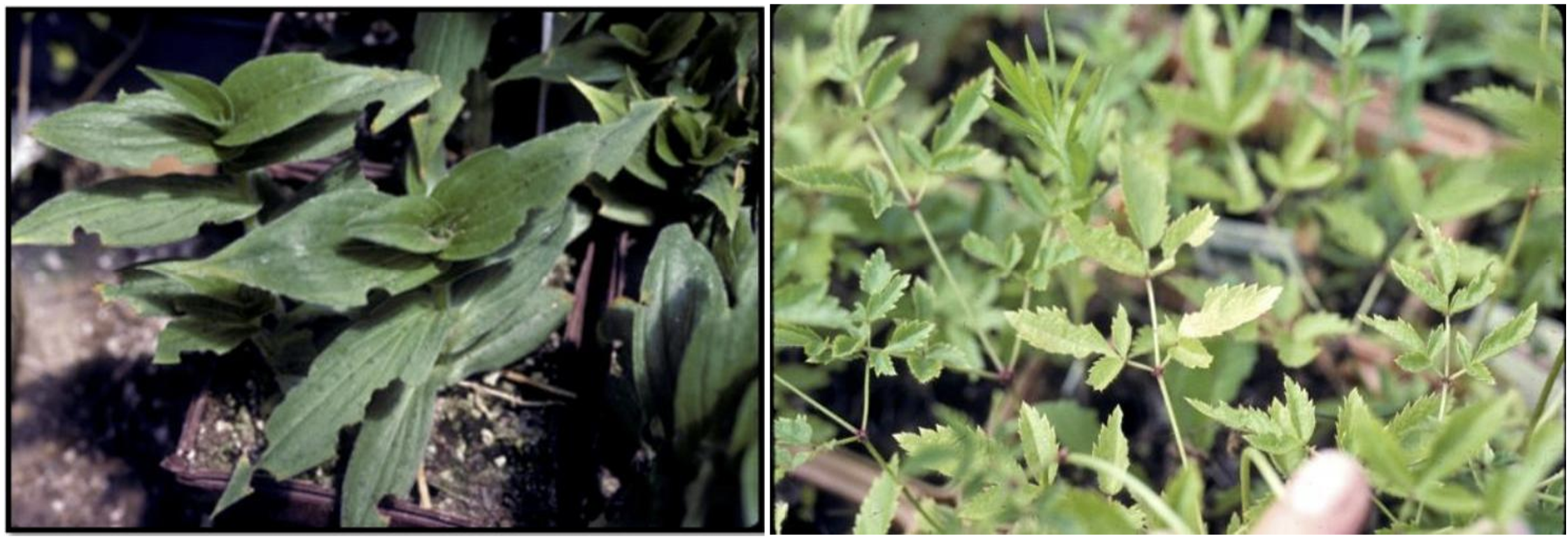
Adults feed at night and hide around the base of plants during the day. As the adults feed, they cause c-shaped notching along the leaf margin to both herbaceous and woody plants. This damage is primarily cosmetic and may be hard to see on certain plants such as Astilbe.
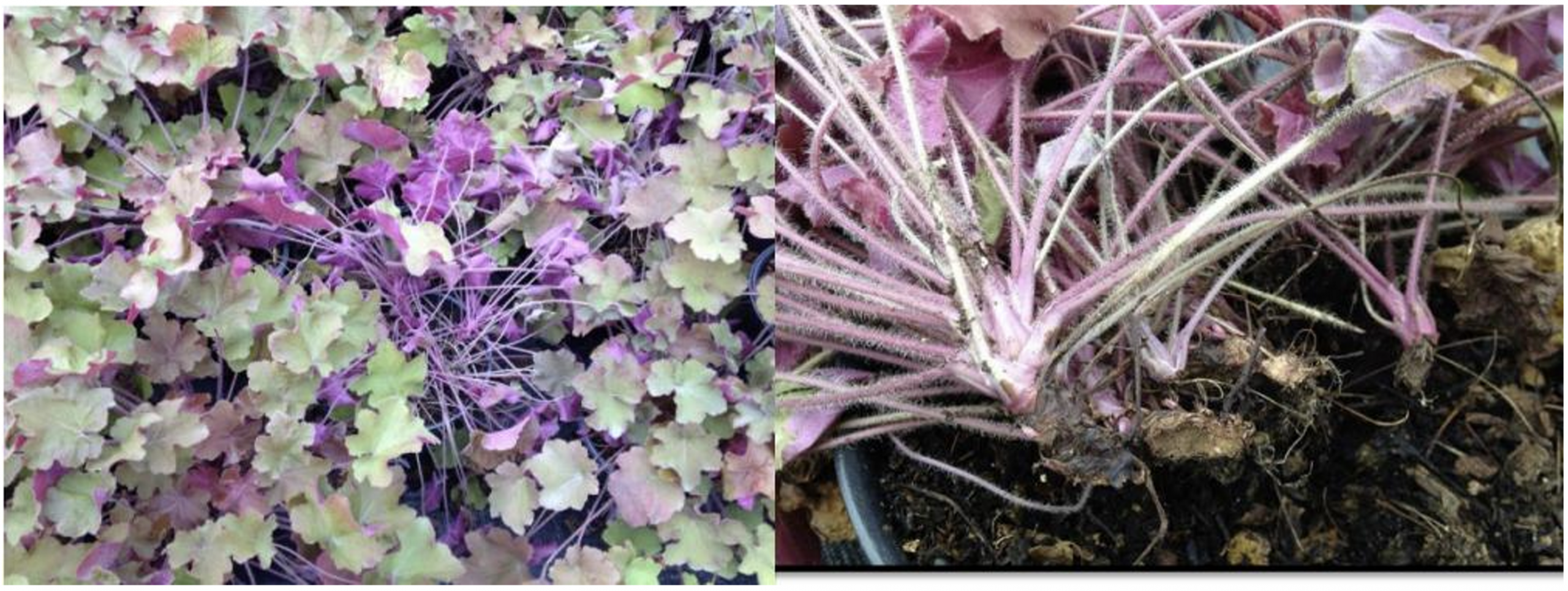
The young larvae feed on fine roots and the mature larvae feed on stems, crowns, and larger roots. In herbaceous perennials, the larvae often feed in the crown severely reducing root systems and causing plant death.
Some of the perennials prone to damage include Astilbe, Bergenia, Epimedium, Helleborus, Heuchera, Heucherella, Hosta, Physostegia, Phlox, Primula, Saxifrage, Sedum and Tricyrtis. Some herbaceous perennials are very good hosts, such as Astilbe or Tricyrtis, but seem to tolerate more damage than other species.
Black vine weevils can also enter greenhouses and have been reported to damage some greenhouse crops such as begonia, impatiens, gloxinia, geranium and roses.
Biology and Life Cycle
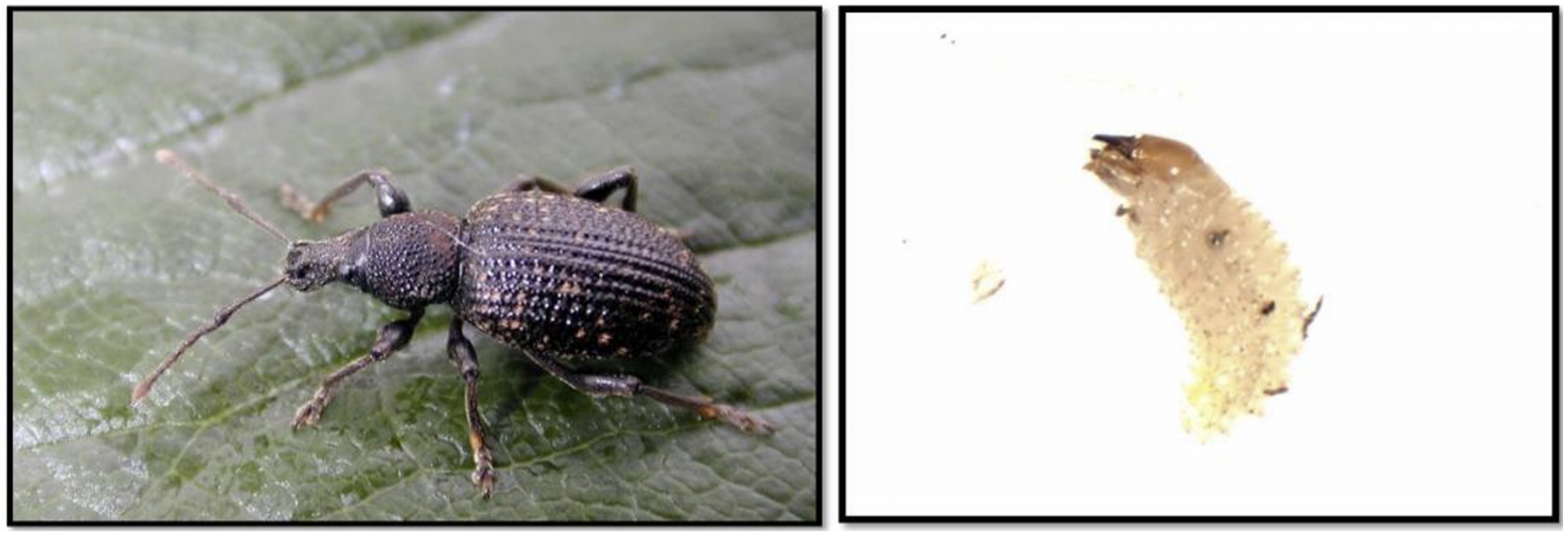
Their life cycle progresses from egg, to larva, pupa, and adult. The black vine weevil adult is 3/8-inch-long, brown-to-black in color with yellow-brown markings on its wing covers, with ridges extending down the length of the abdomen. Adults have a distinct, short snout and elbowed antennae. Adult black vine weevils cannot fly because their wing covers are fused together.
After approximately two to three weeks of adult feeding, egg laying begins. Outdoors, adult female weevils lay eggs from July through August. Adults can live more than one year, often laying 200 to 400 eggs the first year and over 400 eggs in the second year. Eggs hatch in about two weeks and are laid in the upper one to two inches of the growing media. All adults are females who do not need to mate to reproduce. This is called parthenogenesis.
Larvae hatch in August and begin feeding on fine young roots. Larvae are white to cream colored, legless grubs with yellow-brown heads and are covered with fine hairs. The larvae have six instars. When mature, they are about 1/2 inch long. Older larvae are also slightly C-shaped but lack legs. Black vine weevil larvae feed on the roots of host plants and then overwinter as full-grown larvae. Larvae resume feeding in the early spring, often causing the heaviest damage. Pupation occurs in earthen cells that they form in the growing medium.
There is generally one generation per year, but in greenhouses, depending upon temperatures and environmental conditions, several overlapping generations with different life stages may be present.
Scouting
Since the larvae are active in the growing media and adults feed at night by notching the edges of leaves, infestations may go unnoticed until significant damage has occurred. Although adults are active at night, they may be monitored by placing
horizontal sticky boards on benches to trap adults. Check plant debris and growing medium around plants for the presence of adult black vine weevils. During the day, adults stay at the base of favored host plants, under and on the side of containers. Adults may be active during cloudy, overcast days.
Larvae feed on roots, causing wilting as roots are damaged. If plants exhibit these symptoms, check the root system and surrounding root ball for the presence of larvae.
Biological Controls
Black vine weevil larvae are susceptible to nearly all commercially available species of entomopathogenic nematodes. Some of the commercially available species include Heterorhabditis bacteriophora, Steinernema kraussei (Nemasys L) and Steinernema carpocapsae that are applied as drenches to the growing medium. Apply the nematodes to moist soil in the early morning or evening to avoid heat and direct sunlight. The nematodes are attracted to, enter, and kill all larval stages and pupae, but not eggs or adults.
Heterohabditis bacteriophora is applied to the soil with a minimum temperature of 57° F. The infected larvae turn brick red to maroon. Steinernema kraussei is effective in a wide range of temperatures from 41 to 86° F; infected larvae or pupae turn dark yellow. Consider other Steinernema species if soil temperatures exceed 60°F. Infected larvae or pupae remain creamy yellow-white, but you can see nematode movement through the cuticle with a hand lens. These nematodes can be applied from March to May and from August until November to target the larvae after eggs have been laid. The nematodes are active up to 6 weeks after their application. Repeated applications may be needed depending upon the level of infestation. Nematodes should be applied to moist growing media during cloudy, overcast weather.
Cultural Controls
Adults cannot fly but may invade heated structures to overwinter or may enter outdoor production areas from surrounding vegetation or be accidentally brought in on infested plant material.
- Avoid black vine weevil infestations by buying nursery stock certified as weevilfree.
- Closely inspect incoming plants to exclude weevils from production areas.
- Segregate infested plant material from susceptible new plantings.
- Check older stock material when dividing.
- Handpick adults if only a few plants are infested.
- Immediately discard heavily infested plants
- Hedgerows of yew, arborvitae or spruce surrounding production areas are good hosts of black vine weevils and may be a source of an infestation.
Chemical Controls
It may be necessary to apply an insecticide drench to protect highly susceptible plants. Drench applications of the insecticide bifenthrin (Talstar N Granular®) effectively kills black vine weevil larvae in containers and in the growing medium. It is applied as a preplant potting mix incorporation based upon the known bulk density of the media as a preventative treatment. See label for special use instructions. All the soil volume must be treated.
Descargo de responsabilidad para las hojas informativas: La información de este documento es solo para fines educativos. Las recomendaciones contenidas se basan en el mejor conocimiento disponible en el momento de la publicación. Cualquier referencia a productos comerciales, nombres comerciales o de marca es solo para información y no se pretende ningún respaldo o aprobación. La Extensión de UConn no garantiza el estándar de ningún producto al que se hace referencia ni implica la aprobación del producto con exclusión de otros que también puedan estar disponibles. La Universidad de Connecticut, Extensión de UConn, Facultad de Agricultura, Salud y Recursos Naturales es un empleador y proveedor de programas con igualdad de oportunidades.