Introduction
The primary whitefly species in greenhouses include the greenhouse whitefly (Trialeurodes vaporariorum) and sweetpotato whitefly (Bemisia tabaci).
Biological controls are more likely to be successful if combined with proper cultural controls and regular scouting. Avoid over fertilizing crops, especially with nitrogen, as this increase their attractiveness to adult whiteflies. Remove “pet plants” and weeds that may be a source of whiteflies.
Host specific parasitic wasps, predatory mites, predatory beetles and entomopathogenic fungi can all be used in your biological control program. The target audience of this fact sheet is commercial greenhouse growers.
Types of Host Specific Parasitic Wasps
Encarsia formosa
Encarsia is especially effective against the greenhouse whitefly on long-term crops. Encarsia adults are very small wasps with a black head and thorax and a yellow abdomen. Females prefer to lay their eggs in the 3rd and 4th instar whitefly larvae. They also host feed on smaller whitefly larvae. Parasitized whiteflies turn black with a small, round hole as the adults emerge. Encarsia formosa is most effective at 70 to 80ºF and 50 to 80% RH. Adults do not fly when ambient air temperatures are below 65ºF and survival is reduced at temperatures >86ºF.
Encarsia are primarily shipped inside black parasitized whitefly pupae which are glued to small cards. They are also available as loose pupae in bottles or sold in combination with Eretmocerus.
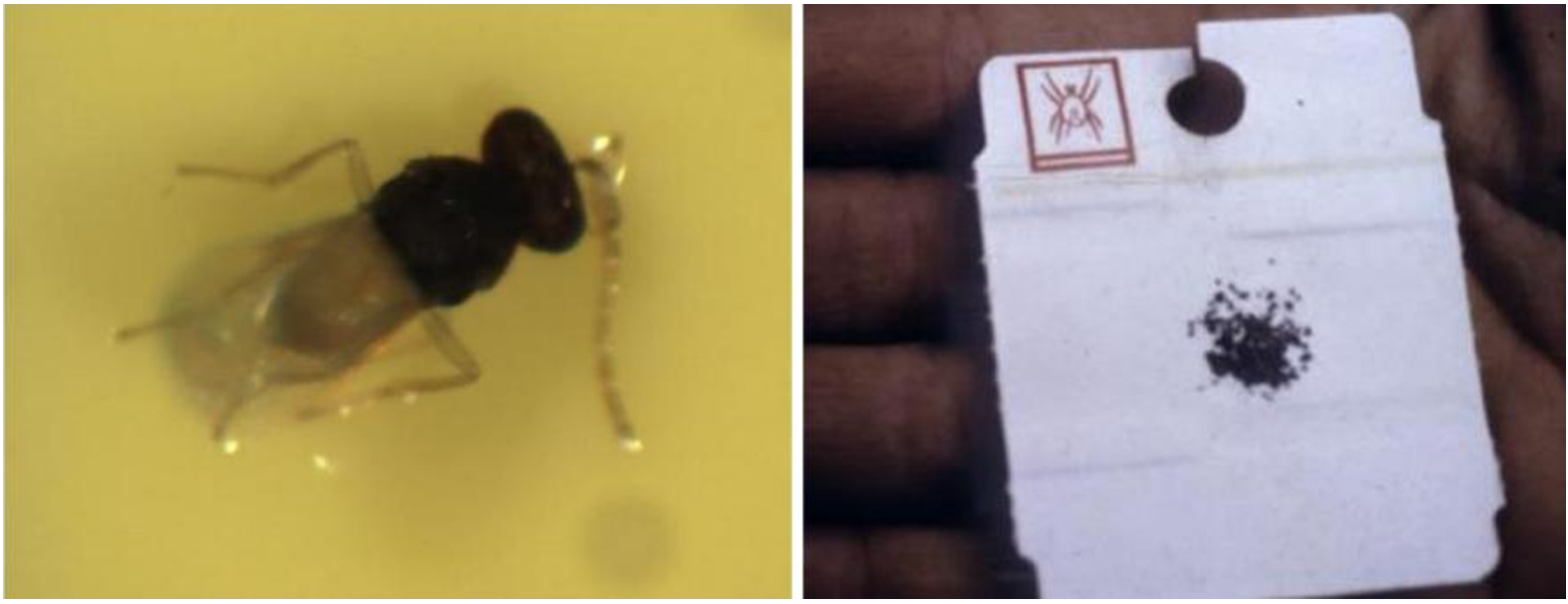
Tips for Using Encarsia Formosa:
- Remove yellow sticky cards before and after releasing E. formosa to avoid capturing adults on the cards. Replace sticky cards 3 to 4 days following release.
- Hang the cards in shaded areas in the lower canopy of plants to avoid desiccation from direct sunlight.
- Adults emerge from the pupae and fly upward. Introduce cards weekly starting when whiteflies are first detected.
- In general, for most crops, continue making releases until 80% to 90% of the whitefly population has been parasitized.
- When scouting, look for the distinct, black greenhouse whitefly pupae that are parasitized.
Encarsia is very sensitive to pesticide residues on plants or dried pesticide residues on greenhouse plastic. Avoid use of insecticides with long residual effects before the wasps are released. Consult online side effects databases maintained by biological control suppliers such as Koppert, Biobest, or Bioline AgriSciences, for more information.
Eretmocerus eremicus
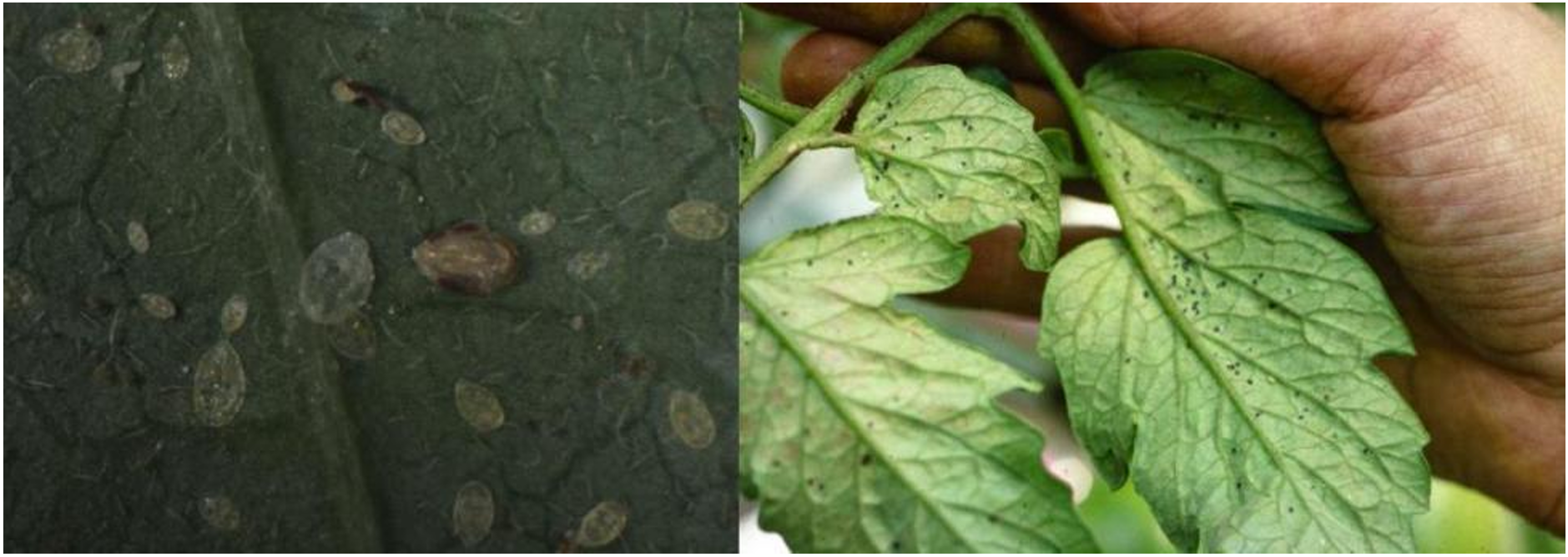
This parasitoid has been commercially available since the 1990s for control of Bemisia tabaci. Eretmocerus are very small parasitic wasps that are pale yellow with clubbed antennae. Besides directly parasitizing whitefly nymphs, E. eremicus adult females kill nymphs by host feeding. Eretmocerus eremicus attacks both sweetpotato whitefly and greenhouse whitefly. It tolerates warmer temperatures (77 to 84° F) as it is native to southern desert areas of California and Arizona
Eretmocerus eremicus is shipped as pupae that are either glued to paper cards or in blister packs or in bottles. When using blister packs, open the flaps and do not place the blister pack so the packs would be facing the sun. Eretmocerus is also available in a mix with Encarsia. Contact biological control suppliers for information on release rates.
Tips for using Eretmocerus eremicus:
- Do not release in direct sunlight.
- Prior to release, remove yellow sticky cards, which attract and capture the emerging parasitoids.
- Replace yellow sticky cards four days after releases have been made.
- When scouting, look for parasitized whiteflies. Greenhouse whitefly pupae are black. Sweetpotato whitefly pupae turn light brown.
- To assess quality of the whitefly parasitic wasps, place cards or blister packs in a small, screened container placed in a shaded location at room temperature for two weeks. Place a small piece of yellow study card on the inside of the
container lid. Count the number of emerged adults. About 95% of the adults should have emerged.
Predatory Mites
Amblyseius swirskii, feeds on whitefly eggs and nymphs. This generalist predatory mite also feeds upon thrips, broad mites, spider mites and pollen. It is most effective at warmer temperatures (70˚F) and a relative humidity of 70%. A. swirskii is available in breeding sachets, or in bulk that is released unto plant leaves.
Growers often use blowers to broadcast these predatory mites when poinsettias are closely spaced pot to pot. In poinsettias, Dr. Vafaie found that combining A. swirskii with Eretmocerus was better at suppressing whiteflies compared to when either species was released alone. Eretmocerus prefers 2 nd instar whitefly nymphs and A. swirskii prefers whitefly eggs and 1 st instar nymphs.
Predatory Beetles
Delphastus pusillus is a small (1.3- 1.4 mm) long, dark brown to black predatory beetlethat attacks all stages of whiteflies but prefers eggs and nymphs. Delphastus adults and larvae are predacious. Optimum temperatures are between 75 and 80° F. Adults will not fly at temperatures below 55° F. Delphastus avoids feeding on parasitized whiteflies so is compatible with whitefly parasitic wasps. However, it does not perform well on greenhouse tomatoes.
Entomopathogenic (insect-killing) fungi
Beauveria bassiana
When Beauveria fungal spores encounter and attach to the cuticle of susceptible insects, the fungal spores germinate and penetrate their body wall by force, producing enzymes that digest the cuticle.
Once the host insect is infected, the fungus rapidly grows inside of the insect, feeding on the nutrients present in the host's body and producing toxins. The infected whitefly larvae or pupa turn brown or pink as the insect’s body is filled with the insect-killing fungus. White growth of the fungus from the insect’s body is not necessarily seen under greenhouse conditions. Begin applications when whitefly populations are low. Beauveria is compatible with many, but not all beneficials.
Isaria fumosoroseus
This insect killing fungus attaches to whitefly eggs, nymphs, pupae, and adults. Foliar applications of Isaria have been successfully combined with releases of Encarsia formosa in commercial greenhouse tomato production.
In summary, host specific parasitic wasps, predatory mites, and entomopathogenic fungi can all be used in your biological control program against whiteflies.
Disclaimer for Fact Sheets: The information in this document is for educational purposes only. The recommendations contained are based on the best available knowledge at the time of publication. Any reference to commercial products, trade or brand names is for information only, and no endorsement or approval is intended. UConn Extension does not guarantee or warrant the standard of any product referenced or imply approval of the product to the exclusion of others which also may be available. The University of Connecticut, UConn Extension, College of Agriculture, Health and Natural Resources is an equal opportunity program provider and employer.