Introduction
Aphids can be serious and persistent pests in the greenhouse. They are difficult to control due to their high reproductive capability and short development time that quickly leads to their developing insecticide resistance. The presence of aphids, their white shed skins and honeydew can reduce the aesthetic quality of a wide range of greenhouse crops. The target audience of this fact sheet is commercial greenhouse growers.
Cultural Controls
Inspect incoming plants for aphids. Avoid high nitrogen fertilization that promotes lush growth that is favorable to aphids. Remove weeds and “pet plants” that can be sources of aphid infestations.
Biological Controls
Aphids are susceptible to many biological control agents, including aphid parasitoids, predators and entomopathogenic fungi.
Aphid Parasitoids
Parasitoids (parasitic wasps) develop in a single host and kill the host as they grow and mature. In general, parasitoids are more effective than predators in reducing aphid populations. However, it may be difficult for some parasitoids to search effectively on crops with hairy or sticky leaves such as Calibrachoa or million belles. Aphid parasitoids are host specific. If you are unsure of the species of aphids you may have or have multiple species, mixtures of different aphid parasitoids are commercially available. Parasitoids are shipped as either adults or “aphid mummies” from which the
adults emerge.
Aphidius lays its eggs in aphids and the larvae develop within the aphid. The aphid is killed as the developing larvae feed upon it. The swollen exoskeleton of the aphid remains and is referred to as an “aphid mummy.” As the adults emerge from this mummy, you will see the small round exit hole.
Aphidius colemani is a tiny (2 mm.) long wasp that is released against green peach aphids and melon aphids. The adult wasp lays one egg inside an aphid. This egg hatches into a larva that feeds inside the aphid. When mature, a new adult wasp will emerge from the tan aphid mummy. This active searcher is not as effective at temperatures above 86 °F.
Aphidius ervi attacks larger aphids such as the foxglove (Aulacorthum solani) and potato aphids (Macrosiphum euphorbiae). It resembles A. colemani but is about twice as large and darker in color
Aphidius matricariae attacks green peach aphid (Myzus persicae) including the closely related and difficult to manage, tobacco aphid (Myzus persicae subsp. nicotianae).
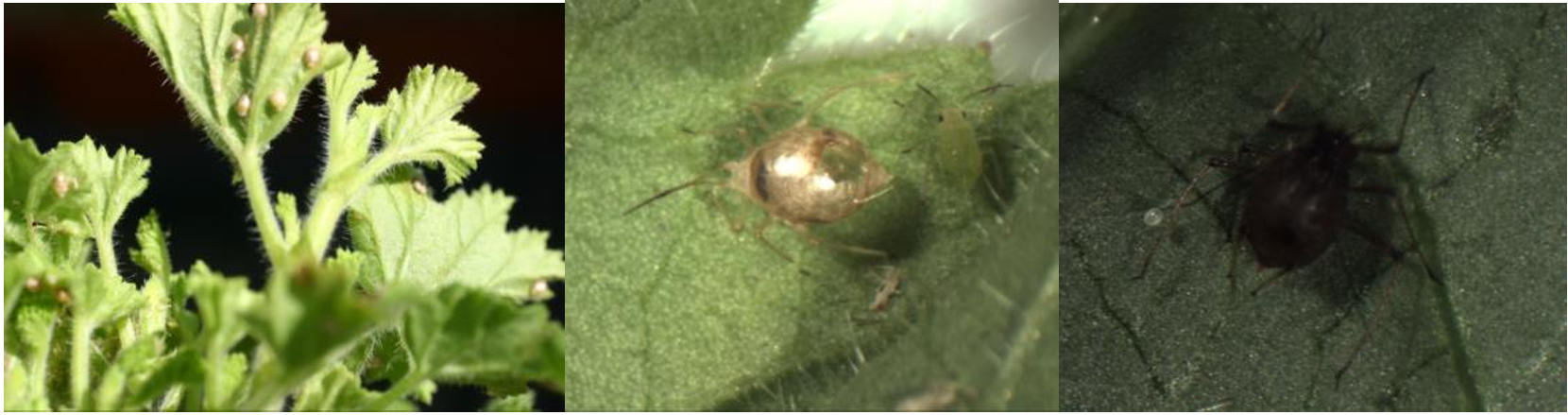
Aphelinus abdominalis attacks foxglove (Aulacorthum solani) and potato aphids (Macrosiphum euphorbiae). Adults feed on the small aphid nymphs and parasitize the larger aphids. Apelinus is better able to withstand higher temperatures than Aphidius spp. This species works more slowly for a longer period than the other parasitic wasps. Look for the elongated black mummies that are less swollen than Aphidius mummies.
Tips for Using Aphid Parasitoids
- Release preventively.
- Remove yellow sticky cardsTemperatures should be between 65 and 77° F and relative humidity between 70 and 85%.
- Release at the end of the day in shaded locations.
- Look for aphid mummies after about 2 to 3 weeks, depending upon greenhouse temperatures.
- Consult with your supplier on release rates.
Aphid Predators
Predators consume many prey during their lifetime. Repeated releases of aphid predators are often needed to keep pace with the aphids' high reproductive rate in the greenhouse. Their effectiveness depends upon their predation rate, and ability to locate prey.
Predatory Midges
The predatory midge, Aphidoletes aphidimyza, can feed on more than 60 different species of aphids. This gall midge is nocturnal and prefers dark and humid areas closest to the lower plant canopy. These predatory midges require a period of darkness for mating and egg laying. Only the larvae stage is predacious. Adults feed primarily upon pollen and honeydew. The bright orange larva kills aphids by biting their knee joints, injecting a paralyzing toxin, and then sucking out their body fluids.
Aphidoletes aphidimyza is typically sold as pupae mixed with a carrier in trays, bottles, or blister packs. Adults that emerge from the pupae lay their eggs near aphid colonies. Larvae move to the ground to pupate and use organic debris to make their pupal cocoons. Plastic or concrete floors will not provide sufficient pupation sites. Sawdust, peat, or holes in the weed mat barrier on the ground are needed. Some growers also place their aphid banker plants in trays of moist sand to provide pupation sites.
Adults are short-lived and tend to be active at night, so are rarely seen. This midge is most effective in the summer and will go into diapause (resting period) between September and March. This is because the larvae need at least 15.5 hours of light to prevent the pupae from diapausing. The adults will lay eggs and larvae will feed upon aphids, but there is no second generation of midges produced. Low light intensities are sufficient to prevent diapause. This predatory midge works well against green peach aphids, but not against foxglove aphids because the foxglove aphids are too low in the
plant canopy.
Tips for Using Aphid Midges
- Place in greenhouse away from direct sunlight.
- Release in the early morning or evening near aphid colonies.
- Temperatures should be between 60 and 80° F, relative humidity between 50 to 85%.
- Look for fed upon aphids that will appear shriveled and turn brown or black.
- Can be used with Aphidius parasitoids.
Green Lacewings
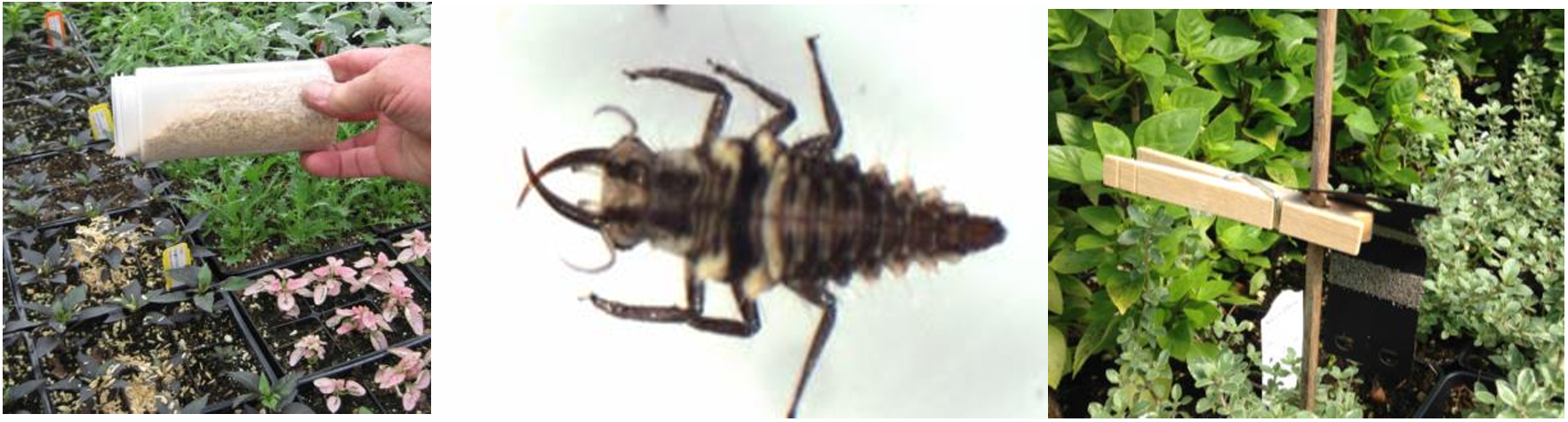
The green lacewing (Chrysopa rufilabiris and C. carnea) adults are active at night and feed on nectar, pollen, and honeydew. The predatory larvae (also known as” aphid lions”) prefer to feed upon aphids, but will also feed upon whiteflies, spider mites, thrips, lepidopteran eggs, and mealybug larvae. Green lacewings may be less effective on plants with hairy or sticky leaves.
Green lacewings are commercially available as eggs on cards, or as larvae shipped with a food source in an inert material in a small container. Larvae may survive better than eggs and are quicker acting. A reduction in aphid population should occur after approximately two weeks with clean new growth. Green lacewings are also available as adults shipped in a small cardboard container. Look on the underside of leaves for the eggs laid on extended stalks.
Tips for Using Lacewings
- Look for clean, new growth as a sign that aphids have been killed.
- Ants and slugs will eat lacewing eggs on the cards so need to be controlled.
- Lacewings may be less effective on plants with hairy or sticky leaves.
- If it is too warm (above 95° F), they will leave the greenhouse.
Lady Beetles
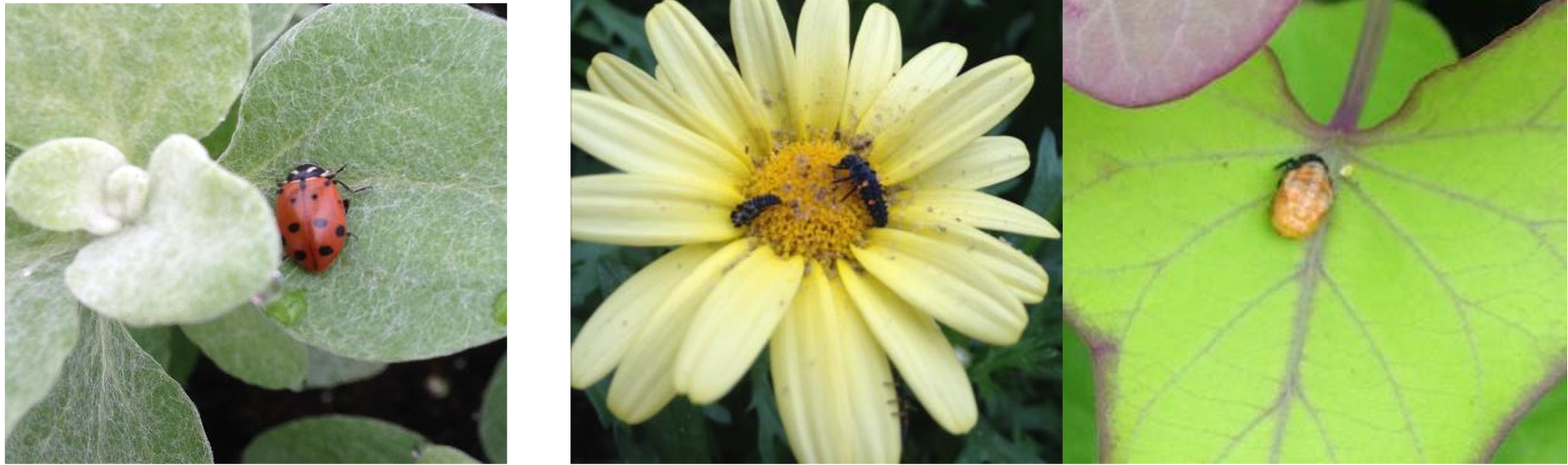
Lady beetles feed on many different types of aphids and other soft-bodied insects. Both larvae and adults feed upon aphid nymphs and adults. Adult lady beetles feed upon pollen, fungi, and nectar in the absence of prey. Eggs are laid near prey and the larvae may consume from 500 to 1000 aphids. Older, fourth instar larvae are more efficient at capturing prey than adults.
Convergent ladybird beetles (Hippodamia convergens) are wild-collected from the mountainous areas of the west coast where ladybird beetles migrate and aggregate in large masses. This removes ladybeetles from their native habitat. Because they are field collected and not mass-produced, quality control guidelines for H. convergens have not yet been developed. Adalia bipunctata (two spotted lady beetle) is commercially reared and available from some biological control suppliers.
Tips for Using Lady Bird Beetles
- Adults can be refrigerated until released.
- Release in the evening or early morning, near aphid colonies when the vents are closed.
- Repeated applications may be needed.
- Look for aphids that have been fed upon and for ladybird beetle adults, larvae, or their bright yellow eggs.
- Flowering, pollen-producing plants will attract the beetles.
Naturally occurring predators
Hover flies, also known as syrphid or flower flies are naturally occurring beneficial, predatory insects that may enter the greenhouse from outdoors. Adults begin emerging in April and May about the same time that aphid populations start to increase outdoors. They are called hover flies because of the ability of the adult to hover in mid-air, dart a short distance very quickly, and then hover again.
Adults are small (up to ¾ of an inch long) and look like small bees or wasps. They are in the fly (Diptera) family with two wings, short antennae, and large eyes. Hover flies lay their eggs (resembling a small grain of rice) near aphid colonies. Eggs hatch into small, legless larvae with a tapered head that feed upon aphids.

Pathogens
Several types of entomopathogenic (or insect-killing) fungi have been developed for use against greenhouse insect pests that can be mass produced including Beauveria bassiana and Isaria fumosoroseus. Growers often combine these microbial products with the insect growth regulator, azadirachtin (IGR) to slow down shedding of spores Beauveria may not be compatible with the convergent ladybird beetle (Hippodamia convergens) depending on the concentration of spores applied.
Tips for Using Insect Killing Fungi
- Works by contact, so thorough coverage is needed.
- Use preventively and do not expect a quick knockdown.
- Repeated applications are needed, look for a reduction in pest numbers after two to three applications.
- Spray to glisten, not to runoff.
- Spray on a rainy day or at the end of the day (to increase fungal sporulation).
- Most do best with refrigerated storage.
Aphids can be difficult to manage, but aphid parasitoids, predators and entomopathogenic fungi can be part of a biological control program.
Disclaimer for Fact Sheets: The information in this document is for educational purposes only. The recommendations
contained are based on the best available knowledge at the time of publication. Any reference to commercial products, trade or brand names is for information only, and no endorsement or approval is intended. UConn Extension does not guarantee or warrant the standard of any product referenced or imply approval of the product to the exclusion of others which also may be available. The University of Connecticut, UConn Extension, College of Agriculture, Health and Natural Resources is an equal opportunity program provider and employer.