Introduction
Maintaining weed-free growing conditions is an essential part of producing high quality greenhouse crops. Insects and diseases can be kept to a minimum only if proper weed control practices are carried out regularly, along with appropriate control measures. The target audience of this fact sheet is commercial greenhouse growers.
- Weeds may compete with desirable crop plants for light, water, and nutrients.
- The presence of weeds also reduces the aesthetic value of the crops grown and creates a poor impression to customers.
- Weeds are also a primary reservoir of as aphids, whiteflies, thrips, mites, slugs and diseases.
- Low growing weeds help maintain moist conditions providing a favorable environment for fungus gnats and shore flies.
- Many common greenhouse weeds such as chickweed, oxalis, bittercress, dandelion and ground ivy can become infected with tospoviruses (impatiens necrotic spot virus (INSV) and tomato spotted wilt virus (TSWV) while showing few, if any visible symptoms. Thrips can then vector the virus to susceptible greenhouse crops.
Prevention
- Weed seeds are easily blown into the greenhouse though vents and other openings.
- Weeds and their seeds can be introduced into the greenhouse on infected plant material, tools, and equipment.
- Seeds can be moved in soil, by the wind, irrigation water, animals, and people. Annual weeds such as creeping wood sorrel, hairy bittercress, prostrate spurge, common chickweed reproduce primarily by seed, with several generations occurring per year.
Sanitation
- Keep weed seeds and rhizomes out of the greenhouse by using sterile media," clean" plant materials, and controlling weeds outside the greenhouse.
- Clean up spilled growing media, especially on greenhouse floors, which provides an ideal environment for the germination of weed seeds.
- Screen vents and other openings to help to limit the entry of windblown seed, as well as insects.
- When scouting, identify the type of weeds (broadleaf or grass), life cycle (annual, biennial, or perennial) and location. See the UMass Extension Weed Herbarium and references for help in identification.
- Remove weeds from greenhouse pots, benches, and floors before they flower and produce seed. For example, a single plant of bittercress can produce 5000 seeds, that germinate in as little as 5 days and can propel the seeds over 9 feet from the plant! Yellow and creeping woodsorrel expel seeds by force, too.
Physical Barriers
- The use of a physical barrier such as weed block fabric will help to limit weed establishment on greenhouse floors.
- Leave the weed fabric bare for ease of cleanup. Covering the weed fabric with gravel will make it difficult to remove any spilled potting media.
- Regularly hand pull any escaped weeds before they go to seed.
Careful Use of Herbicides
- Very few herbicides are labeled for greenhouse use due to the potential for severe injury or death of desirable plants. This injury may occur in a number of ways including:
- Spray drift may occur if fans are operating at the time of application.
- Herbicides can volatilize, changing from a liquid to a gas.
Herbicide vapors are easily trapped within an enclosed greenhouse injuring desirable crops. Always be sure the herbicide selected is labeled for use in the greenhouse. Carefully follow all label instructions and precautions. It is the applicator's responsibility to read and follow all label directions. Use a dedicated sprayer that is labeled for herbicide use only.
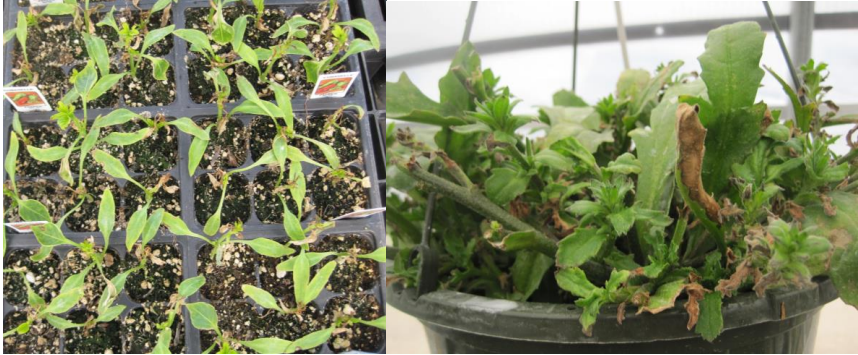
Some of the symptoms of herbicide injury include:
- Discolored, thickened, or stunted leaves.
- Injured growing point of young seedlings, severely stunting their growth.
- Severe symptoms result in unsaleable plants.
Types of Herbicides
Herbicides are generally classified according to their mechanism of action (contact or translocated/systemic) and how they are used (premergence or postemergence).
Preemergence herbicides are applied before weeds emerge. They provide residual control of weed seedlings and can persist for many months, and in some cases, over a year. Preemergence herbicides continue to vaporize, causing plant damage. Only one preemergence herbicide Marengo® (indaziflam) is labeled for use on greenhouse floors in an empty greenhouse.
Postemergence herbicides are applied after weeds have emerged. In the greenhouse, several postemergence herbicides can be used under greenhouse benches and on floors. There are two different types of postemergence herbicides: contact and translocated/systemic. Contact herbicides kill only the portion of the plant that the herbicide contacts, so good spray coverage is generally needed.
Translocated/systemic herbicides are absorbed and move through the plant. Target weeds must be actively growing for the herbicide to be effective. Translocated/systemic herbicides such as Roundup® and Finale® are best applied to actively growing weeds when temperatures are above 50oF. Roundup® (and other glyphosate products) can only be used in an empty greenhouse between crops.
Weed Management Outside the Greenhouse:
- Prevents weed seeds from being blown into the greenhouse,
- Prevents perennial weeds such as bindweed, quackgrass, etc. from growing under the foundation of the greenhouse, and
- Helps reduce the unwanted entry of winged insects into the greenhouse.
Prevention
- Maintain a 10 to 20-foot weed-free barrier around the greenhouse.
- A geotextile fabric can be used outside the greenhouse to prevent weed growth.
- Mow beyond this area before weeds set seed to help limit the entry of weed seeds.
Precautions on Herbicide Use Near Greenhouses
Herbicide labels should state if use near greenhouses is allowed. Close greenhouse vents and openings while applying herbicides, to prevent drift inside to sensitive crops. Soil residual and post emergence herbicides may be carefully used surrounding the greenhouse. Select effective herbicides with low volatility.
Do not use any auxin type herbicides, such as those labeled for broadleaf weed control in turf, near greenhouses. Their volatility and the extreme sensitivity of greenhouse crops to these herbicides can result in severe injury. Do not use soil sterilant herbicides around greenhouses.
Herbicides Labeled for Use in the Greenhouse and their Characteristics
| Herbicide | Mode of Action | Target Weeds | Comments |
| Axxe (ammonium nonanoate) 4 hr. REI | Contact. Non-selective. Cell membrane disruptor. |
Annual & perennial broadleaves, grasses, liverworts | Avoid contact with desirable vegetation. Does not provide any residual weed control. Organic. |
| Envoy Plus (clethodim) 24 hr. REI | Contact. Selective, postemergance herbicide. Inhibits lipid synthesis. No residual activity. |
Annual & perennial grasses | Apply to actively growing, grasses beneath greenhouse benches. Does not control sedges or broadleaf weeds. Not widely used in greenhouses. |
| Finale XL (glufosinateammonium) 12 hr. REI | Translocated/systemic. Non-selective, postemergence herbicide. Disrupts cell membranes. |
Annual & perennial grasses & broadleaves | Apply to actively growing weeds under greenhouse benches. Turn off air circulation fans. Do not use in greenhouses containing edible crops. No soil activity. |
| Fireworxx (caprylic acid & capric acid) 24 hr. REI | Contact. Non-selective. | Annual weeds, suppression of biennial & perennial weeds. | Avoid contact with desirable vegetation. Does not provide any residual weed control. Organic. |
| Fusilade II (fluazifop-Pbutyl) 12 hr. REI | Translocated/systemic. Selective, postemergence herbicide. |
Annual & perennial grasses | Thorough coverage is important for good activity. Best used against young actively growing weeds. |
| Marengo (indaziflam) 12 hr. REI | Residual. Selective, preemergence herbicide. | Annual grasses & broadleaves | General weed control under greenhouse benches in an empty greenhouse prior to plant production. |
| Reward or Diquat SPC 2L (diquat dibrominde) 24 hr. REI | Contact. Non-selective. | Annual & perennial broadleaves & grasses | General weed control} in/around greenhouses and under greenhouse benches. Most effective on small, actively growing weeds. Avoid contact with desirable vegetation. Do not use in greenhouse with edible crops. |
| Scythe (pelargonic acid & related fatty acids) 12 hr. REI | Contact. Non-selective | Annual & perennial broadleaves & grasses. Mosses & liverworts. |
Apply to young, succulent weeds. Cool or cloudy weather slows down activity. Avoid contact with desirable vegetation. Provides no residual weed control but leaves a strong odor. |
| Round-up (glyphosate) 4 hr. REI | Translocated/systemic herbicide. Non-selective. No residual soil activity. |
Annual & perennial grasses & broadleaves | Use to control weeds under greenhouse benches in an empty greenhouse. Turn off air circulation fans to reduce drift. No residual soil activity. |
Mention of particular materials is for educational purposes only and is not to be interpreted as an endorsement, nor is criticism implied of any materials not mentioned. Consult and follow pesticide labels for registered uses. The label is the law!
Disclaimer for Fact Sheets: The information in this document is for educational purposes only. The recommendations
contained are based on the best available knowledge at the time of publication. Any reference to commercial products, trade or brand names is for information only, and no endorsement or approval is intended. UConn Extension does not guarantee or warrant the standard of any product referenced or imply approval of the product to the exclusion of others which also may be available. The University of Connecticut, UConn Extension, College of Agriculture, Health and Natural Resources is an equal opportunity program provider and employer.