Introduction
Nematodes are non-segmented roundworms. They range in size from less than a half a millimeter (microscopic) to nearly eight meters long and live in moist or aquatic environments. While most of the approximately 20,000 named species feed on microbes, fungi, or other tiny organisms (even other nematodes), some are parasitic on plants. Most plant parasitic nematodes are soil inhabitants that damage plants by feeding in or on the roots. Foliar nematodes, in contrast, feed on above-ground plant parts, causing injury on leaves, buds and young stems on ornamental plants. The target audience of this factsheet is commercial greenhouse and nursery growers.
Types of Foliar Nematodes and Their Host Range
Foliar nematodes (Aphelenchoides spp.) have a wide host range of over 700 plant species. Species that may affect the ornamental plant industry include A. fragariae, and A. ritzembabosi. Foliar nematodes mainly feed inside plant leaves but can also feed on flower buds. Most overwinter in the soil and then move up the plant stems when moisture is present to the leaves and sometimes, flower buds.
The strawberry leaf nematode (Aphelenchoides fragariae) is common on many different herbaceous perennials and plants collected from the wild. Anemone, Aquilegia, Baptista, Bergenia, chrysanthemum, many different types of ferns, Fragaria, Hepatica, Heuchera, Hosta, Hypericum, Iris, Ligularia, Lilium, Malva, orchids, Paeonia, Papaver, Phlox, Polygonatum, Rogersia and Tricyrtis have all been reported as hosts. Bedding plants such as begonia, coleus, garden impatiens, geranium, and salvia can also become infected. Woody plants such as privet and azalea also can serve as sources of infection for herbaceous plants.
The chrysanthemum foliar nematode (A. ritzemabosi) attacks chrysanthemums and related composites such as aster.
The stem and bulb nematodes (Ditylenchus dipsaci) are especially common on Phlox subulata. Symptoms include distorted new growth and yellow or brown infected leaf tissues. Plants are stunted and may die. Tulip, narcissus, and hyacinth can also become infected. Bulb scales turn brown, and infected bulbs may then rot. Leaves are twisted and stunted.
Favorable Conditions
Foliar nematodes need a film of water to move across plant surfaces. When plants are watered overhead, foliar nematodes are spread in the splashing water or during rainfall events. Symptom-less infected plants can also serve as a source of infection. Sometimes nematodes infect flowers and later seeds.
Symptoms
As they feed on the outside of the leaf, new growth may curl and become stunted and twisted. These microscopic roundworms then enter plant leaves through the stomata, feeding within the leaves on the spongy mesophyll cells.
As the nematodes feed within the leaves, the affected leaf tissue turns pale green, then yellow, and later brown. Sometimes, the brown tissue drops out of the leaf, resulting in a shot-hole appearance that can be easily confused with fungal diseases or insect damages.
Nematodes cannot easily move across the veins, so leaf lesions are often bounded by the larger veins. Leaf blighting may be most prevalent in mid to late summer. On dicots, with their network of veins, affected leaves have a patch-like appearance (Figures 1 & 2). This patch-like appearance can often be confused with bacterial leaf spots or downy mildew infections.
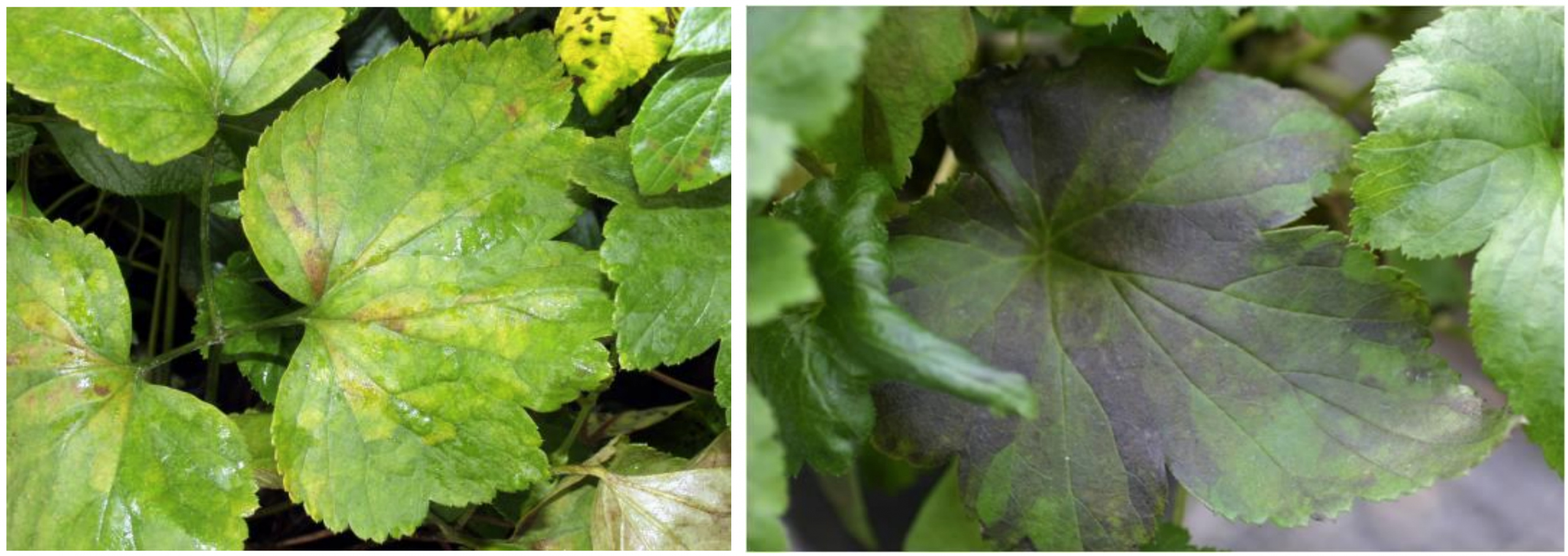
Symptoms vary with host plant and age of the lesion. Lesions are not limited by leaf veins in some hosts, such as begonia. On monocots such as Hosta, Iris and Lilium, one will see a stripe-like pattern, as the nematodes cannot cross the parallel veins.
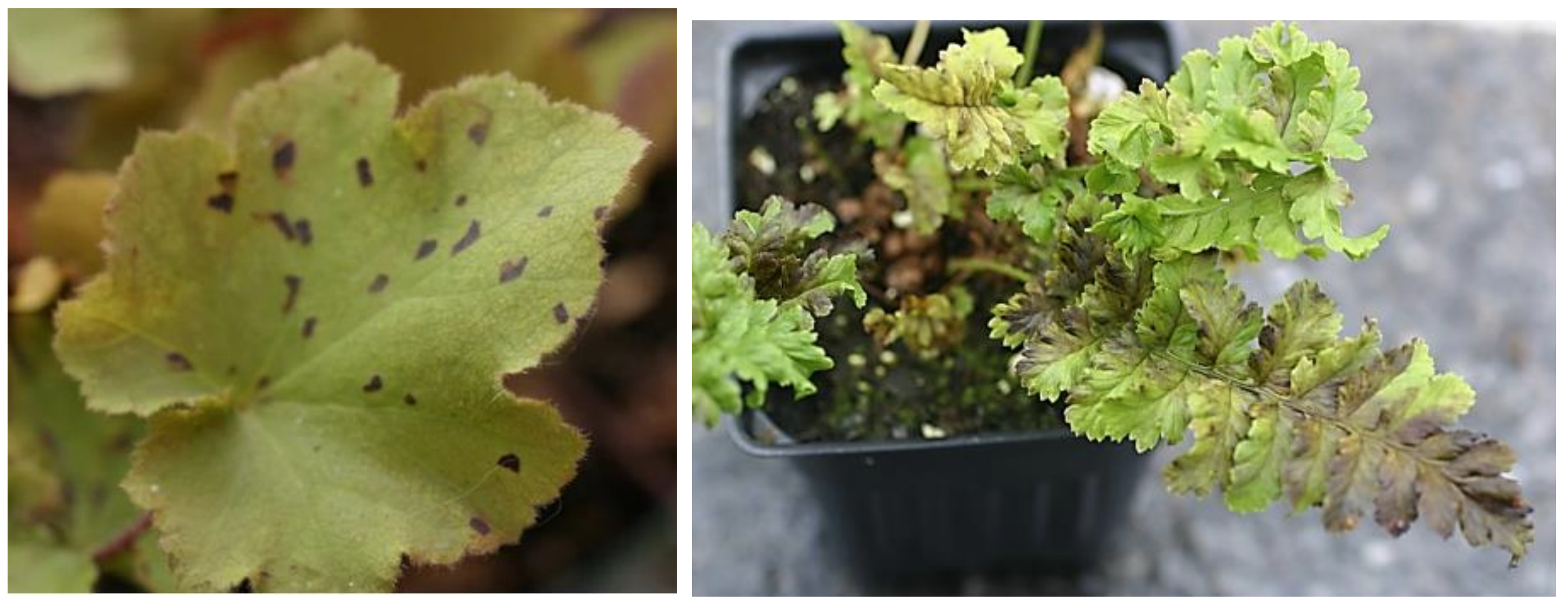
Severely infected plants can also become infected with Botrytis blight, masking the symptoms of foliar nematode infestation, and killing the plants.
Disease Cycle
Once inside the leaf, nematodes can complete their life cycle, from egg to juvenile to adult, in as little as two weeks. They can over-winter in buds or desiccated leaves and in plant debris in the soil. Populations can become quite high before symptoms are seen. Foliar nematodes have a life cycle typical of other plant parasitic nematodes that includes the egg,
four juvenile stages, and adults.
Adults and juveniles overwinter below ground in the soil, plant debris and living plant tissue such as below-ground buds. Overwintering populations are generally low, and numbers increase during the growing season. As new growth begins in the spring, nematodes migrate up onto plant surfaces when a film of water is present and then begin feeding.
Early feeding sites include stems, buds, and young leaves. As the plant matures, the nematodes enter the leaves and feed there for the remainder of the season.
Reproduction occurs within the leaves and a life cycle can be completed within 2-4 weeks depending on temperature. When the leaf surfaces are wet, foliar nematodes can move from one feeding location to another by exiting through a stomate and re-entering the leaf through another. Some studies indicate that they are able to enter the leaf directly. They spread from leaf to leaf or plant to plant when they are in contact or via splashing water.
Spread can occur during vegetative propagation or when symptomless infested plant material is introduced into greenhouses or nursery propagation houses. Foliar nematodes can survive in a dormant state for several years in dried plant material.
Management
- The first and most important step is to destroy infected plants.
- Do not place infected plants in a compost or cull pile. The foliar nematodes can survive desiccation, so could then be reintroduced into your production area.
- Use only pest-free planting material and exclude foliar nematodes from propagation areas.
- Avoidance of infected cuttings and stock plants during vegetative propagation is the most important means of control.
- Reduce overhead watering and the duration of leaf wetness by proper plant placement and spacing.
- Keep greenhouses and propagation houses weed-free, as common weeds can be hosts.
- Become familiar with the characteristic symptoms. To confirm the presence of foliar nematodes, submit samples to a plant diagnostic laboratory.
An integrated approach of scouting, sanitation, environmental modification, and nematode suppression are all-necessary to manage these nematodes.
Disclaimer for Fact Sheets: The information in this document is for educational purposes only. The recommendations contained are based on the best available knowledge at the time of publication. Any reference to commercial products, trade or brand names is for information only, and no endorsement or approval is intended. UConn Extension does not guarantee or warrant the standard of any product referenced or imply approval of the product to the exclusion of others which also may be available. The University of Connecticut, UConn Extension, College of Agriculture, Health and Natural Resources is an equal opportunity program provider and employer.