UConn Extension Events
March 27th, Finding the Right Marketing Channel for Your Farm Business
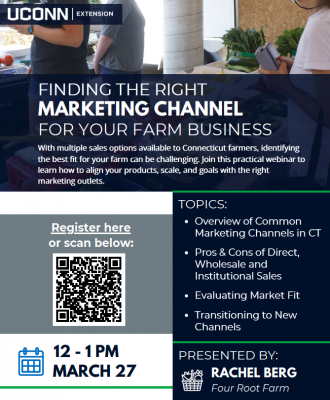 With multiple sales options available to Connecticut farmers, identifying the best fit for your farm can be challenge. Hear from Rachel Berg, Farmer and Co-Owner of Four Root Farm in East Haddam, to learn how to align your products, scale, and goals with the right marketing outlets. Topics will include:
- Overview of Common Marketing Channels in CT
- Pros & Cons of Direct, Wholesale, and Institutional Sales
- Evaluating Market Fit
- Transitioning to New Channels
Register to attend this webinar on March 27th!
Solid Ground Farmer Trainings
Solid Ground offers in-person training opportunities as well as e-learning tools for new and beginning farmers. These trainings are intended for production farmers in Connecticut. A sample of available trainings include topics such as Ag Mechanics, Business of Farming, and Risk Management.
See their full calendar of upcoming events: Solid Ground Farmer Trainings
Online Course Offerings
Farm Risk Management Online Course Modules, Asynchronous & Free to the Public
Farm Risk Management Online Certificate
This unique program from the University of Connecticut's (UConn) College of Agriculture focuses on one of today’s most critical topics for the agriculture industry, farm risk management. Farm risk management involves understanding and mitigating factors that can impact agricultural operations, such as climate change, pest management, and financial uncertainties. Through this grant-funded 12-module course you will gain knowledge and strategies to enhance the resilience and sustainability of your farm. Knowledge is the key.
Designed for the Agricultural Industry
Serving livestock farms, dairy farms, crop farms, fruit & vegetable farms, or anyone seeking to develop a farm, this free course is a must for the modern-day farmer. View the listing of modules.
USDA Funded & Free to the Public
UConn’s Farm Risk Management Online Course modules are developed in conjunction with UConn’s College of Agriculture, UConn’s Center for Excellence in Teaching & Learning, and UConn’s Academic Program Development & Support unit, and are funded by a grant from the United States Department of Agriculture (USDA).
Flexible & Convenient
Take one module or all twelve Farm Risk Management online modules. Learners will receive a course completion certificate for each module completed that can be downloaded and printed.
Courses are self-paced and offered 100% online and asynchronous; you can participate in the course at any time of day from anywhere with an Internet connection.
How to Register
Registration for UConn’s Farm Risk Management Online Course modules is facilitated by UConn’s non-credit online course registration platform. Register Here.
Conferences
2026 New England Vegetable & Fruit Conference
December 15-17, 2026
Manchester, New Hampshire
More details to come. For now, visit the conference website to learn more.
2027 UConn Extension Annual Vegetable and Small Fruit Growers Conference
Save the date!
Next year's conference is tentatively scheduled for Tuesday, January 12th, 2027.
Community Programs
Participate in UMN/UNH High Tunnel Cover Crop Trial
Becky Sideman at University of New Hampshire is once again putting the call out to recruit organic high tunnel growers as part of an OREI funded high tunnel cover crops project. This Fall 2025 trial will look similar to last year’s: growers will get sent seed, a free soil test and help interpreting it, and will be asked to complete a couple of short surveys to let the researchers known how it went. A biomass sample from the following spring would be ideal as well, but is not required.
These on-farm trials are meant to evaluate how legume cover crops perform in active farming systems. Farmers will not be asked to plant replicated arrangements of the trial plots on their farms. Instead, researchers will plant all of the cover crop options in replicated plots on a research station, while each participating farmer plants one plot of each of the cover crop options that they select. Farmers can select between two levels of participation and compensation, depending on the amount of time and effort they are willing to commit.
- Read the full trial instructions, detailed species and timing menu, and farmer expectations for each level here .
- Watch the recording of the High Tunnel Cover Crop Trial Webinar
- Sign up to participate by telling the team which species you’d like to grow and how much seed to send.
Contact the research team with questions: hightunnel-cc@umn.edu
Submit a Soil Sample to CAES for Program Providing Free Analysis of PFAS
The new program, which is voluntary for CT farms, provides sampling kits to ensure contamination-free soil collection, and provides data on 14 PFAS directly to the farmers who submit samples. “Our hope is that PFAS data will help farmers protect their safety and that of their customers” says Jasmine Jones, the PFAS technician at CAES. PFAS found in farm soils may impact crops and livestock, and may pose a risk to drinking water wells on and near farms. There are no enforceable limits for PFAS on farms at the state or federal level, though high levels can be harmful to human and animal health. “Collecting data on PFAS concentrations at CT farms is an important step towards understanding the scope of PFAS contamination issues in CT” says Sara Nason, Ph.D., a research scientist at CAES. The new CAES program uses a certified EPA method for soil analysis, and has ISO:17025:2017 accreditation, an internationally recognized lab quality certification. “Data quality has been a big priority for our PFAS measurements” says Nason.
Additional program information can be found on the CAES website at:
https://portal.ct.gov/caes/about-caes/pfas-in-ctagricultural-soils/pfas-in-ct-agricultural-soils.
Detailed information on PFAS can be found on the following websites:
Get free soil health testing on your farm by participating in AFT’s New England Soil Health Survey!
New England Soil Health Survey
Free Soil testing is available through a new program from AFT New England and the USDA ARS Food Systems Research Unit. Farms in Vermont, New Hampshire, Connecticut and Massachusetts are eligible to receive free soil health testing on up to three fields after completing a short survey.
Learn more at: https://farmland.org/new-england-soil-health-survey/
UConn Extension Online Library
Browse past educational events hosted by UConn Extension. Recordings of educational videos can be found on the UConn Extension YouTube playlist entitled "Agriculture and Food".