Introduction
Downy mildew diseases are of emerging concern in the greenhouse industry. Reproduction and spread are rapid causing serious losses to many susceptible crops. Downy mildews are difficult to control once established. They should not be confused with powdery mildews, for all “mildews” are not the same. Downy mildews are caused by different species of water molds (oomycetes) that are more closely related to Pythium and Phytophthora or algae than to true fungi. In some cases, downy mildew infections are systemic whereas powdery mildew infections are not. Downy mildews must be managed preventively with different classes of fungicides than powdery mildews. The target audience of this fact sheet is commercial greenhouse growers.
Symptoms
Symptoms vary depending upon the specific downy mildew pathogen, the host plant, and environmental conditions. Some of the more common symptoms of downy mildew include yellow, red, or brown patches on the leaves that may be bounded by leaf veins. At first glance, these angular lesions may be confused with bacterial leaf spots or the injury caused by foliar nematodes. However, with downy mildew infections, a coating of sporulation (either white, gray, or violet) may be seen on the leaf undersides, especially during humid conditions. Diseased plants may be stunted with systemic infections. Because of the abundant sporulation, sometimes growers confuse downy mildew with Botrytis gray mold. However, Botrytis sporulates on weakened or dying plant tissue whereas downy mildew emerges from stomata in areas of the leaf that are not yet dead and brown.
Causal Organisms and Host Ranges
Downy mildews are obligate parasites that need a living host to grow and reproduce. Pathogens such as Peronospora, Plasmopara, Bremia, and Basidiophora may cause downy mildews on ornamental plants. Most of the downy mildews are host specific and infect only closely related plants. Some ornamentals prone to infection include snapdragon, salvia, alyssum, pansy, rose, primula, Osteospermum, coleus, statice, verbena, ornamental cabbage, perilla and cleome. Herbaceous perennials such as Aster, Agastache, Buddleia, Coreopsis, Digitalis, Geum, hardy geranium or cranesbill, Lamium, Papaver, Rudbeckia, Veronica and Viola are also susceptible to different downy mildews.
Coleus Downy Mildew
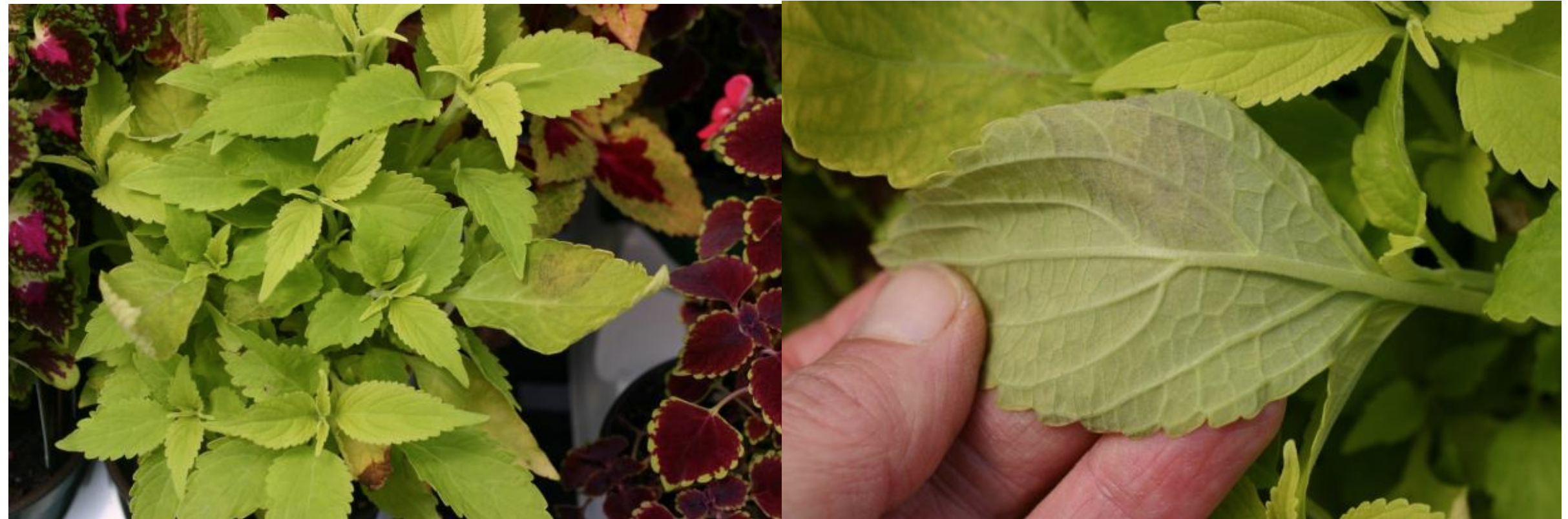
Symptoms on coleus include brown, irregular lesions on coleus leaves, leaf drop, and stunting of seedlings. Because the lesions are irregular, infection can cause leaves to become twisted and distorted. In cool, wet, humid conditions, sporangia may be visible as a downy-gray to purplish growth on the underside of leaves. Constant temperatures between 59° F and 68° F promote coleus downy mildew, with warmer temperatures above 77° F resulting in minimal infection.Do not carry over coleus plants from one season to the next because they may be carrying the disease without showing obvious symptoms. Seed and vegetatively propagated types of coleus are susceptible, in addition to Agastache and perilla. Cultivars of coleus vary in their reactions to downy mildew, so choosing less susceptible varieties is an important management tool. See Special Research Report #136 from the American Floral Endowment: Disease Management Coleus Cultivars and Downy Mildew for more information on coleus varieties less susceptible to downy mildew.
Rudbeckia Downy Mildew
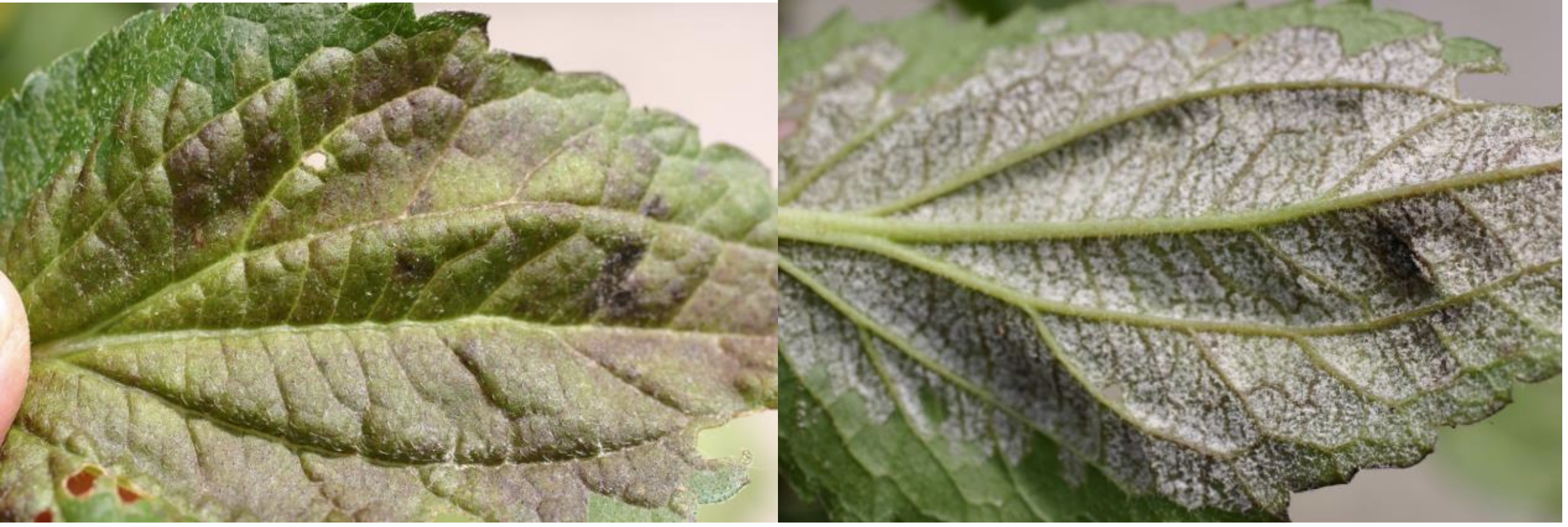
Symptoms of downy mildew on rudbeckia caused by Plasmopara halstedii are blotchy, necrotic patches on the upper leaf surface. Fuzzy, grayish-white sporulation develops on the leaf undersides. P. halstedii is also reported to infect Centaurea, Coreopsis, Erigeron, and Helianthus.
Poppy Downy Mildew
Symptoms of downy mildew on poppy caused by Peronospora arborescens are necrotic, angular leaf spots with profuse sporulation on the underside of the leaves.
Foxglove Downy Mildew
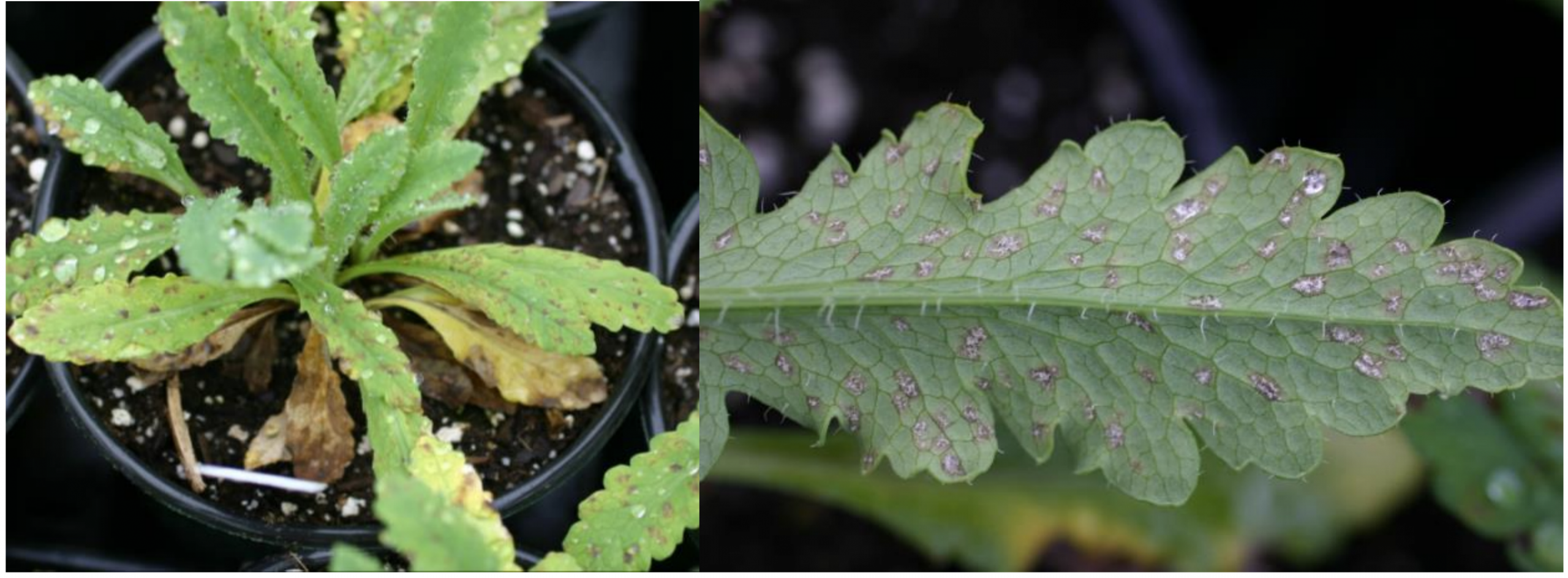
Symptoms of downy mildew on foxglove caused by Peronospora digitalis are light green, rectangular lesions that are bound by leaf veins. Spots eventually turn brown and necrotic. Purple-gray sporulation occurs on the lower leaves. Digitalis purpurea Alba, Apricot and Foxy hybrids appear to be very susceptible to this disease.
Conditions Favoring Downy Mildew
Downy mildews develop during cool (50-75° F), wet conditions with high relative humidity above 85% at the leaf surface. Prolonged periods of leaf wetness favor downy mildew sporulation, spread and infection.
Monitoring
Look on underside of leaves, early in the day. Scout routinely, at least once a week. Use a hand lens to look for blooms of sporangia (they may resemble branched trees with lemons).
Disease Cycle
The pathogen overwinters in or on plant parts as mycelium. Downy mildews produce sporangia on sporangiophores that are distinct from mycelium in how they branch. Sporangiophores emerge in groups from small openings in the plant leaves (stomata). The disease cycle from initial infection to production of additional spores is usually about 7 to 10 days but can be shorter under warm and humid conditions.
Management
- Inspect incoming plugs or plants carefully for signs of downy mildew upon arrival.
- Select less susceptible cultivars, if available.
- Monitor susceptible plants at least once a week.
- Promptly remove diseased plants and debris.
- Reduce humidity levels in the greenhouse by using proper plant spacing.
- In the greenhouse, proper environmental management with the use of computerized controls, HAF fans, heating and venting to reduce humidity levels is necessary. For more, see Reduce Greenhouse Humidity
- Water early in the day.
- Avoid overhead irrigation and use drip irrigation whenever possible.
- Thoroughly sanitize the greenhouse or production area before new plants are introduced and between crop cycles.
Chemical Controls
Plan on preventive programs for highly susceptible varieties of coleus, foxglove, Rudbeckia or on plants that you have had a problem within the past. Rotate fungicides among different FRAC (mode of action) codes to slow down the development of resistance. Over-reliance on systemic fungicides leads to the development of resistant populations and many of the systemic fungicides have specific resistant management guidelines on their labels. See the New York and New England Management Guidelines for Greenhouse Floriculture and Herbaceous Ornamentals for more information. Available from Northeast Greenhouse Conference and Expo.
Disclaimer for Fact Sheets: The information in this document is for educational purposes only. The recommendations contained are based on the best available knowledge at the time of publication. Any reference to commercial products, trade or brand names is for information only, and no endorsement or approval is intended. UConn Extension does not guarantee or warrant the standard of any product referenced or imply approval of the product to the exclusion of others which also may be available. The University of Connecticut, UConn Extension, College of Agriculture, Health and Natural Resources is an equal opportunity program provider and employer.