Aphids can be challenging and common pests on vegetable transplants. Peppers are especially prone to aphids, but aphids can also occur on eggplant, Cole crops and leafy greens. It is important to avoid long residual pesticides that would adversely affect aphid parasites and predators that occur naturally in the garden or field. Use of more selective insecticides or preventive use of biological control agents help with this goal. More gardeners are also interested in purchasing organically grown transplants.
Aphid Feeding Damage
Aphids feed by inserting their stylet-like, sucking mouthparts directly into the phloem and removing plant sap. When high aphid populations develop, plants become stunted with curling and twisting of the young leaves. As aphids feed, a sugary plant sap, known as “honeydew,” is excreted. As aphid molt, whitish cast skins are left behind.
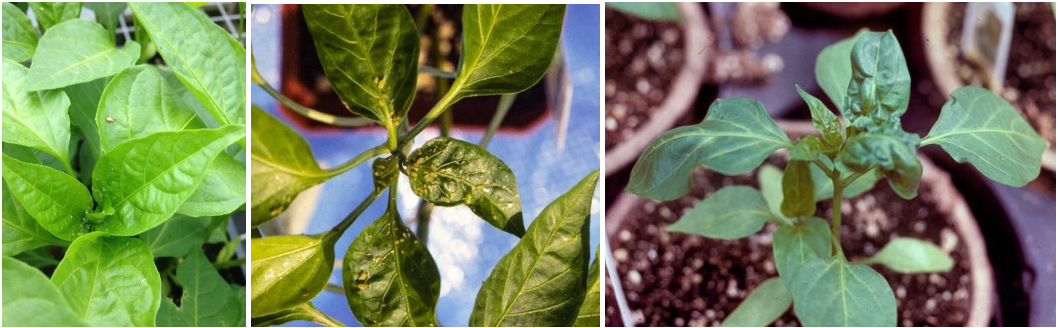
Biology and Life Cycle of Aphids
Most of the aphids found in greenhouses do not mate. All the aphids’ present are females that can give birth to live nymphs. An adult female may live for up to one month. During this time, she may give birth to 60 to 100 live aphid nymphs. Migratory winged aphids may appear suddenly when the colony becomes overcrowded or when the food supply is depleted. Winged aphids may also enter greenhouses from outdoors.
Monitoring
Regular, weekly scouting is needed to detect aphids early before populations explode. Focus on random plant inspections to detect wingless aphid nymphs. Look for whitishcast skins and honeydew on key plants such as pepper, eggplant, Cole crops and leafy greens.
Identification
Aphids are small (less than 1/8 of an inch long), soft-bodied, pear-shaped insects with long legs and antennae. Look for cornicles, or “tail pipe like” protrusions at the rear of their abdomen.
Proper identification is important to choose the most effective biological control agent. Aphids vary in color depending upon the plants they are feeding on, so do not rely upon color to identify species. See references for more information.
Three of the most common species found in greenhouses include the green peach aphid (Myzus persicae), the melon or cotton aphid (Aphis gossypii) and the foxglove aphid (Aulacorthum solani). The potato aphid (Macrosiphum euphorbiae) is less common but can occur on tomato and peppers.
- Green peach aphids tend to be spread more evenly throughout the crop whereas melon aphids tend to be found in isolated hot spots.
- Melon aphids are also less likely to form winged adults and usually stay on the lower leaves and along the plant stem.
- Foxglove aphids inject toxic saliva as they feed leading to curled and distorted leaves, and early leaf drop. Foxglove aphids also tend to drop off the leaves so may be hard to find. Because foxglove aphids reproduce faster at 50˚ to 60˚ F than at 77˚, F they are more of a problem during cool springs.
- Potato aphids tend to be scattered throughout the plant.
Yellow sticky cards will help you detect the entrance of winged aphids into greenhouses from outdoors. But, as most of the aphids in the greenhouse are wingless, focus first on visual monitoring.
Cultural Controls
- Aphid-infested weeds under the benches and just outside the greenhouse are frequently a source of recurring aphid problems. Inspect and remove weeds promptly. Use a weed mat barrier to prevent weed growth under the benches.
- The use of excessive nitrogen promotes lush growth that is favorable to aphid development.
- Remove unsold pet plants that can be sources of aphid infestations.
Biological Controls
Biological controls are best used preventively in conjunction with proper cultural practices.
Aphid Parasitoids
Parasitoids (parasitic wasps) develop in a single host and kill the host as they grow and mature. In general, parasitoids are more effective than predators in reducing aphid populations. Aphid parasitoids are host specific. If you are unsure of the species of aphids you may have or if you have multiple species, mixtures of different aphid parasitoids are commercially available. Parasitoids are shipped as either adults or “aphid mummies” from which the adults emerge.
- Aphidius lays its eggs in aphids and the larvae develop within the aphid. The aphid is killed as the developing larvae feed upon it. The swollen exoskeleton of the aphid remains and is referred to as an “aphid mummy.” As the adults emerge from this mummy, you will see the small round exit hole.
- Aphidius colemani is a tiny (2 mm.) long wasp that is released against the smaller green peach aphids and melon aphids.
- Aphidius ervi attacks larger aphids such as the foxglove (Aulacorthum solani) and potato aphids (Macrosiphum euphorbiae). It resembles A. colemani but is about twice as large and darker in color.
Aphid Predators
Green lacewing (Chrysoperla rufilabiris and C. carnea) adults are active at night and feed on nectar, pollen, and honeydew. The predatory larvae (also known as “aphid lions”) prefer to feed upon aphids, but will also feed upon whiteflies, spider mites, thrips, and caterpillar eggs.
Green lacewings are sold as eggs on cards, or as larvae shipped with a food source in an inert material in a small container. Larvae may survive better than eggs and are quicker acting. A reduction in aphid population should occur after approximately two weeks.
Ladybird Beetles
Both larvae and adult ladybird beetles feed upon aphid nymphs and adults. Ladybird beetle adults feed upon pollen, fungi, and nectar in the absence of prey. Eggs are laid near prey and the larvae may consume from 500 to 1000 aphids. Older, fourth instar larvae are more efficient at capturing prey than adults.
Convergent ladybird beetles (Hippodamia convergens) are wild-collected from the mountainous areas of the west coast where ladybird beetles migrate and aggregate in large masses. This removes ladybeetles from their native habitat. Adalia bipunctata (two spotted lady beetle) is commercially reared and available from some biological control suppliers.
Use of selective insecticides
Chemical options for aphids and other pests on Vegetable transplants, are listed in the Vegetable Transplant section of the New England Vegetable Management Guide that is available online at: https://nevegetable.org/vegetable-transplant-production.
Disclaimer for Fact Sheets: The information in this document is for educational purposes only. The recommendations
contained are based on the best available knowledge at the time of publication. Any reference to commercial products, trade or brand names is for information only, and no endorsement or approval is intended. UConn Extension does not guarantee or warrant the standard of any product referenced or imply approval of the product to the exclusion of others which also may be available. The University of Connecticut, UConn Extension, College of Agriculture, Health and Natural Resources is an equal opportunity program provider and employer.