Test your growing medium before starting your vegetable transplants to ensure healthy transplants and to help prevent nutritional problems from developing.
Soilless mixes are not tested in the same way as field soil samples. Weak acid solutions are used to extract nutrients from field soils. Greenhouse media, including both soilless media and organic media with compost, are mixed with distilled water until saturated and then analyzed. Most soil testing laboratories, such as the UConn Soil Nutrient Analysis Laboratory, use the saturated media extract (SME) method. When submitting samples, it is helpful to write “Greenhouse Sample” on your mailing envelope or call to let them know you will be sending samples for greenhouse testing. Typically, the UConn lab processes SME samples for commercial growers in 1 to 2 working days.
When collecting a media sample, be sure it is both representative and of adequate sample size. Take several samples from 10 or more locations. Test samples from different media batches. Transfer one and one half to two cups of the potting
mixture from the clean container to a zip lock bag and label the outside of the bag with the sample name or number. Be consistent in sampling procedures each time you sample. In addition to taking a sample at least 3 weeks before using it, submitting routine samples during the growing season will help you prevent nutritional problems.
Two of the more common nutritional problems that can occur on vegetable transplants include toxicity caused by high soluble salts and ammonium.
Injury from high soluble salts is most common on young tender seedlings shortly after transplanting. The major sources of high salts are excessive fertilizer from liquid feeds or media from sources that contain high concentration of salts (for ex. Animal waste). Excessive liquid fertilizers applied during periods of slow growth (cold and cloudy seasons) can result in high salts. This can easily happen if your fertilizer injector is not calibrated or working properly. Be sure to calibrate your injector before the spring growing season begins!
High salts can come from compost-based growing media. The quality of the compost depends upon what it was made from and how well it was “finished.” (how long it was allowed to mature). Finished composts may contain 5.0 mS/cm soluble salts or more depending on the feedstocks used. However, most seedlings only tolerate a soluble salt level of 1.0 mS/cm. If high salts occur, irrigate with clear water, to leach excess salts. Of course, the best approach is to prevent problems with early testing of the media and calibration of injectors.
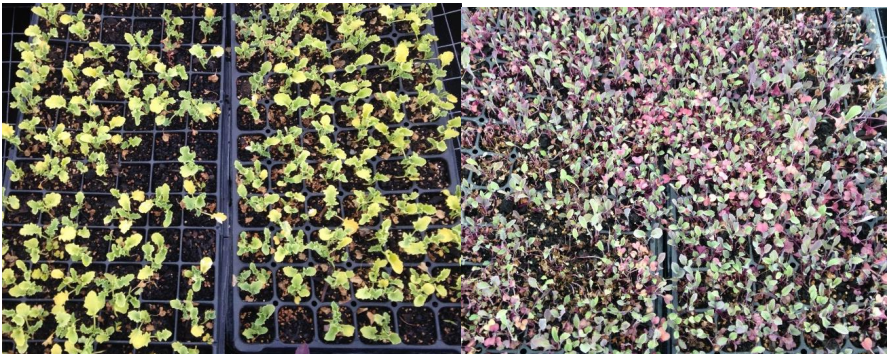
During cool growing conditions, (less than 60◦ F), wet growing media and low pH, nitrifying bacteria are suppressed so that ammonium may build up to toxic levels. Tomatoes, eggplants, and peppers are particularly sensitive to high levels of
ammonium, but other vegetable bedding plants can also be damaged. Symptoms of ammonium toxicity include yellowing or chlorosis between the veins and scattered necrotic spots. Plants may be stunted. At first, young leaves are affected, but later older leaves show symptoms. Roots tips are also damaged.
If you are using organic growing media, the aerobic bacteria that are needed to convert ammonium nitrogen to nitrate nitrogen are dependent on environmental conditions. The speed of this reaction depends upon both temperature and microbial activity. When ammonium levels are excessive, plants can easily take up too much resulting in toxic levels, causing cell damage. Compost that is high in nitrogen sources, such as poultry litter or food wastes, can be high in ammonium and other nutrients. If ammonium toxicity has occurred, raise greenhouse temperatures, stop fertilizing and leach with clear water. Preventing ammonium toxicity is much easier than trying to solve this problem after it occurs.
In addition to sending media samples to a laboratory, you can routinely test your growing media at your greenhouse. This helps you identify trends and see if the pH and EC levels are staying within acceptable parameters. Portable pH and EC testing meters are available from your greenhouse distributor.
In short, test your media early in order to prevent problems.
This article originally appeared in Crop Talk, 5(4) 6-7. December 2019 issue and was reviewed by Dr. Rosa Raudales and Dawn Pettinelli, UConn
Disclaimer for Fact Sheets: The information in this document is for educational purposes only. The recommendations
contained are based on the best available knowledge at the time of publication. Any reference to commercial products, trade or brand names is for information only, and no endorsement or approval is intended. UConn Extension does not guarantee or warrant the standard of any product referenced or imply approval of the product to the exclusion of others which also may be available. The University of Connecticut, UConn Extension, College of Agriculture, Health and Natural Resources is an equal opportunity program provider and employer.