Introduction
Powdery mildew is one of the most common diseases in commercial greenhouse production. Some greenhouse crops prone to infection include African violet, begonia, calibrachoa, dahlia, gerbera daisy, hydrangea, petunia, rose, kalanchoe and poinsettia. Many herbaceous perennials such as Aster, Centaurea, Coreopsis, Delphinium, Monarda, Phlox, Rudbeckia, Sedum and Viola may become infected. Edible herbs such as rosemary, sage, and mint are often infected with this disease. Although powdery mildews rarely kill a plant, they reduce the aesthetic value and marketability of the diseased plants. The target audience for this factsheet is commercial greenhouse growers.
Symptoms
Powdery mildew is often easily recognized by its white talcum-like growth. Powdery mildew colonies can vary from white and fluffy to colonies that are faint and hard to see.
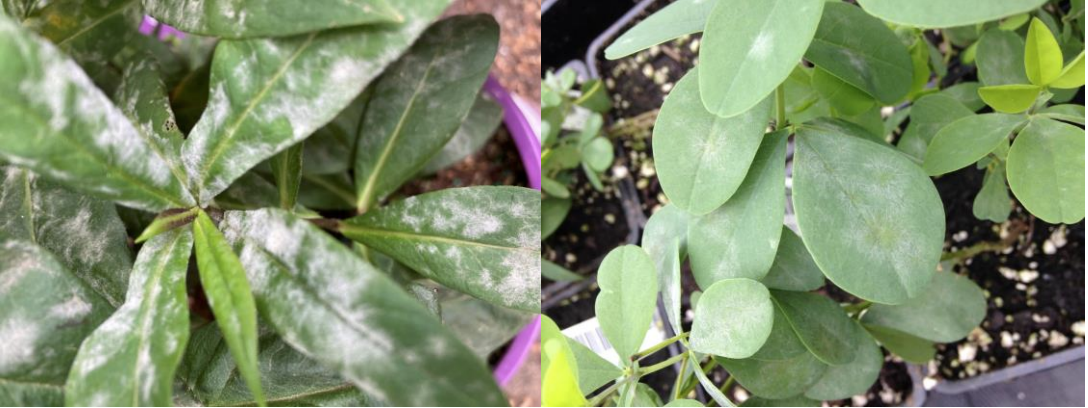
- Symptoms may appear first on the upper leaf surface, but they can also develop on the lower surface.
- When symptoms develop on more mature leaves, powdery mildew is harder to be detected and seems to occur “overnight”, catching many growers unaware.
- As soon as favorable environmental conditions develop, powdery mildew develops into an epidemic as more leaves become infected.
Causal Organisms and Host Range
Powdery mildews generally look alike so it is a common misconception that they are all caused by the same fungus. However, different types of fungi such as Golovinomyces (formerly Erysiphe), Leveillula, Microsphaera and Spaerotheca may occur in the greenhouse. These fungi are obligate parasites that need a living plant host to complete their life cycle and usually survive in the greenhouse on crop or weed hosts.
Powdery mildews can attack healthy, vigorously growing plants. Golovinomyces (formerly Erysiphe) has a broad host range and attacks many members of the Aster family. Sometimes, powdery mildews are relatively host specific. For example, Sphaerotheca violae only attacks Viola. If you are growing a diverse mix of herbaceous perennials in the greenhouse, it is helpful to know the type of powdery mildew that may be present so you can better determine the potential spread of powdery mildew to your crops. This will make scouting easier. For a chart of the more common powdery mildews and the host plants they attack, consult Penn State Extension’s Powdery Mildew Cross Listing.
Conditions Favoring Powdery Mildew
- Powdery mildew, unlike many foliar diseases, does not need free moisture on the leaf to thrive.
- Favorable environmental conditions include moderate temperatures of between 70o to 85o F and relatively low light levels. High relative humidity (greater than 95%) especially at night and low relative humidity during the day.
- Infections may be more common in the spring and fall when changes between the day and night temperatures encourage high relative humidity levels, especially at night.
Spores (conidia) are produced in chains. Air currents and water splash in the greenhouse easily move these spores. The spores germinate and thread-like strands (hyphae) grow along the leaf tissue. Powdery mildews obtain plant nutrients by sending feeding organs (haustoria) into the epidermis. Once a spore lands on a plant, it may take as little as 3 days but more often five to 7 days for infection to develop. High humidity levels favor spore formation and low humidity levels favor spore dispersal.
Monitoring
- Begin scouting early, as often as you can, at least once a week, and more often, every two to three days, if possible.
- Look for the fluffy, talcum-like, powdery colonies especially on the upper surfaces of leaves. Stems and flowers may also be attacked.
- Use a 10x-hand lens to look for whitish threads radiating out from a central point or for chains of spores. Spray residue does not appear as fluffy and tends to have more of a droplet like outline. If powdery mildew develops on the lower surface, one may see a small, yellow spot on the upper surface on poinsettia and other crops.
- Powdery mildew may first be detected in locations with more changes between day and night temperatures.
- Hanging baskets or plants near the vents may first develop powdery mildew. Flag the affected area so you can easily revisit the plants after sprays have been applied.
- If only a low level of disease is detected, remove infected leaves or plants. Because the spores are so easily airborne, carry a plastic bag and carefully place the infected material into the bag.
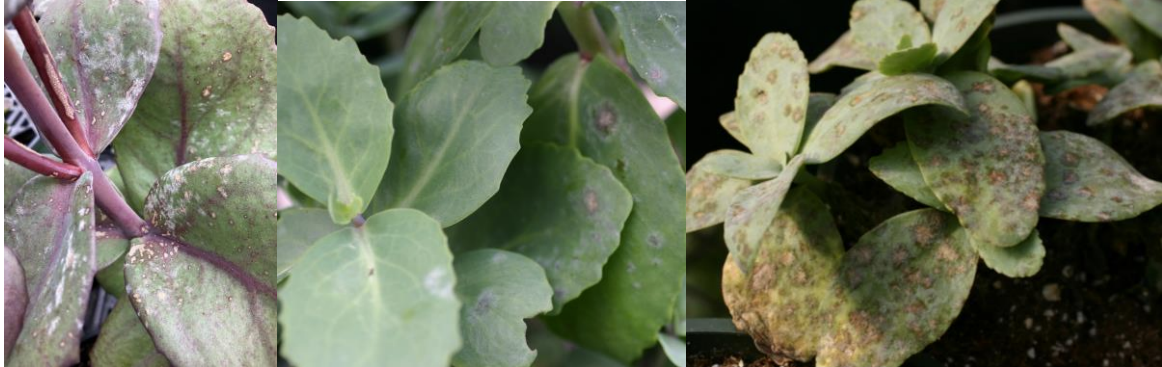
- On susceptible varieties of sedum and kalanchoe, brown scab-like lesions develop with little powdery growth. From a distance, it looks like a leaf spot disease or perhaps spray injury occurred.
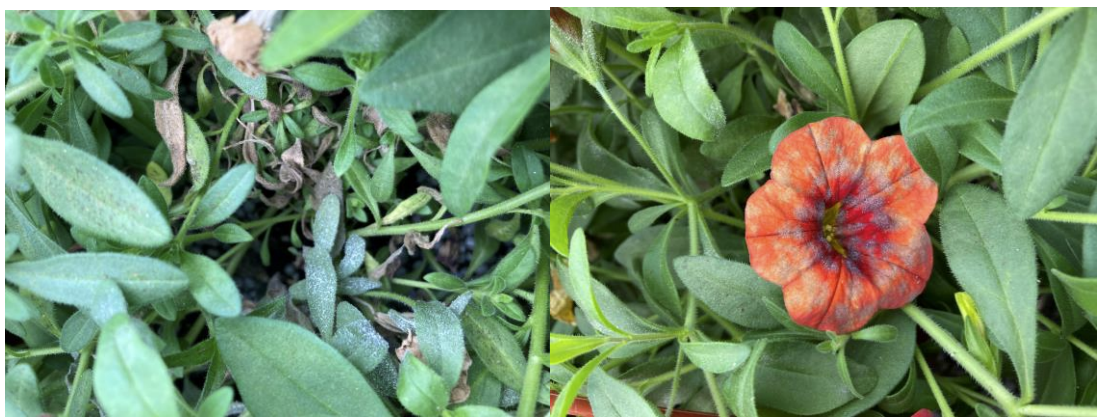
- On Calibrachoa, watch for lower leaves for very faint powdery white growth. As the disease progresses, lower leaves later turn brown and die. These may be mistakenly attributed to Botrytis stem canker. Place the chlorotic leaves in a plastic bag with a moist paper towel for about a day and then look for the white fungal growth. Symptoms are easily overlooked on hanging baskets until the plants are flowering and ready for sale. Not all varieties are equally susceptible.
Managing Powdery Mildews in the Greenhouse Prevention
- Maintain proper plant spacing to reduce relative humidity levels within the plant canopy. (This will also help you gain better spray coverage).
- Keep relative humidity levels below 93% in the greenhouse.
- Heat and ventilate in the late afternoon and early morning to reduce relatively humidity at night. See the factsheet, Reduce Greenhouse Humidity on the UConn Greenhouse IPM webpage under Greenhouse Management and
Engineering. - Clean your greenhouse thoroughly between crops, removing all weeds that could be potential hosts.
- Most ornamental crops are not selected for disease resistance. However, some resistant cultivars are available. Consult Disease Resistant Annuals and Perennials in the Landscape for more information.
- Preventive applications of biological fungicides are often helpful. They can also be part of a rotation with chemical fungicides.
- Applications of silicon fertilization have slowed the progression of powdery mildew on zinnia, phlox and sunflower but did not eliminate it.
Chemical Controls
- Powdery mildews only colonize the upper layer of cells, so chemical eradication is possible.
- One does not need to spray preventatively for powdery mildew, but one does need to spray as soon as the disease is detected.
- Rotate among fungicide classes to discourage development of resistance. Certain fungicides, especially systemic fungicides are, “at risk” to development of resistance if they are used continuously. The fungicide resistance action committee (FRAC) has developed a numbering system for fungicides with the same mode of action. Fungicides with a high risk should be used in rotation with other fungicides or mixed with fungicides with different modes of actions.
Consult the most recent edition of the New York and New England Management Guidelines for Greenhouse Floriculture and Herbaceous Ornamentals for more specific up-to-date recommendations. For fungicides labeled for powdery mildew on herbs, look under the heading herb transplants on the UConn Greenhouse IPM webpage under publications. For fungicides labeled for powdery mildew on greenhouse tomatoes, see the New England Vegetable Management Guide.
Disclaimer for Fact Sheets: The information in this document is for educational purposes only. The recommendations
contained are based on the best available knowledge at the time of publication. Any reference to commercial products, trade or brand names is for information only, and no endorsement or approval is intended. UConn Extension does not guarantee or warrant the standard of any product referenced or imply approval of the product to the exclusion of others which also may be available. The University of Connecticut, UConn Extension, College of Agriculture, Health and Natural Resources is an equal opportunity program provider and employer.