Introduction
Viruses are very small, submicroscopic particles that cause plant disease. There is no control for plants infected with a virus. Common viruses that may infect greenhouse crops include (but are not limited to): impatiens necrotic spot virus (INSV) and tomato spotted wilt virus (TSWV), which are also known as tospoviruses, tobacco mosaic virus (TMV) and cucumber mosaic virus (CMV). The target audience of this fact sheet is commercial greenhouse growers.
Symptoms
Symptoms vary depending on the type of virus, the host plant, how long the host plant has been infected, the strain of the virus, and environmental conditions. Symptom expression can be temperature sensitive – some viruses are expressed at high temperatures whereas others are expressed at lower temperatures. Viral symptoms can also be masked when the plants are growing vigorously. Sometimes, symptoms may only be apparent when multiple infections are present or when plants become stressed. Viruses rarely kill their hosts, but they alter the host plants appearance. Some virus-infected plants are even grown and propagated because of their attractive appearance. For example, the variegated foliage in flowering maple is due to the abutilon mosaic virus.
Some of the symptoms of virus infection include:
- Stunting
- Mosaic (a variable pattern of chlorotic and healthy tissue on the same leaf)
- Distortion of leaves or growing points
- Yellow or chlorotic streaking
- Yellow veins, or vein clearing
- Ring spots, or unusual line patterns
- Dead brown areas (necrosis)
- Bronzing or reddening of leaves or flowers
- Curling of leaves or leaf margins
Virus symptoms often resemble nutritional disorders, chemical spray injury, herbicide spray injury, fungal or bacterial pathogens or injury from fumes from a faulty furnace. Infected plants may also show only mild symptoms or symptoms may be latent. Serological techniques such as ELISA (enzyme-linked immunosorbent assay) can be used to confirm infection by a particular type of virus. Growers may purchase ImmunoStrip tests from Agdia or submit samples to their plant diagnostic laboratory for screening for the more common viruses affecting the particular plant they are producing.
What is a Virus?
Viruses are ultra-microscopic particles that infect living cells and alter their host's development. They consist of nucleic acids (genetic material) surrounded by a protein coat. Viruses are completely dependent upon the host plant for their reproduction. They usually begin infection through a wound, often from insect feeding or by mechanical transmission. Once a plant is infected, the virus spreads systemically within the plant. There is no cure for virus-infected plants. Plant viruses are often named based on the symptoms they caused on the first detected host plant. For example, a virus causing light and dark green areas (mosaic patterns) first observed on tobacco was named “tobacco mosaic virus.”
How are Viruses Spread?
Viruses can be transmitted by insects, primarily thrips, aphids, and whiteflies. Mites, leafhoppers, and nematodes occasionally transmit viruses. Viruses are often spread by the propagation of infected plant parts (cuttings, grafting, bulbs, and sometimes seeds) and some can also be spread mechanically in plant sap on workers hands or tools. Many common weeds can become infected with viruses without showing symptoms and be a favored host of the insect vector.
Tospoviruses
Tospoviruses including INSV and TSWV have a very wide host range of over 1000 plant species. Some hosts of INSV include garden impatiens, New Guinea impatiens, lobelia, Rieger begonia, snapdragon, listhanthus and cyclamen. Anemone, browallia, calceolaria, campanula, Clerodendrum, Diascia, fuchsia, gardenia, gerbera daisy, lantana, pepper, Plectranthus, ranunculus, and solanum can also become infected with tospoviruses. INSV may be more common in greenhouse crops, and TSWV may occur in the greenhouse but also on ornamentals, vegetables, and field crops grown outdoors, especially tomatoes and peppers.
Infected plants may show stunting, necrotic and chlorotic spotting, stem cankers, line patterns, ringspots, and flower color breaking.
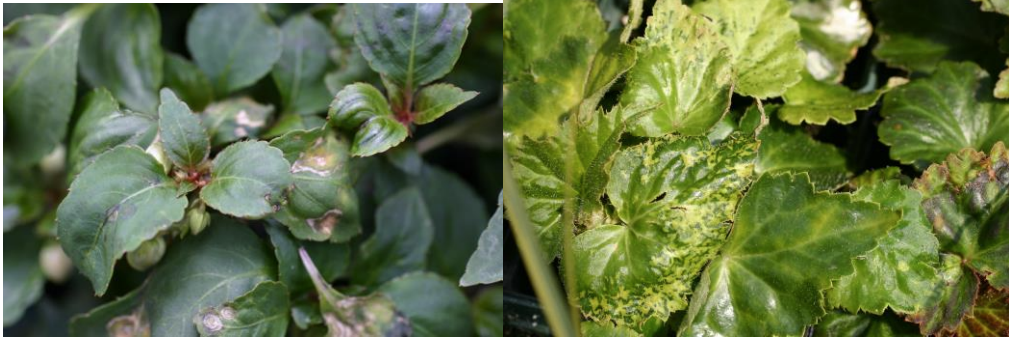
Tospoviruses are spread by thrips especially the dominant species found in CT greenhouses which is the western flower thrips (Frankliniella occidentalis). TSWV is also reported to be vectored by F. fusca (tobacco thrips), F. intonsa (flower thrips), F. schultzei (common blossom thrips), Scirtothrips dorsalis (chilli thrips), T. palmi, (melon thrips), and T. setosus (Japanese flower thrips).
Thrips cannot transmit the virus unless they acquire it as first instar larvae when they feed upon infected plants (including weeds). Winged adults are primarily responsible for viral spread. Tospoviruses are also spread in plant sap when cuttings are taken from infected plants.
Specific Management Tips
- Rogue and destroy infected plants
- Use sticky cards to monitor for thrips and promptly begin a strict thrips management program.
- When tospoviruses are present, the threshold level for thrips is zero.
Cucumber mosaic virus (CMV)
Cucumber mosaic virus has a wide host range of over 1200 species of plants. CMV has been reported on anemone, campanula, columbine, delphinium, dahlia, geranium, lavender, lily, lisianthus, marigold, petunia, phlox, zinnia as well as many bulb crops. Infected plants may show mild mosaic patterns and mottling, flower color breaking, flecking, fern leaf distortion and stunting.
CMV is primarily spread by aphids that can acquire the virus in as little as 5 to 10 seconds. Aphids then move the virus from plant to plant for a few hours. There are a large number of aphid vectors (80 species), including green peach aphids (Myzus persicae) and melon or cotton aphids (Aphis gossypii) that are common in the ornamental plant industry. CMV is also spread mechanically in the plant sap when cuttings are taken from infected stock plants. Plant handling is unlikely to spread CMV. Seed transmission can also occur.
Specific Management Tips
- Rogue and destroy diseased plants
- Control aphids.
- Eliminate weeds such as common pokeweed, chickweed, field bindweed, yellow rocket, and bittersweet nightshade that may be reservoirs of CMV and harbor aphids.
Tobacco mosaic virus (TMV)
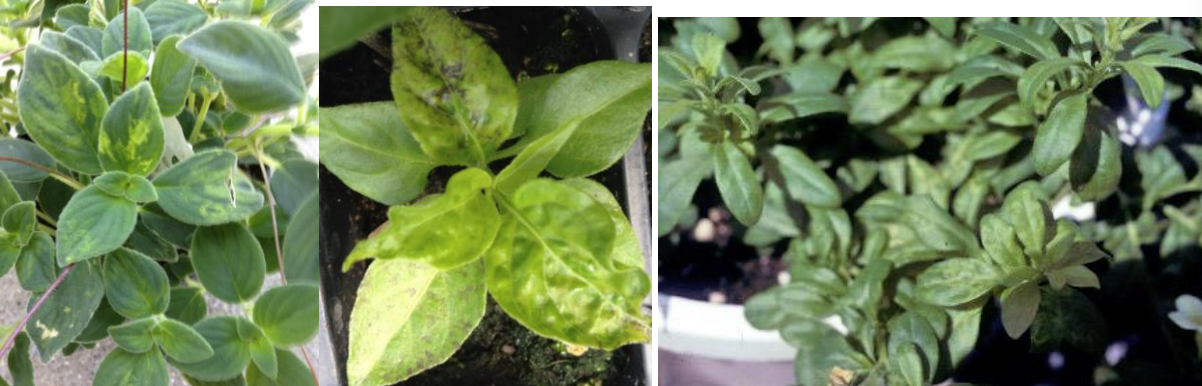
Tobacco mosaic virus has a wide host range. Among ornamentals, cyclamen, gerbera daisy, New Guinea impatiens, and geranium are reported as hosts. Among bedding plants, symptoms have been seen most commonly on petunia. Among vegetable crops, tomato, eggplant, and pepper are also susceptible, but resistant varieties are available.
Symptoms include:
- Yellow mottling
- Mosaic
- Upward leaf curling
- Flower color breaking
- Necrotic lesions
- Overall stunting
- Some infected plants may not show any symptoms at all
- Symptoms vary depending upon the particular virus isolate, temperature, light level and cultivar infected. Multiple infections can also occur.
TMV is a very stable virus that can survive for years on tools or plant surfaces where plant sap has dried. It is spread mechanically in plant sap on workers hands or tools after they handle infected plant material or tobacco products. TMV is not transmitted by insects! Workers can easily spread this virus when they handle plants or when cutting tools become contaminated. TMV can persist in dried tobacco leaves, and tobacco products can also be a source of TMV.
Specific Management tips
- Discard infected plants including roots.
- Disinfect hands by washing with milk, or tri-sodium phosphate and then thoroughly with soap and water.
- Smokers need to wash their hands before entering the greenhouse to reduce the potential of infecting healthy plants. Smoking should not be allowed in greenhouses.
- Hard surfaces such as doorknobs, forklift steering wheels, or flats can become contaminated after handling virus-infected plants and remain a source of infection.
- Treat TMV contaminated tools with a solution of nonfat dry milk and tween or 1:10 dilution of household bleach (0.6 % sodium hypochlorite).
- Thoroughly disinfect the growing area with a commercially available disinfectant. Control perennial weeds in the Solanaceous family such as ground cherry and horsenettle that could be reservoirs of TMV.
Management of Viruses
The best way to control viruses is to keep them out of production areas. All viruses can be spread in plant sap during vegetative propagation.
- Prevention is the grower's first line of defense against virus infection.
- Purchase clean, virus-free seed, cuttings, seed, and stock plants from a reputable supplier. Virus-indexed plant material may be available for certain crops. If unsure, isolate incoming plants in quarantine type area until you have determined that they are virus-free.
- Don't rely on visual diagnosis to determine whether or what type of virus is present. You may not become aware of a problem until it is widespread. Routine testing of plants showing symptoms and those not showing symptoms is needed, especially before taking vegetative cuttings. Serological techniques such as ELISA (are available to identify different types of viruses. On-site grower kits using this same technology are also available from companies such as Agdia, which can help you identify a particular virus.
- Do not take cuttings from infected stock plants. Many viruses are spread mechanically in the sap that contaminates worker's hands or cutting tools. To remove contamination of most viruses from tools, they can be soaked in commercially available disinfectants such as quaternary ammonium compounds or hydrogen dioxide. Soak the tools for at least one minute. Propagators need to soak their cutting tools on a regular basis, after use on each stock plant or defined area.
- Control insect vectors, if needed.
- Keep growing areas weed-free. Weeds can be reservoirs both of viruses and their insect vectors.
- Discard and destroy virus-infected plants. Do not compost or place in cull piles near the greenhouse.
Disclaimer for Fact Sheets: The information in this document is for educational purposes only. The recommendations
contained are based on the best available knowledge at the time of publication. Any reference to commercial products, trade or brand names is for information only, and no endorsement or approval is intended. UConn Extension does not guarantee or warrant the standard of any product referenced or imply approval of the product to the exclusion of others which also may be available. The University of Connecticut, UConn Extension, College of Agriculture, Health and Natural Resources is an equal opportunity program provider and employer.