Verticillium Wilt
Author: Matthew DeBacco
Reviewed by: Shuresh Ghimire, Ph.D.
Associate Extension Educator
Extension Vegetable Specialist
Date of Publication: July 1, 2026
Introduction
Verticillium wilt is a soilborne fungal disease primarily caused by two fungi Verticillium dahliae and Verticillium albo-atrum that also infect eggplant, potatoes, peppers and strawberries. These pathogens initially enter the roots and then multiply in the plants vascular system, reducing water and nutrient flow resulting in the plant visually wilting. This disease is a long-term concern since the microsclerotia can survive in the soil for 10-15 years.
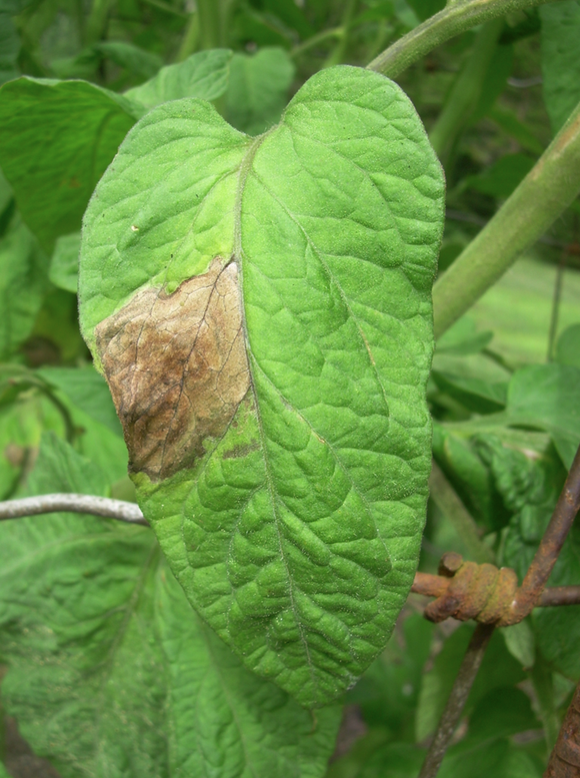
Symptoms
The fungal disease Verticilium wilt causes wilting as the name says, but growers may first recognize yellowing leaves that typically have a V-shaper pattern. The wilting can most easily be seen during the heat of the day, with plants recovering in the evening when the infection is in the early stages of development. As the disease develops, cutting the stem horizontally will typically show a brown to tan colored ring indicating the clogging of the vascular system.
Host Crops: Solanaceae family (Tomatoes, Peppers, Eggplant)
Identification of Disease
While hot temperatures may bring on the wiling in the plants, Verticillium wilt prefers cooler condition (55-85F) which makes it more common in the early and latter portions of the growing season. Plants grown in neutral to alkaline soils (Ph 7 to 9) can favor infection as can physical damage to the roots. Since the pathogen has a wide host range that expands beyond economic crops, weeds in the area (such as ragweed and cocklebur) can act as asymptomatic reservoirs for the pathogen which can complicate field crop rotation plans.
Not to Be Confused with:
Fusarium- May need lab confirmation for specific identification
Prevention
Variety Selection
Resistant varieties, keeping in-mind that there are different subsets of Verticililum so look for tomatoe varieties that are listed to be resistant to multiple Verticillium wilts. Some are provided below…
Cherry TomatoesAstoria Camelia F1 Sunrise Sauce F1 (Roma) Super Sweet 100 F1
Grape TomatoesConde Jelly Bean Red F1
HeirloomRoma
|
PlumBuena Vista Cedro Daytona F1 (Saladette) El Cid F1 Fenicio Granadero F1 Halley 3155 Invincible Latino Mariana F1 (Saladette) Oyamel (saladette) Picus F1 (Roma) Pony Express F1 (Roma) Pozzano F1 Ribelle F1 Shelby Villa |
SlicersArbason F1 Beorange F1 Better Boy F1 Big Beef F1 Biltmore F1 Bolzano F1 Bush Early Girl II F1 Camaro F1 Carolina Gold (yellow) Celebrity F1 Dixie Red F1 HM 1823 F1 Jamestown Mt. Majesty F1 Mt. Spring F1 Red Mountain F1 Scarlet Red F1 Sunbrite F1 Torero F1 |
RootstockArnold F1 (rootstock) Balance (rootstock) Bowman (rootstock) Maxifort F1 (rootstock) Multifort (rootstock) |
Cultural
Crop rotation can help reduce pressure.
Mechanical Approaches
Sanitize tools and equipment with a 10% bleach solution or 70% alcohol for at least 30 seconds to prevent spread between plants or fields.
Spray Products
Consult New England Vegetable Management Guide for a list of labeled products.
References
Cornell Cooperative Extension. (2018, January 22). Fusarium and Verticillium wilts of tomato [PDF]. https://s3.amazonaws.com/assets.cce.cornell.edu/attachments/28095/Fusarium_and_Verticillium_Wilts_of_Tomato_1.22.18.pdf?1516652322
Cornell University. (n.d.). Verticillium wilt of tomato. eCommons. https://ecommons.cornell.edu/server/api/core/bitstreams/7940df2f-acb0-4bc6-9ec4-ddb2ad172762/content
North Carolina State Extension. (n.d.). Verticillium wilt of tomato and eggplant. https://content.ces.ncsu.edu/verticillium-wilt-of-tomato-and-eggplant
Panth, M., Baysal-Gurel, F., Simmons, T., Addesso, K. M., & Witcher, A. L. (2023). Impact of winter cover crop usage in soilborne disease management in cucurbit crops. Frontiers in Plant Science, 13, 1067524. https://pmc.ncbi.nlm.nih.gov/articles/PMC9865522/
University of California Agriculture and Natural Resources. (n.d.). Verticillium and fusarium wilt. https://ucanr.edu/blog/hort-coco-uc-master-gardener-program-contra-costa/article/verticillium-and-fusarium-wilt
Washington State University. (n.d.). Tomato: Verticillium wilt. Hortsense. https://hortsense.cahnrs.wsu.edu/fact-sheet/tomato-verticillium-wilt/
Consult and follow pesticide labels for registered uses. To avoid potential phytotoxicity problems, spot test before widespread use. No discrimination is intended for any products not listed.
The information in this document is for educational purposes only. The recommendations contained are based on the best available knowledge at the time of publication. Any reference to commercial products, trade or brand names is for information only, and no endorsement or approval is intended. UConn Extension does not guarantee or warrant the standard of any product referenced or imply approval of the product to the exclusion of others which also may be available. The University of Connecticut, UConn Extension, College of Agriculture, Health and Natural Resources is an equal opportunity program provider and employer.