Spotted Wilt Virus
Author: Matthew DeBacco
Reviewed by: Shuresh Ghimire, Ph.D.
Associate Extension Educator
Extension Vegetable Specialist
Date of Publication: July 1, 2026
Introduction
Tomato spotted wilt virus (TSWV) in the genus Orthotospovirus has a wide host range so keep an eye out for this on pepper, tobacco, potatoes, onions, and many other crops. It is primarily spread by thrips, especially the western flower thrips (Frankliniella occidentalis), which feed on plants and transmit the virus.
Symptoms
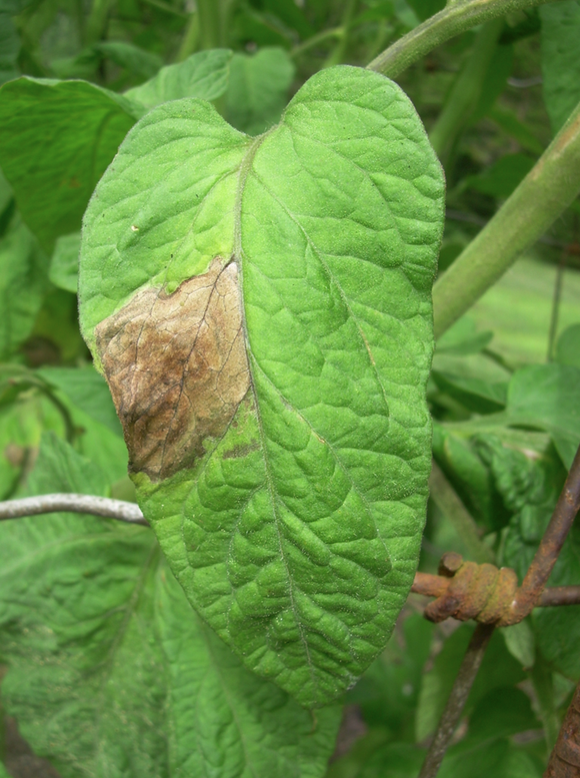
Tomatoes typically exhibit brown lesions and a "shepherd’s crook" appearance in seedlings. The leaves can show bronzing or yellowing coloration with an overall stunted growth of the plant, and the fruits will show ring spots.
Host Crops: Solanaceae family (Tomatoes, Peppers, Eggplant)
Identification of Disease
Early infection often results in total fruit loss, while established plants may exhibit decreased yields and one-sided growth.
Using a diagnostic tool such as the Agdia ImmunoStrip® is the only true method to confirm an infection, which is important since the symptoms can be similar to other viral diseases. This is important because the symptoms vary widely depending on the host and plant age. However, symptoms specific to tomatoes are bronzing of uppermost leaves with small brown lesions, foliage browning and rolling, wilting, and a "shepherd’s crook" appearance in seedlings. Fruit may show yellow ringspots and brown necrotic sunken areas.
Not to Be Confused with:
Early Blight: Which has defined lesion margins
Vectors:
Tomato Spotted Wilt Virus is vectored by thrips, with the western flower thrips being of special concern. Thrips acquire TSWV during their larval stage by feeding on infected plants, where the virus circulates and replicates inside of the thrip allowing it to be transmitted throughout the entire insect's life. It only takes 5 min of feeding for thrips to acquire the virus, causing it to easily spread quickly.
Adult thrips cannot be infected because of a midgut barrier. The virus also does not pass onto the eggs limiting some of the viral load carry over. Still, growers need to keep in-mind that weed hosts can be the source of overwintering and provide virus reservoir.
Prevention
Managing TSWV involves controlling thrips with insecticides, removing infected plants, and planting resistant varieties. However, there’s a challenge: some strains can overcome resistance, like those affecting tomatoes with the Sw-5 gene, which were detected in North Carolina in 2022. It’s not seed-transmitted and doesn’t affect humans or animals directly. Enclosing greenhouse windows with fine-meshed screening can help limit thrips movement.
Variety Selection
Planting resistant varieties, such as tomato hybrids with the Sw-5 gene (or pepper cultivars with the Tsw gene). However, resistance-breaking variants have been detected in North Carolina in summer 2022 which could reduce the effectives of this strategy.
Cultural
Remove infested plants to prevent the spread, and avoid producing vegetable transplants in greenhouses where ornamentals are imported or propagated that may have thrips.
Control weed hosts to reduce virus reservoirs, especially in and around greenhouses and growing areas.
References
Cornell University. (n.d.). Tomato spotted wilt virus (TSWV). LiveGPath. https://blogs.cornell.edu/livegpath/gallery/tomato/tomato-spotted-wilt-virus-tswv/
New Mexico State University. (n.d.). Chile pepper viruses in New Mexico. https://pubs.nmsu.edu/_h/H242/
North Carolina State University Extension. (2022). Tomato spotted wilt virus on tomato and pepper. https://content.ces.ncsu.edu/tomato-spotted-wilt-virus-on-tomato-and-pepper
Oklahoma State University Extension. (n.d.). Tomato spotted wilt virus. https://extension.okstate.edu/programs/digital-diagnostics/plant-diseases/tomato-spotted-wilt-virus.html
Royal Horticultural Society. (n.d.). Impatiens necrotic spot & tomato spotted wilt virus. https://www.rhs.org.uk/disease/impatiens-necrotic-spot-tomato-spotted-wilt-virus
University of California Statewide IPM Program. (n.d.). Tomato spotted wilt virus. https://ipm.ucanr.edu/agriculture/tomato/tomato-spotted-wilt/#gsc.tab=0
University of New Hampshire Extension. (2022, February). Tomato spotted wilt virus (TSWV): A virus you should know and be able to identify. https://extension.unh.edu/blog/2022/02/tomato-spotted-wilt-virus-tswv-virus-you-should-know-be-able-identify
Utah State University Extension. (n.d.). Tomato spotted wilt virus (TSWV) of tomato & pepper. https://extension.usu.edu/planthealth/research/tswv
Consult and follow pesticide labels for registered uses. To avoid potential phytotoxicity problems, spot test before widespread use. No discrimination is intended for any products not listed.
The information in this document is for educational purposes only. The recommendations contained are based on the best available knowledge at the time of publication. Any reference to commercial products, trade or brand names is for information only, and no endorsement or approval is intended. UConn Extension does not guarantee or warrant the standard of any product referenced or imply approval of the product to the exclusion of others which also may be available. The University of Connecticut, UConn Extension, College of Agriculture, Health and Natural Resources is an equal opportunity program provider and employer.