Septoria Leaf Spot
Author: Matthew DeBacco
Reviewed by: Shuresh Ghimire, Ph.D.
Associate Extension Educator
Extension Vegetable Specialist
Date of Publication: July 1, 2026
Introduction
Tomato septoria leaf spot is a fungal disease caused by the fungus Septoria lycopersici that typically starts on the lower, older leaves and is favored by warm, wet and humid conditions. This disease can also impact other plants in the Solanaceae family, such as potatoes and eggplants.
Symptoms
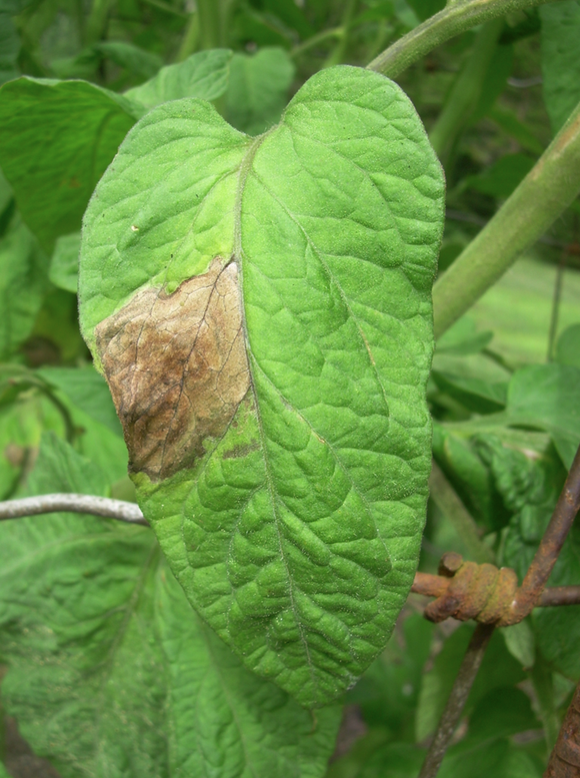
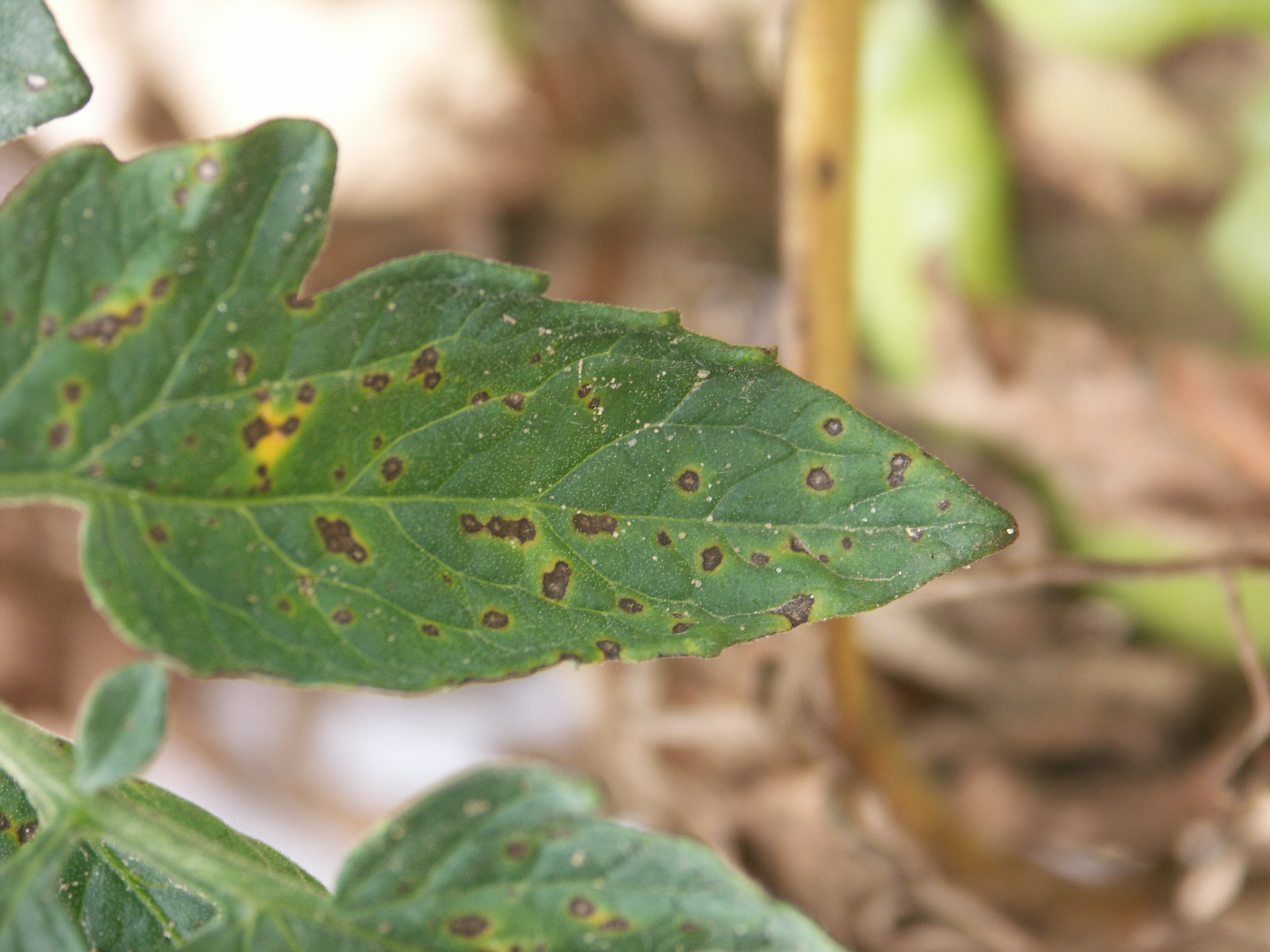
Septoria is identified as small (1/16” to 1/8”), water-soaked spots on the underside of the leaves initially that develop into circular lesions with grayish-white or tan centers and dark brown margins. These spots can multiply, causing leaves to yellow, brown, and drop, potentially leading to severe defoliation.
Inspecting the center of the spots closely, tiny black fruiting bodies (pycnidia) may be seen with the aid of a hand-held magnifying loupe. Note: This is a key identifying feature.
As the disease progresses, this can lead to expansive damage and ultimately leaf defoliation that starts lower on the plant and progresses upward. This can lead to a secondary problem with sunscald on the actual fruit.
Host Crops: Solanaceae family (Tomatoes, Peppers, Eggplant)
Identification of Disease
Looking at the underside of the lower (older) leaves is typically where the disease will start. It may be difficult to see with the naked eye, but a hand lens can help inspect the center of the lesions to look for the distinctive pycnidia.
Not to Be Confused with:
Early Blight (Alternaria solani)- Larger spots (up to ½”) with concentric rings
Bacterial Spot (Xanthomonas spp.)- also causes water-soaked spots with yellow halos but often affects fruit, unlike Septoria, which rarely impacts stems or fruit directly.
Transmission:
The fungus Septoria lycopersici survives in plant debris and soil as well as on weed hosts like horse nettle (Solanum carolinense) and black nightshade (Solanum nigrum). It can also persist on tomato seeds, though the extent of seedborne transmission is not fully confirmed.
While not a specific vector, managing insect pests like aphids and flea beetles will help limit secondary transmitting of spores.
Prevention
Variety Selection
Minimal resistance across varieties, however ‘Iron Lady’ shows some tolerance
Cultural
Remove host weed species like horse nettle and black nightshade.
Sanitation: Remove and destroy infected plant debris at the end of the growing season. Avoid composting heavily infected material and consider burning or burying where local ordinances allow. Deep plowing in large fields can help bury debris.
Crop Rotation: Rotate tomatoes with non-Solanaceous crops (Ex. corn or beans). If disease is identified, a minimum of a 2–3-year rotation to break the disease cycle is recommended since spores can survive in soil for up to 3 years.
Planting Practices: Start with disease-free seeds or transplants and ensure adequate plant spacing (suggested 24-36 inches apart) to improve airflow and reduce humidity.
Watering: Use drip irrigation or soaker hoses to water at the base of plants, avoiding overhead watering that can splash spores onto leaves. Water early in the day to allow foliage to dry quickly.
Mulching: Apply a 3-4 inch layer of straw or other high-quality mulch to prevent soil splash onto leaves, which can reduce infection risk and aid water retention.
Airflow: Thin plants and prune excess foliage, including removing the lowest 3-4 leaf branches once plants are established and starting to develop fruits, to improve air circulation and reduce humidity, which slows disease development.
Monitoring: Regularly inspect plants for early symptoms, especially during wet weather, and remove infected leaves during the growing season to slow spread. At the end of the season, remove all infected plant parts to reduce overwintering inoculum.
Spray Products: Consult New England Vegetable Management Guide for a list of labeled products.
References
Connecticut Agricultural Experiment Station. (n.d.). Septoria leaf spot of tomato. https://portal.ct.gov/CAES/Fact-Sheets/Plant-Pathology/Septoria-Leaf-Spot-of-Tomato
Cornell University. (n.d.). Tomato: Septoria leaf spot. https://blogs.cornell.edu/livegpath/gallery/tomato/tomato-septoria-leaf-spot/
Michigan State University Extension. (n.d.). Septoria leaf spot on tomatoes: Preventing spots before your eyes. https://www.canr.msu.edu/news/septoria_leaf_spot_on_tomatoes_preventing_spots_before_your_eyes
Missouri Botanical Garden. (n.d.). Septoria leaf spot of tomato. https://www.missouribotanicalgarden.org/gardens-gardening/your-garden/help-for-the-home-gardener/advice-tips-resources/insects-pests-and-problems/diseases/fungal-spots/septoria-leaf-spot-of-tomato
North Carolina State University Extension. (n.d.). Septoria leaf spot of tomato. https://content.ces.ncsu.edu/septoria-leaf-spot-of-tomato
Purdue University. (n.d.). Septoria leaf spot of tomato [Image]. Agricultural Economics, Purdue University. https://ag.purdue.edu/department/arge/swpap/_media/septoria-leaf-spot-of-tomato-5-original.jpg
University of Maine Cooperative Extension. (n.d.). Septoria leaf spot of tomato (Publication No. 5088). https://extension.umaine.edu/ipm/ipddl/publications/5088e/
University of Wisconsin-Madison Extension. (n.d.). Septoria leaf spot [Fact sheet]. https://pddc.wisc.edu/wp-content/blogs.dir/39/files/Fact_Sheets/FC_PDF/Septoria_Leaf_Spot.pdf
Consult and follow pesticide labels for registered uses. To avoid potential phytotoxicity problems, spot test before widespread use. No discrimination is intended for any products not listed.
The information in this document is for educational purposes only. The recommendations contained are based on the best available knowledge at the time of publication. Any reference to commercial products, trade or brand names is for information only, and no endorsement or approval is intended. UConn Extension does not guarantee or warrant the standard of any product referenced or imply approval of the product to the exclusion of others which also may be available. The University of Connecticut, UConn Extension, College of Agriculture, Health and Natural Resources is an equal opportunity program provider and employer.